

Demand Letter Template: Get Paid Faster with a Proven Letter
Think of a demand letter template as a ready-made framework for your first official step in sorting out a dispute. In the UK, you’ll often hear it called a Letter Before Action. It's a surprisingly effective way to get a resolution without immediately having to step into a courtroom.
Why Your First Move Should Be a Letter Before Action
Create a Free Demand Letter here!
Before you even think about legal proceedings, a well-written demand letter is your most valuable asset. It professionally lays out your complaint, sticks to the facts, and gives the other person a clear chance to make things right.
It’s less of an aggressive threat and more of a structured, serious conversation. This single document shows you mean business and can often resolve a conflict quickly, saving you a mountain of time, stress, and money.
Whether you're a freelancer chasing a late invoice, a business dealing with a broken contract, or a landlord sorting out property damage, this letter creates a formal record of your claim.
So, Why Is It So Effective?
The power of a Letter Before Action comes down to its clarity and the serious consequences it implies. It shifts the dispute from messy emails and missed calls into a formal setting, proving you understand your rights and are ready to take the next step if needed.
It works so well because it organises your complaint into a logical, factual story that’s hard for the other person to ignore or misunderstand.
Crucially, it also creates an official paper trail. This shows you’ve made a reasonable attempt to settle things before going to court—something UK courts expect to see.
Often, just receiving a formal letter like this is enough to make someone take the issue seriously. It prompts them to find a solution simply to avoid the headache of legal action.
A Real-World Example
Let's say a freelance web developer finishes a project, but the client is ignoring their final £2,500 invoice. Emails have gone unanswered for weeks. Instead of hiring a solicitor straight away, the developer uses a template to draft a clear Letter Before Action.
The letter politely but firmly states the invoice number, the amount due, the work delivered, and a final payment deadline of 14 days. It also notes that if payment isn't made, the developer will start a claim in the small claims court to get back the debt plus any costs.
Two days later, the invoice is paid in full.
That’s the difference it makes. The letter turned a frustrating stalemate into a closed case, just by formalising the request and spelling out the consequences. To get into the nitty-gritty, you can learn more from our comprehensive guide on letters before legal action.
A well-structured demand letter isn't about starting a fight; it's about professionally and effectively ending a dispute before it truly begins. It gives both parties a chance to resolve matters amicably and cost-effectively.
The Anatomy of a Demand Letter That Gets Results
Create a Free Demand Letter here!
A good demand letter isn’t just an angry list of complaints. It's a carefully constructed document, a strategic first move designed to get a very specific result without ever stepping into a courtroom. For your letter to be taken seriously, it needs to be clear, factual, and legally sound.
Think of it like building a case from the ground up. You lay the foundation with cold, hard facts, present your evidence, state exactly what you want, and then explain what happens if you don't get it. When all these pieces are in place and properly articulated, your letter becomes incredibly difficult for the other party to ignore. Let's break down what those essential components look like.
Building a Factual Foundation
First things first, you need to set the scene with undeniable facts. This is not the time for emotional language, accusations, or assumptions. Your goal is to create a clear, chronological story of what happened—a timeline that anyone, including a judge, could follow without confusion.
Start with the basics right at the top: your name and address, the recipient's details, and the date. Always use a clear subject line that gets straight to the point, something like, "Letter Before Action Regarding Unpaid Invoice [Invoice Number]." This immediately tells them why you're writing.
From there, you need to detail the background of the dispute. This section must include:
- Key Dates: Pinpoint the exact dates of agreements, services delivered, relevant communications, or when the breach occurred. For example, "On 15 March 2024, we entered into a contract for..."
- Specific References: Don't be vague. Always mention invoice numbers, contract reference codes, or order numbers. This helps the recipient find the relevant records on their end and shows you’re organised.
- A Clear Narrative: Briefly walk them through the sequence of events. Keep it concise and focused only on the facts that led to the dispute.
This solid, factual foundation removes any wiggle room for ambiguity. It demonstrates that your claim is based on a clear record of events, not just a feeling of being wronged.
Articulating Your Demand with Precision
Once the facts are laid out, you have to be crystal clear about what you want. A wishy-washy request like "please sort this out" is simple to ignore. Your demand needs to be specific, measurable, and directly justified by the facts you've just presented.
This is the heart of your letter. It’s where you tell the recipient exactly what they need to do to make this problem go away. This might be a demand for a specific sum of money, the return of property, or finishing a job they promised to do.
Your demand should leave no room for interpretation. If you are requesting payment, state the exact amount, including any applicable interest or late fees you are legally entitled to charge. If you need an action performed, describe it clearly.
For instance, instead of just saying "I demand payment for the outstanding invoice," get specific: "I demand full payment of £1,250.00 for invoice #INV-0047, which was due on 30 April 2024." This level of detail shows you are meticulous and absolutely serious.
Setting Deadlines and Consequences
A demand without a deadline is just a suggestion. To create a sense of urgency and force a response, you have to set a firm—but reasonable—timeframe. In the UK, giving them 14 to 28 days is generally seen as fair. It provides enough time to review your claim and act on it.
State the deadline clearly. Something like, "You are required to make full payment within 14 days of the date of this letter," creates a clear timeline and a trigger point for your next steps.
Just as important is outlining what happens if they ignore you. This isn't about making empty threats; it’s a professional statement of your intentions. State that if your demand isn't met by the deadline, you'll have no choice but to start legal proceedings in the small claims court to recover the debt, plus any associated court fees and statutory interest. This shows you know the process and you're ready to follow through.
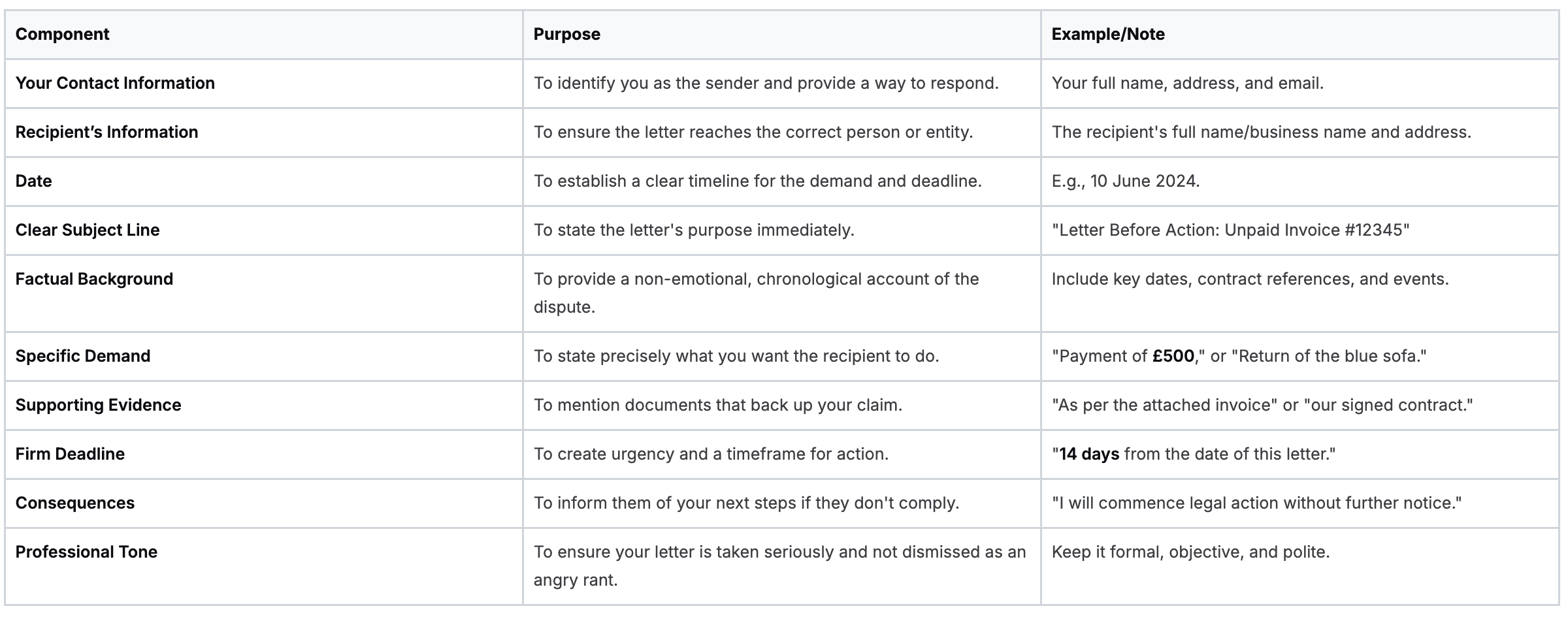
Key Elements Checklist for Your Demand Letter
To make sure every letter you send hits the mark, use this checklist. It covers all the non-negotiable components to ensure your document is clear, professional, and legally robust.
Create a Free Demand Letter here!
By methodically including each of these elements, you significantly increase the chances of your demand letter achieving its goal: a swift and satisfactory resolution.
Demand Letter Templates for Real-World Scenarios

Create a Free Demand Letter here!
It’s one thing to know the theory behind a strong demand letter, but it's another entirely to find the right words when you’re staring at a blank page. This is where a solid demand letter template becomes your most practical tool, giving you the structure and professional language needed to handle common disputes.
Below, you’ll find adaptable, copy-and-paste templates for three common situations faced by UK individuals and businesses. Think of them as a solid starting point, with clear placeholders like [Your Company Name] or [Outstanding Amount] for you to fill in. Just remember to replace everything in brackets with your specific details.
These aren't just generic forms. They’ve been put together to be legally sound and situationally aware, helping you communicate with clarity and authority whether you're chasing an overdue invoice or dealing with a broken contract.
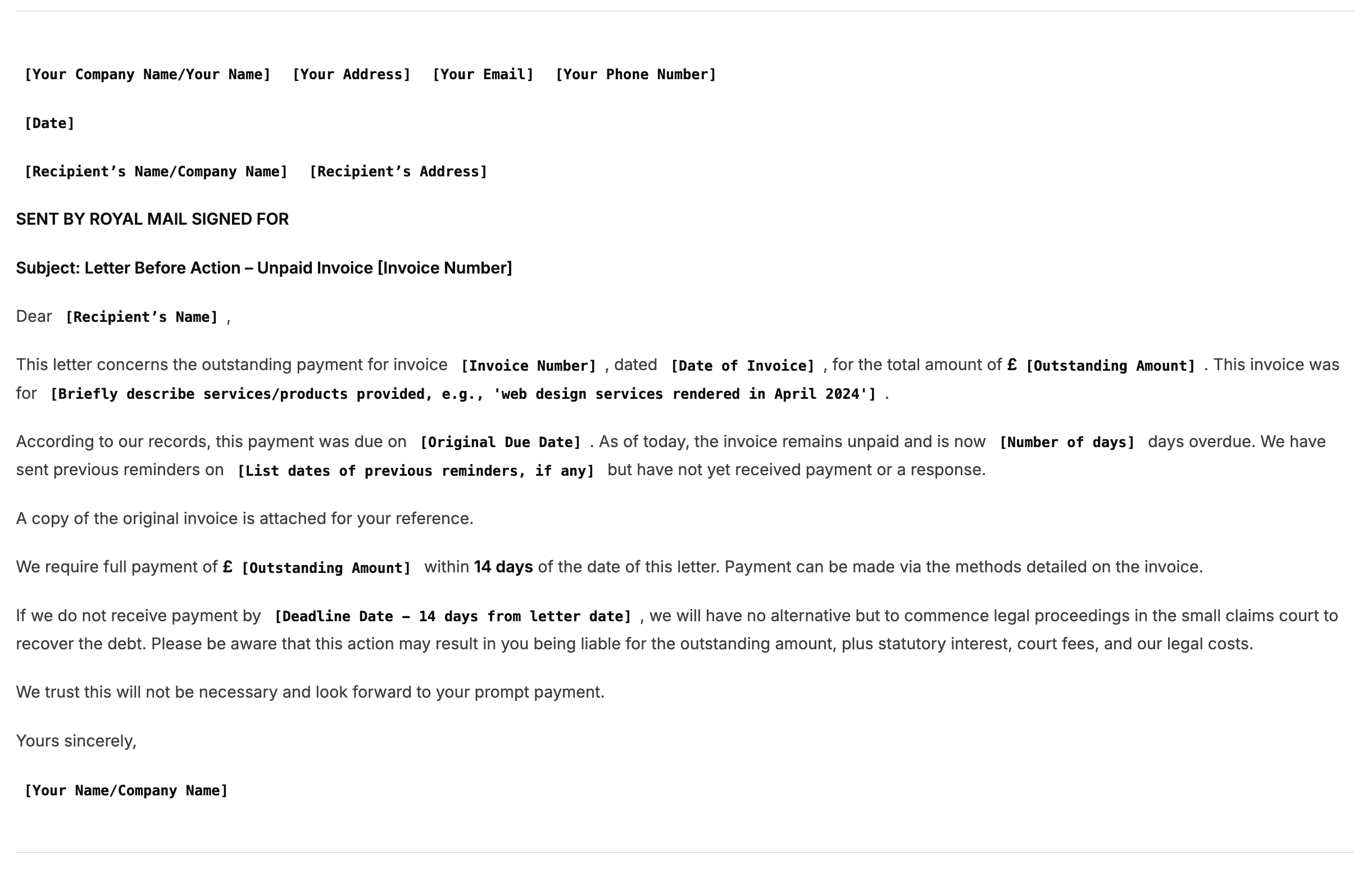
Chasing an Unpaid Invoice
This is probably the most frequent reason small businesses and freelancers need to send a formal demand. The goal is to be firm but professional, clearly referencing the specific invoice that needs settling. This initial letter sets a polite but serious tone.
Create a Free Demand Letter here!
Customising Your Invoice Demand
While this demand letter template provides a strong foundation, its real power comes from a few small tweaks. If your relationship with the client is generally good, you could soften the opening with a line like, "We are writing as we have not yet received payment for the attached invoice and assume it may have been an oversight."
On the other hand, if this is the final step after many broken promises, you can keep the language direct and to the point. The trick is to match the tone to the situation while keeping all the critical legal bits intact.
Key Takeaway: The goal isn’t to burn bridges; it’s to get paid. A professional, factual letter is far more likely to get a result than an emotional or accusatory one. Stick to the facts: the work was done, the invoice was issued, and the payment is late.
The need for clear, pre-emptive action is more important than ever. In the UK, civil justice statistics from Q2 2026 showed there were 72,000 defended claims—an increase of 13% from the previous year. This rise shows why a well-drafted demand letter is so vital; it’s your first and best chance to resolve a dispute before it ends up in court. You can learn more by reading the UK civil justice trends on the official government page.
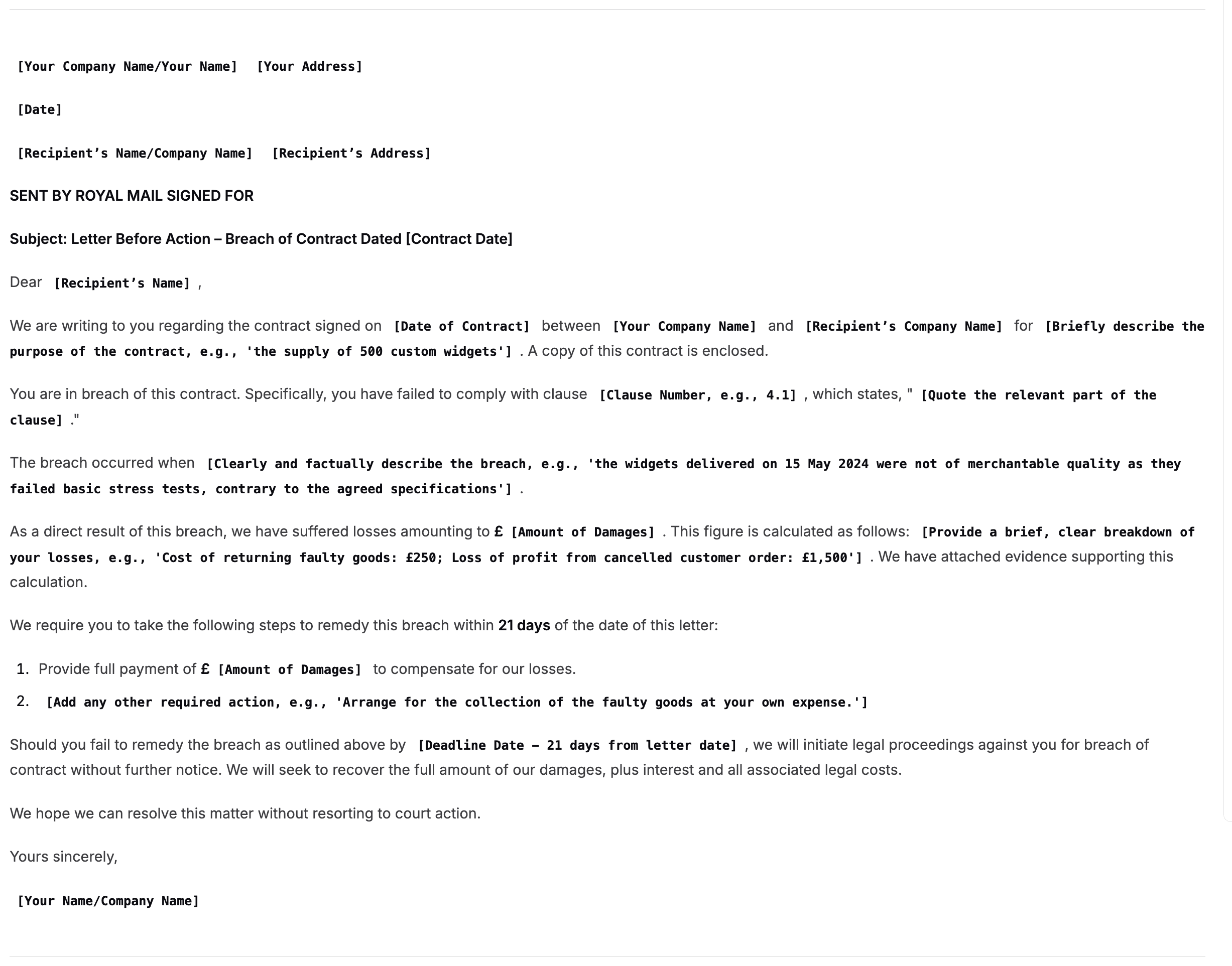
When There’s a Breach of Contract
When someone fails to meet their contractual obligations, the fallout can be significant. This template is designed for those clear-cut situations—for instance, a supplier delivering faulty goods or a service provider failing to complete agreed-upon work.
This kind of letter needs to be precise. You must outline exactly which part of the contract was breached and what you need them to do to fix it. For a more detailed look at this, you might find our resources on drafting a breach of contract letter helpful.
Create a Free Demand Letter here!
Using a Platform for Complex Documents
While these templates are excellent for common issues, some situations demand more specialised documents. This screenshot from the Robot Lawyer document library shows the variety of legal templates available, from NDAs to tenancy agreements, helping you find the right tool for any situation.
Create a Free Demand Letter here!
Using a trusted platform gives you peace of mind that your document is up-to-date and covers all necessary legal ground, which is especially important for more complex disputes.
Costly Mistakes to Avoid When Writing Your Letter
Knowing what to put in your demand letter is one thing, but knowing what to leave out is just as critical. One wrong move can completely undermine your position, make the conflict worse, or simply get your letter tossed in the bin.
If you steer clear of these common slip-ups, you’ll give your letter the professional credibility it needs and the best possible chance of getting you the result you want.
Keeping Your Cool (and Your Credibility)
It’s only natural to be angry or frustrated, especially when you’re out of pocket or have been seriously let down. But letting that emotion bleed onto the page is one of the worst mistakes you can make.
Threats, insults, or overly aggressive language will immediately put the other person on the defensive. It makes you look unprofessional and kills any hope of a reasonable conversation. Worse, if things end up in court, an emotional or threatening letter can be used to paint you as the unreasonable one.
Stick to the facts. Keep your tone firm, objective, and professional.
Vagueness Will Get You Nowhere
A demand letter that lacks specific details is a letter that’s easy to ignore. Don't leave any room for confusion. Ambiguity is your enemy.
- Instead of saying, "I need you to sort this out," be precise: "I require a full refund of £450 for the faulty product delivered on 15th May."
- "Please respond soon" is not a deadline. State a clear timeframe, like "within 14 days from the date of this letter."
- Always include reference points like invoice numbers, contract dates, and a simple, chronological summary of what happened.
A letter packed with precise information shows you're organised, serious, and know exactly what you’re talking about.
A demand letter's power lies in its clarity. If the recipient has to guess what you want or when you want it, you have already lost the advantage. Your request should be so clear that there is no room for misunderstanding.
Forgetting to Prove It Was Delivered
You could write the most brilliant demand letter in the world, but it’s worthless if you can’t prove the other person actually received it. Just popping a stamp on it and hoping for the best is a huge gamble.
If the dispute goes further, they could simply say, "I never got it." That instantly weakens your argument that you tried to resolve things amicably first. This is why using a tracked postage service is non-negotiable.
Services like Royal Mail Signed For give you a receipt and online confirmation of delivery. That small extra cost is an investment, providing crucial proof that could make all the difference later.
The need for a professional, well-documented approach is clear when you look at the wider picture. For instance, UK employment tribunal data shows how many workplace conflicts escalate when not handled properly early on. In the first quarter of 2026 alone, Acas reported 11,568 new tribunal claims. These figures highlight why a properly sent demand letter is a vital first step to resolving disputes before they reach such a formal and expensive stage. You can explore more UK dispute statistics on the Acas website.
What to Do After You Hit Send
So, you’ve hit send on your demand letter. It's a big step, but this is the start of a new phase, not the end of the road. That waiting period can feel like you're in limbo, which is why having a clear plan for every potential outcome is the key to staying in control.
In a perfect world, the other party simply complies with your request. They pay up or take the action you’ve demanded. If that happens, all you need to do is send a quick letter or email confirming you’ve received the payment and that the matter is now closed. It’s good practice and provides formal closure for everyone involved.
But business disputes are rarely that clean-cut. You need to be ready for the more common scenarios.
Navigating the Possible Responses
What happens next is entirely dictated by how the recipient reacts. Their response will usually fall into one of three camps, and each one calls for a different game plan.
You’re likely to get one of these:
- A Counter-Offer: They might acknowledge the problem but disagree on the amount or the specific terms. This is your cue to start negotiating.
- An Outright Refusal: You could get a letter back denying any fault or responsibility and flat-out refusing to meet your demands.
- Complete Silence: It’s also incredibly common for them to just ignore you, hoping you’ll lose steam and give up.
Getting a counter-offer is actually a pretty good sign—it means they’re taking the issue seriously. The ball is back in your court. If you demanded £2,000 and they’ve come back with an offer of £1,500, you have a choice to make. Is it worth the extra time, effort, and potential cost to fight for the last £500, or is it better to accept the lower sum and move on?
If you do decide to settle, it's a very good idea to get it all in writing with a simple debt settlement agreement.
When They Ignore or Refuse You
If your letter is met with a flat "no" or, worse, a deafening silence, it’s time to escalate. This is the moment you have to make good on the consequences you mentioned in your letter—usually, that means starting a claim in the small claims court.
This isn’t nearly as intimidating as it might sound. The UK’s Money Claim Online (MCOL) service is built for these exact kinds of disputes, making it relatively straightforward and affordable to get the ball rolling.
This is precisely where all your hard work pays off. Your professionally crafted demand letter template and your proof of delivery are now crucial pieces of evidence. They prove to the court that you acted reasonably and tried to sort things out before taking legal action.
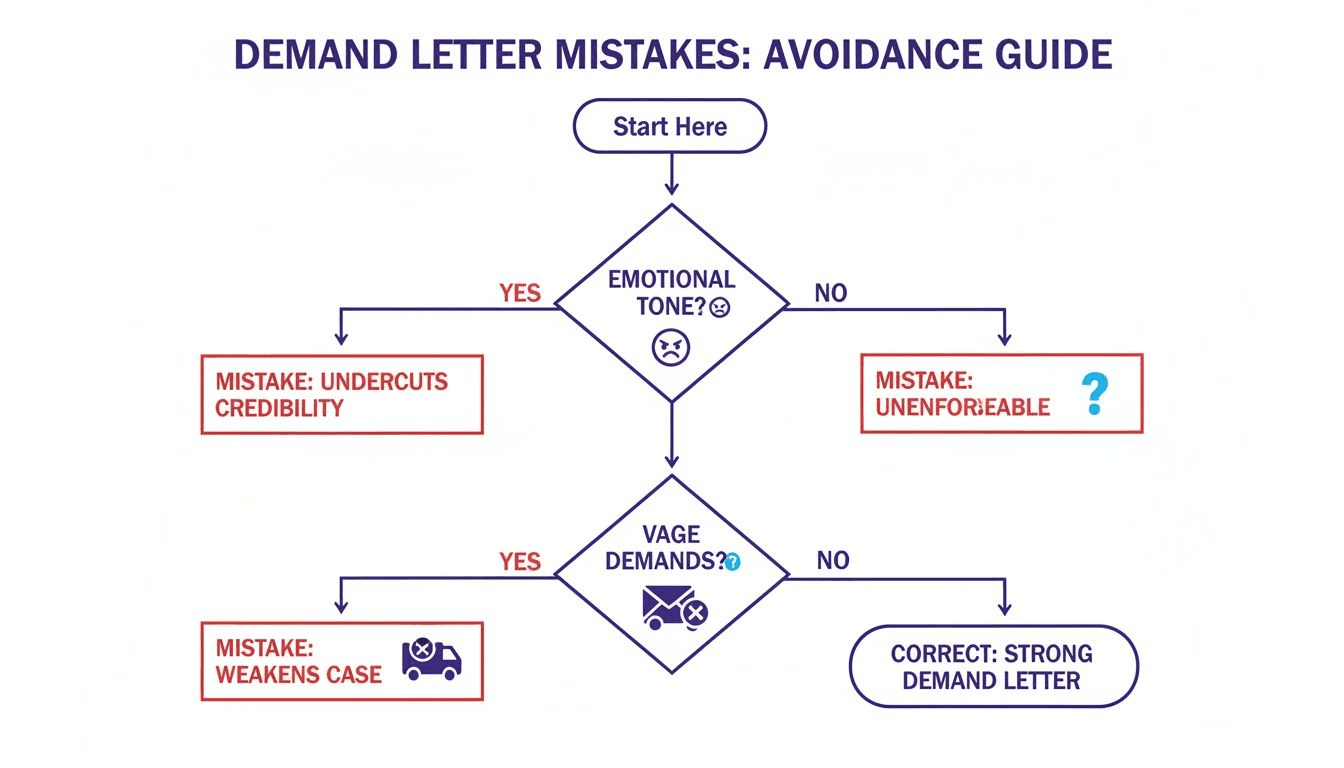
The flowchart below shows just how important it is to get your letter right from the start.
Create a Free Demand Letter here!
As you can see, a professional tone, clear demands, and proof you sent it are the foundations for any successful escalation.
The truth is, many disputes need that extra push. According to the latest UK civil justice statistics on the official government website, Companies Court applications in London went up by 12% in 2025, and winding-up petitions saw a 13% increase. This just goes to show that a demand letter is very often the first official step in a longer process.
Expert Tip: Don't let silence put you off. Ignoring you is a classic tactic designed to test your resolve. Moving forward with a court claim as soon as your deadline passes sends a powerful message: you're serious.
Ultimately, having the right tools makes all the difference. Robot Lawyer can help you generate any follow-up documents you need or escalate the matter correctly, so you feel prepared and confident, no matter what happens next.
Common Questions About Demand Letters
When you're dealing with a dispute, it's natural to have a few questions. Let's clear up some of the most common queries people have about sending a demand letter in the UK so you can move forward with confidence.
Do I Really Need a Solicitor for a Demand Letter?
For many straightforward issues, like chasing an unpaid invoice or dealing with a minor breach of contract, a well-drafted letter using a solid template is often all it takes. It's a very effective way to show you mean business without immediately racking up legal fees.
However, if the dispute is particularly complicated, involves a significant amount of money, or rests on a tricky point of law, getting professional advice is always a smart move. Think of a demand letter as your powerful first step, not necessarily your only one.
How Can I Prove They Received My Letter?
Simply popping a letter in the post or firing off an email isn't enough to create a legal paper trail. To get undeniable proof of delivery, you absolutely must use a tracked service from Royal Mail.
Your best options are:
- Signed For: This service gives you confirmation of delivery, complete with a signature from whoever received it.
- Special Delivery Guaranteed: This is the most robust option, offering full end-to-end tracking and a signature upon delivery.
This documentation is vital if the matter ever goes to court. It stops the other party from using the classic excuse of "I never received it" to try and delay things.
The power of a demand letter is directly linked to its delivery. If you can't prove it was received, your carefully written document loses a huge amount of its legal impact. Always pay for tracked postage.
What Should I Do If Someone Sends Me One?
Whatever you do, don't just ignore it. Ignoring a Letter Before Action is one of the quickest routes to having a default judgment issued against you by the court.
Read the letter carefully to understand exactly what the sender is claiming and why. Then, pull together all of your own records – contracts, emails, invoices, and any other communication – and work out if you think their claim has any merit.
You can then decide whether to agree to their terms, propose an alternative solution, or formally dispute their claim with your own evidence. For any large or complex claims, it's always wise to get your own legal advice before responding.
Is an Email Demand Letter Legally Valid?
Yes, an email can be a legally valid demand letter in the UK, but there's a catch. It must contain all the essential components of a formal letter, including a clear summary of the facts, a specific demand for action, and a firm deadline.
The main problem with email is proving the recipient actually read it. Because of this, the best practice is to send the formal letter via a tracked postal service and then follow up with a digital copy by email. In your email, you can simply mention that the formal letter is in the post, creating a professional and undeniable paper trail.
Ready to create a professional, effective legal document in minutes? Robot Lawyer provides custom-tailored templates verified by legal experts. Start your 7-day free trial and take control of your legal needs today. Visit us at https://robotlawyer.co.