

Your UK Redundancy Process Step by Step Guide for 2026
Making redundancies is one of the toughest decisions a business owner has to make. But when it's necessary, you have to follow a compliant UK redundancy process step by step. This means building a genuine business case, figuring out a selection pool, consulting with your people, and making sure the final dismissals are handled with the correct notice and pay.
Following these stages carefully isn't just about ticking legal boxes; it's about treating your employees with the respect they deserve during a difficult time.
Laying the Groundwork for a Fair Redundancy Process

Create a Free Redundancy Letter Here!
The very first step in any redundancy process isn't actually about people at all—it's about the business itself. Before a single name is mentioned, you must create a solid, documented business case that proves the redundancies are genuine. Rushing this stage is a common mistake I've seen trip up countless businesses, often leading to costly unfair dismissal claims.
Under UK law, a genuine redundancy situation usually fits into one of three scenarios:
- Business Closure: The entire business is shutting down.
- Workplace Closure: A particular site or location where an employee works is closing.
- Diminished Requirement: The business needs fewer employees to do a specific type of work.
That third category is by far the most common. It often crops up during a restructure, when new tech automates tasks, or when a simple downturn in business means you just don’t need as many roles.
Defining Your Business Case
Your business case needs to be more than just a quick note. Think of it as a detailed document that spells out the why behind the proposed changes. For example, if a tech startup is facing cash flow issues, its business case might show a 30% drop in quarterly revenue and a critical need to slash its monthly burn rate by £50,000 to survive.
The document should explain your reasoning, what you're trying to achieve, and why redundancy is the proposed path. Crucially, you must also show you’ve considered alternatives. Have you thought about a recruitment freeze, cutting back on spending, or offering voluntary sabbaticals? Documenting these shows that redundancy is genuinely a last resort.
Expert Tip: Always frame your business case around the roles, not the people. The conversation should start with, "We no longer need three 'Junior Developer' roles," not, "We need to let John, Jane, and Sarah go." This focus on roles is absolutely fundamental to keeping the process fair.
Getting this initial planning right has never been more important. Economic pressures have led to a huge spike in planned job cuts. In the first two months of 2026 alone, data from the Insolvency Service revealed that 736 employers filed HR1 notices, putting 56,396 jobs at risk—that’s a 9% jump from the same period in 2025.
Identifying the Redundancy Pool
Once you have a rock-solid business case, you can move on to identifying the "pool" of employees at risk. This pool is made up of all the employees who do the same or very similar work to the roles that are being made redundant. For instance, if you’re cutting back on sales managers, then all of your sales managers should be in that selection pool.
Defining this pool too narrowly is a classic pitfall. If you single out one specific role as redundant without looking at others doing similar work, you open yourself up to claims of unfair selection. You need a clear, logical reason for how you’ve drawn the boundaries of your pool.
Once that's established, you're ready to formally let the affected individuals know they're at risk. For some guidance on how to word this sensitive initial communication, our template for an at risk of redundancy letter provides some helpful examples.
Creating an Objective and Fair Selection Matrix
Once you've established a solid business case and identified the pool of at-risk roles, you arrive at one of the most sensitive parts of the process: deciding which individuals to make redundant. This is where many employers stumble. Making selections based on a gut feeling or who you simply "get on with" is a fast track to an unfair dismissal claim.
Your strongest defence against accusations of bias is a properly constructed redundancy selection matrix. Think of it as a scoring system that lets you assess every employee in the redundancy pool against the same set of objective, measurable criteria. It's all about fairness and transparency.
Choosing Defensible Selection Criteria
The criteria you pick must be directly relevant to the future needs of your business. More importantly, they must not be discriminatory under the Equality Act 2010. That means you absolutely cannot base your decisions on an employee's age, disability, gender reassignment, marital status, pregnancy, race, religion, sex, or sexual orientation.
So, what are your options? The best criteria are those you can back up with hard evidence.
- Performance and Skills: This is usually the most important factor. You should base this on documented evidence, like recent performance reviews, skills assessments, or qualifications that are crucial for the remaining roles.
- Disciplinary Record: It's acceptable to consider live disciplinary warnings. However, any warnings that have already expired ("spent" warnings) should not be part of your assessment.
- Attendance Record: You have to be careful here. You can score based on unauthorised absences, but you must completely disregard any time off related to an employee's disability, pregnancy, or maternity/paternity leave. Failing to do so is a clear form of discrimination.
- Length of Service: The old "last in, first out" method is now seen as risky because it can indirectly discriminate against younger workers. It's much safer to use this as a minor factor or simply as a tie-breaker if two employees have identical scores.
Be very wary of using vague criteria like "attitude" or "team player." These are incredibly subjective and almost impossible to prove with concrete evidence. If you can't point to a specific document or recorded event to justify a score, don't use that criterion.
Building Your Selection Matrix
Creating the matrix is straightforward. It’s essentially a grid with the names of the at-risk employees listed down the side and your chosen selection criteria along the top.
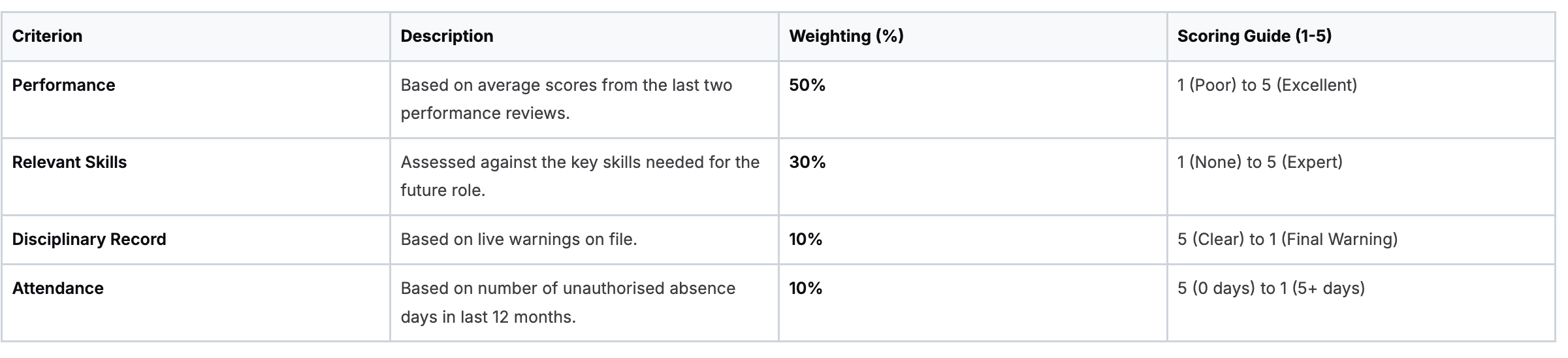
To make the process even more robust, you should apply a weighting to each criterion based on its importance to the business going forward. For example, essential skills might be worth 50% of the total score, while an employee’s disciplinary record might only account for 10%.
Here’s an example of how a selection matrix might look. This kind of structured approach helps ensure every employee is judged fairly and consistently.
Sample Redundancy Selection Criteria Matrix
Create a Free Redundancy Letter Here!
The real key to a defensible process is consistency. Every employee in the pool must be scored against the exact same criteria. It's also best practice to have at least two managers conduct the scoring independently to ensure impartiality and then compare their results.
You must also document the reasoning behind every single score. Simply writing down a '3' for performance isn't enough. You need to be able to show which specific performance review or data point led to that score.
This level of detail is what protects you if your decision is challenged later on. For more guidance on how to structure these kinds of assessments, you can find valuable tips on creating a comprehensive employee evaluation that will stand up to scrutiny.
After the scoring is complete, the employees with the lowest total scores are the ones who would be provisionally selected for redundancy. The next step, of course, is the all-important consultation process.
Running a Meaningful Consultation Process
Once you’ve identified the at-risk pool and built your selection matrix, you’re moving into what I consider the most human—and legally critical—part of any redundancy process. This is the consultation stage.
Let me be clear: this is not just a box-ticking exercise. It's a mandatory and meaningful dialogue with your people. The entire point is to explore every possible avenue to avoid making them redundant. Treating it as a mere formality after you've already made up your mind is a recipe for a tribunal claim and will do serious damage to the morale of your remaining team.
Individual vs Collective Consultation
The type of consultation you’re required to run hinges on one simple factor: the number of redundancies you’re proposing at a single establishment over a 90-day period.
- Individual Consultation: This applies to every single proposed redundancy, even if it's just one person. It means sitting down one-on-one with each affected employee to discuss their personal situation.
- Collective Consultation: This is a legal must if you’re proposing to make 20 or more employees redundant within 90 days. This involves consulting with employee representatives, which could be from a recognised trade union or elected by the staff themselves.
The rules around collective consultation are incredibly strict. You must start this process at least 30 days before the first dismissal for 20 to 99 proposed redundancies. This jumps to at least 45 days if you're looking at 100 or more. Get these timescales wrong, and you could face a hefty "protective award" for each affected employee.
Key Takeaway: A proper consultation is a two-way street. It’s your opportunity to explain the business case for the changes and the employee’s chance to ask questions, challenge their selection, and offer alternatives.
This stage is under more scrutiny than ever. Data from the Office for National Statistics showed the redundancy rate hit 4.9 per 1,000 employees in late 2025. With job security so fragile, employment tribunals are taking a very hard line on procedural fairness. In fact, over 30% of redundancy-related tribunal cases point to failures in the consultation process, making it a common and costly mistake for employers. You can learn more about the rise in redundancies and its impact on HR procedures.
Structuring the Consultation Meetings
Whether you're meeting with individuals or employee reps, the goal is the same: find a way to avoid the redundancy. In these meetings, you are obligated to provide specific written information.
This isn't optional. You must cover:
- The reasons behind the proposed redundancies.
- The numbers and types of roles you’re proposing to make redundant.
- The total number of employees in those roles at the establishment.
- The proposed method for selecting employees (your selection matrix).
- The proposed method for carrying out the dismissals, including the timeframe.
- How you will calculate redundancy payments.
The selection method is often a key point of discussion. You need to be able to explain how you're making your decisions fairly.
Create a Free Redundancy Letter Here!
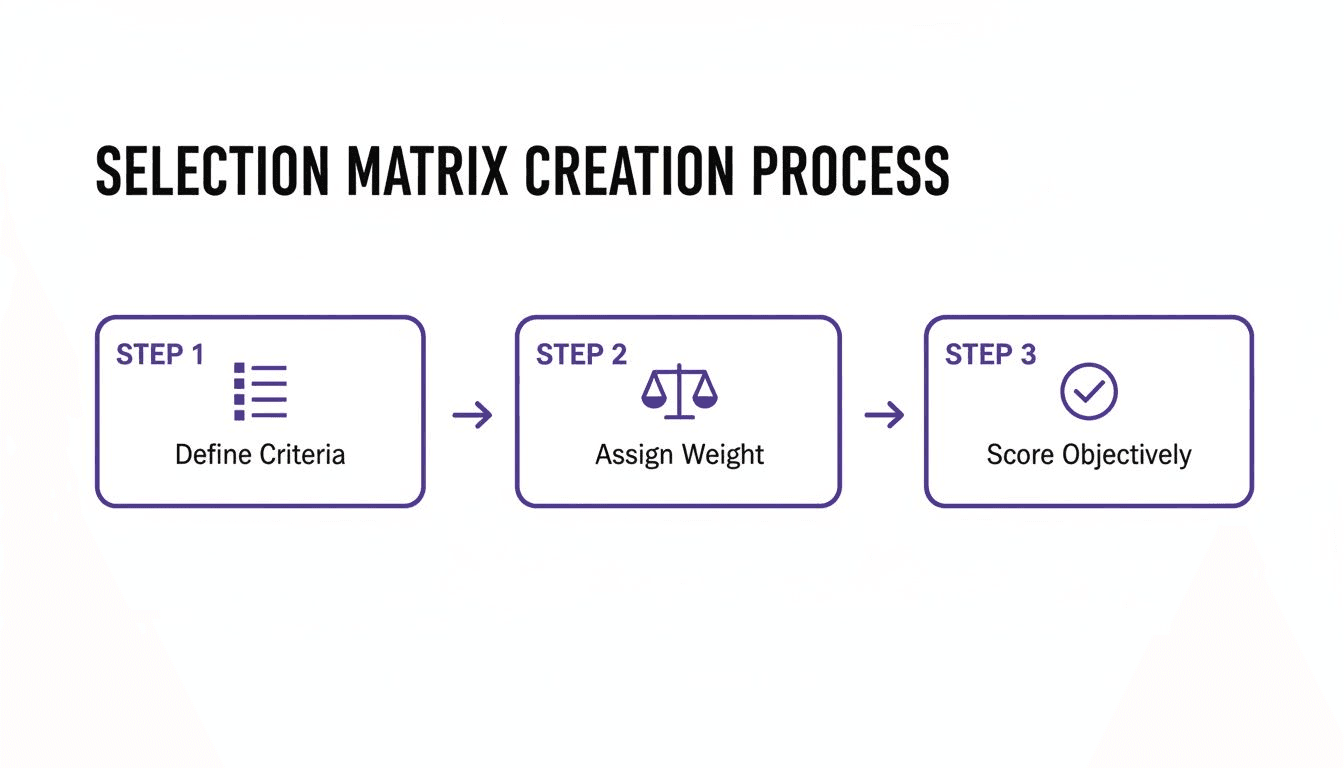
This visual shows the basics of defining criteria, weighting them, and scoring objectively. You'll need to walk employees through your specific approach during the consultation.
Ultimately, the most important part of the meeting is the discussion around alternatives. This isn't about just paying lip service to the idea; it’s a legal requirement to genuinely explore other options.
Exploring Alternatives to Redundancy
Your main objective during consultation should always be to mitigate job losses. You are legally required to actively look for and consider any alternatives.
Here are the main options you should be exploring:
- Suitable Alternative Employment: This is the big one. You have a duty to proactively search for other available roles within your company—and even associated group companies—that the at-risk employee could do. This means more than just pointing them to your careers page.
- Voluntary Redundancy or Early Retirement: Offering these schemes first can often reduce or even eliminate the need for compulsory redundancies. It's always worth asking the question.
- Changes to Terms and Conditions: Could a temporary reduction in hours or pay across a department save jobs? This requires employee agreement but can be a powerful tool to weather a short-term storm.
- Retraining or Redeployment: Is there another role in the business that the employee could be retrained for? Thinking creatively here can save valuable talent.
Throughout this entire process, document everything. Keep detailed minutes of every meeting, make a note of all suggestions from employees, and record your responses and the rationale behind your decisions. If your process is ever challenged, this paper trail will be your best defence.
Calculating Redundancy Pay and Finalising Dismissal

Create a Free Redundancy Letter Here!
Once the consultations have wrapped up, you enter what is arguably the most admin-heavy part of the process: confirming the redundancy, issuing notice, and, crucially, getting the numbers right. It's easy to breathe a sigh of relief after the difficult conversations are over, but this is where a small slip-up can unravel all your hard work.
This is the final hurdle where many employers trip. Getting the calculations or notice periods wrong is a leading cause of employment tribunal claims—statistics from the ONS show that flawed payments and notice periods account for a staggering 25-30% of cases. To keep things fair and avoid legal headaches, you must get this stage spot on.
Getting The Notice Period Right
Before anything else, you need to determine the correct notice period. This will either be the statutory minimum or what’s written in their employment contract—whichever is longer. You always have to give the more generous of the two.
The legal minimums, or statutory notice periods, are straightforward:
- One week's notice for anyone employed between one month and two years.
- One week's notice for each full year of service for those employed between two and 12 years.
- A flat 12 weeks' notice for anyone who has been with you for 12 years or more.
If an employee’s contract states they get three months' notice, then that’s what you must give them. You can ask them to work this period, but many businesses prefer to make a payment in lieu of notice (PILON). This means their employment ends right away, and you pay them for the notice period they would have worked. It offers a clean break for everyone, but it must be allowed for in their contract or agreed upon separately.
Calculating Statutory Redundancy Pay
Any employee with two or more years of continuous service is entitled to statutory redundancy pay. It’s a legal requirement. The calculation hinges on three key pieces of information: their age, their total length of service (which is capped at 20 years), and their average weekly pay (currently capped at £700 a week).
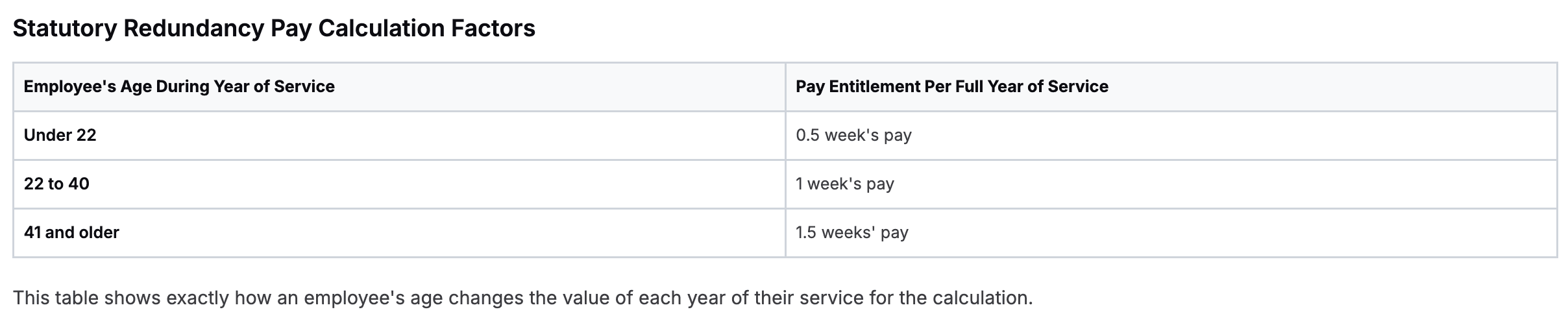
The formula uses a multiplier that changes based on the employee's age during each year they worked for you.
Here’s a quick breakdown of how those factors work together.
Create a Free Redundancy Letter Here!
This table shows exactly how an employee's age changes the value of each year of their service for the calculation.
Let’s walk through a real-world example. Say you’re making a 45-year-old employee redundant. They’ve worked for you for 10 full years and earn £800 a week.
- First, their weekly pay is capped at £700 for the calculation.
- Next, look at their service. They worked 6 years while aged 40 or under. That’s 6 years x 1 week's pay = £4,200.
- For the remaining 4 years, they were over 41. That’s 4 years x 1.5 weeks' pay = £4,200.
- Add it all up, and their total statutory redundancy pay is £8,400.
Important Note: The first £30,000 of a statutory redundancy payment is completely tax-free. However, any extra contractual or enhanced redundancy pay you offer on top of this might be subject to tax and National Insurance.
Putting Together The Final Pay Packet
The final payment is more than just the redundancy amount. It’s a complete package that needs to tie up all the financial loose ends.
A compliant final payment should always include:
- The full statutory redundancy pay.
- Payment for their notice period (or a PILON).
- Any outstanding salary owed right up to their last day.
- Payment for any accrued but untaken holidays.
You absolutely must give the employee a written statement that clearly shows how you've calculated their final pay, especially the redundancy portion. Transparency here isn’t just good practice; it’s a legal requirement and helps prevent disputes down the line.
Finally, don’t forget that employees working their notice period are entitled to reasonable paid time off to look for another job or arrange training. It's these small, respectful details that define a fair and compassionate offboarding. Using a clear redundancy letter to confirm all these details in writing is the best way to ensure there are no misunderstandings.
Managing Appeals and Post-Redundancy Support
You might think the whole redundancy process is wrapped up once dismissal notices have been sent. That’s a common, and often costly, mistake. In reality, the end of the notice period kicks off two final, critical stages: managing any appeals and providing genuine support to those leaving.
Skimping on these last steps can undo all your hard work. A poorly handled appeal can easily turn a minor procedural slip into an expensive employment tribunal claim. Just as importantly, the way you treat departing employees sends a powerful message to those who are left, shaping morale and your long-term reputation as an employer.
Handling the Right to Appeal
Every single employee made redundant has the right to appeal the decision. This is non-negotiable and a cornerstone of a fair redundancy process step by step. An appeal gives the employee a proper channel to question the outcome and, frankly, gives you a chance to review your own process for any errors.
Once an employee lodges an appeal, your immediate job is to set up a formal hearing.
- Who runs the hearing? The appeal must be chaired by a manager more senior than the one who made the initial redundancy decision. Crucially, this person must be completely impartial and have had no prior involvement in the selection process.
- What gets looked at? The appeal manager essentially re-runs the rule over the whole process. They’ll scrutinise the business case for the redundancies, how the selection pool was defined, the objectivity of the scoring, and whether the consultation was truly meaningful.
Employees can appeal for all sorts of reasons. They might feel their scoring was unjust, that a suitable alternative role was available but never offered, or even that the selection was discriminatory. The appeal manager's role is to weigh these arguments and decide if the original dismissal was fair and sound.
A Real-World Scenario: Let's say an employee appeals, claiming a newly advertised 'Project Coordinator' job was a suitable alternative to their 'Admin Manager' role, but it was never discussed with them. The appeal manager has to dig into this. They would compare the two job descriptions, evaluate the employee’s skills against the new role’s demands, and determine if failing to offer it made the dismissal unfair.
If an appeal is successful, the dismissal is overturned, and you need to find a way to reinstate the employee. If it's unsuccessful, you must confirm this in writing, clearly laying out the reasons for the decision. This final, documented step is your best defence against any future legal challenges.
Providing Post-Redundancy Support
While your legal duties might wrap up after the appeal, your moral and business responsibilities continue. The support you give to people on their way out says everything about your company's values. It’s also a smart move for business continuity, helping to steady the morale of your remaining team.
Don't forget, your remaining staff are watching closely. When they see former colleagues treated with compassion and offered practical help, it reassures them and can help ease any 'survivor's guilt' or anxiety about their own roles.
Here are a few practical ways to offer support:
- Outplacement Services: This is probably the most valuable thing you can offer. Funding professional help with CV writing, interview practice, and career coaching gives departing staff a tangible head start in finding a new role.
- Positive References: Barring any serious misconduct, make a commitment to provide a detailed and positive reference. Being able to highlight their skills and contributions can make a huge difference in how quickly they land their next job.
- Networking Assistance: Can you make a few introductions? A warm intro to someone in your professional network who might be hiring can be incredibly helpful and costs you nothing.
- Mental Health Support: Being made redundant is a stressful life event. A simple, compassionate gesture is to extend access to your Employee Assistance Programme (EAP) for a few months after they’ve left.
Treating people with dignity is the final, and most human, piece of the puzzle. It protects your brand, supports the team you still have, and ensures you close this difficult chapter on the best terms possible.
Got Questions About the Redundancy Process?
Even the most thorough plan can hit a snag. When you're in the thick of managing redundancies, theory goes out the window and practical, tricky questions pop up. It's one thing to read a guide, but it's another to apply it under pressure.
Here, I'll tackle some of the most common "what if" scenarios I've seen business owners and HR managers grapple with, giving you the direct answers you need to act with confidence.
What if an Employee Is on Maternity Leave?
This is a big one, and you have to get it right. You absolutely cannot make an employee redundant because they are on maternity, adoption, or shared parental leave. That’s an instant unfair dismissal and a clear case of discrimination.
However, being on maternity leave doesn't grant total immunity from redundancy. If their role is genuinely at risk, they can be included in the process.
The crucial difference? An employee on maternity leave has a priority right to any suitable alternative vacancy. This isn't just a suggestion; it's a legal obligation that puts them at the front of the queue, above all other at-risk employees. You don’t just invite them to apply – you must actively offer them the role if one exists.
How Long Must Consultation Last?
There's a lot of confusion around consultation timings, but the rules are actually quite specific and depend on the number of proposed redundancies within a 90-day period.
- 1 to 19 redundancies: For individual consultations, there's no set legal timeframe. The requirement is that it must be "meaningful." From my experience, this usually means holding at least two meetings over a week or two. This gives the employee proper time to process the information and come back with questions or suggestions.
- 20 to 99 redundancies: Collective consultation must begin at least 30 days before the first dismissal takes place.
- 100+ redundancies: This period extends to at least 45 days before the first dismissal.
Rushing the consultation stage is one of the easiest ways to find yourself on the losing end of an employment tribunal. Always build in enough time for a genuine back-and-forth conversation.
A meaningful consultation is a two-way conversation, not a one-way announcement. It's your legal duty to listen to employee suggestions for avoiding redundancy and give them genuine consideration. Simply going through the motions after a decision has already been made is not compliant.
Can We Just Use Last In, First Out?
In a word, no. Relying solely on a "last in, first out" (LIFO) policy is an outdated and risky approach. While it might seem straightforward and objective on the surface, it can easily lead to claims of indirect age discrimination, as your most recent hires are often your youngest employees.
Acas guidance is very clear about not using LIFO as your only selection criterion. At best, it could be a minor factor in a much broader selection matrix, perhaps as a tie-breaker. A far more robust and defensible method is to use a balanced selection matrix based on objective criteria like skills, qualifications, performance records, and attendance.
What if Someone Volunteers for Redundancy?
Offering voluntary redundancy can be a fantastic way to minimise the need for compulsory dismissals and reduce stress for everyone involved.
If an employee from the at-risk pool puts their hand up and you accept their request, their exit is still legally a redundancy. This means they are entitled to their full statutory and contractual redundancy pay, as long as they have at least two years of continuous service.
But remember, you are not obliged to accept every volunteer. The final decision is always yours. For instance, if a senior developer with critical, hard-to-replace skills volunteers, you can refuse their application if letting them go would damage the business.
Managing legal requirements doesn't have to be a headache. At Robot Lawyer, we provide instant access to professionally verified legal documents, including employment contracts and redundancy letters. Generate your legally sound documents in minutes and handle your HR tasks with confidence.