
Your UK Employee Confidentiality Agreement for 2026
Grabbing a generic employee confidentiality agreement from the internet might feel like a quick win, but for a UK business, it's a gamble that could leave your most valuable information completely exposed. An outdated or one-size-fits-all document often won't hold up in court under current UK employment law, creating a legal minefield you don't want to cross.
Why Is a Generic Template Such a Business Risk?

Create an NDA for free here!
In today's world, your business data is one of your most critical assets. Relying on a generic confidentiality agreement to protect it is like using a cheap padlock on a bank vault. It just doesn't provide real security. These agreements are meant to be your first line of defence for everything from customer lists and financial data to your secret-sauce marketing plans and proprietary code.
The problem is, the legal ground has shifted quite a bit in the United Kingdom. Courts are now closely scrutinising agreements that are too vague, overly restrictive, or don't take new employee protections into account. A template you find on a random website is almost guaranteed to have these flaws.
The Trouble with One-Size-Fits-All Documents
So, where do these free templates usually go wrong? A massive issue is how they define "confidential information." Many try to cover absolutely everything, which can make the whole clause unenforceable. UK courts need these definitions to be reasonable and tied directly to legitimate business interests. For instance, trying to stop an employee from using their general industry knowledge and skills is a common mistake that gets agreements thrown out.
To give you a better idea of what a solid, modern agreement needs, here’s a quick look at the essential components.
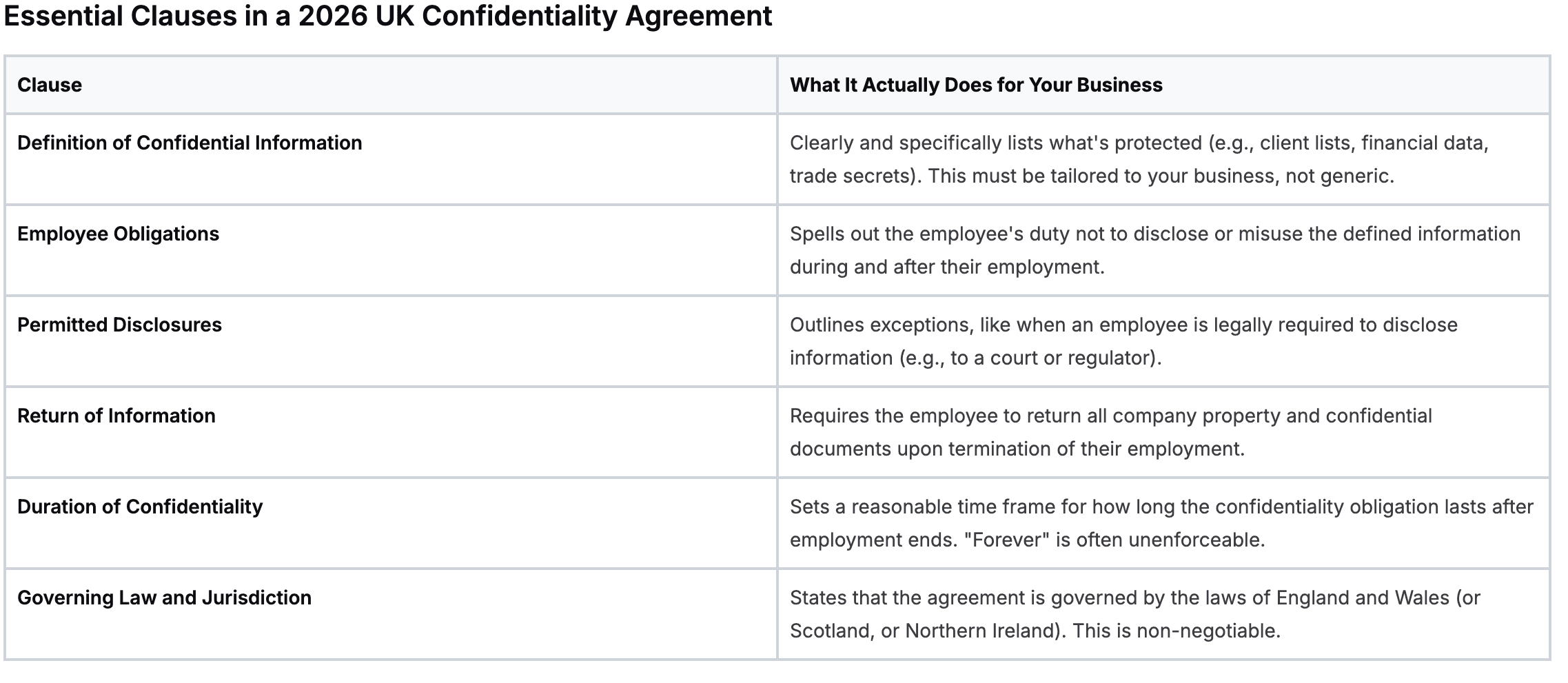
Having these clauses properly drafted is the difference between an agreement that protects you and one that's just a piece of paper.
On top of that, new laws like the Victims and Prisoners Act 2024 have introduced crucial carve-outs. Any contract that tries to stop an employee from reporting a crime or harassment to the police is now completely void.
An employee confidentiality agreement must be a precise legal instrument, not a blunt object. Its purpose is to protect specific, defined business secrets—not to unfairly restrict an employee’s future career or silence lawful disclosures.
Using a non-compliant template puts your business in a tight spot for two main reasons:
- It could be completely voided: If a court finds just one clause unreasonable or illegal, it can invalidate the entire agreement. Suddenly, none of your sensitive information is protected.
- It creates a false sense of security: You operate thinking your trade secrets are safe, only to find out they aren't when a former employee starts a competing business with your client list.
Building a Stronger Defence
The answer isn't to ditch confidentiality agreements altogether. It’s to make sure yours are robust, customised, and legally sound. A well-drafted agreement not only deters leaks but also gives you a solid legal foundation if you ever need to take action.
Your starting point should always be a modern, compliant employee confidentiality agreement —one built with current UK law in mind and designed to be tailored. This guide will walk you through exactly how to do that, step by step.
Defining What Information You Can Legally Protect

Create an NDA for free here!
Before you can shield your business's secrets, you have to be crystal clear about what they actually are. This is exactly where so many generic templates fall flat.
Simply declaring that "all company information" is confidential is a massive red flag for UK courts. It’s a classic overreach that could make your entire agreement worthless. To stand up in court, your definition of confidential information needs to be specific, reasonable, and tied directly to what makes your business tick.
So, what’s fair game? We’re talking about the unique assets that give you a real competitive advantage. This isn’t about an employee's general industry know-how; it’s about proprietary information they could only get by working for you. Your employee confidentiality agreement must be customised to pinpoint these valuable assets.
What Is Genuinely Confidential
For most businesses, the information you need to protect will fall into a few key categories. Use these real-world examples as a guide when tailoring the definition in your own agreement:
- Commercial Information: Think supplier price lists, detailed customer databases, and strategic business plans outlining your next moves. For a marketing agency, a proprietary campaign strategy built for a major client would be a prime example.
- Intellectual Property (IP) and Trade Secrets: This is often the lifeblood of a company. It covers everything from the secret recipe for a new snack to the source code for your flagship software. Unreleased product designs, unique manufacturing methods, and R&D data all belong here.
- Financial and Operational Data: Internal financial reports, profit margins, operational cost structures, and employee salary details are all classic examples of information that needs to be kept under lock and key.
A common mistake is trying to protect too much. A court will always draw a line between your genuine business secrets and an employee's accumulated skills. Your agreement can't stop a former marketing manager from using their marketing skills at another job, but it can stop them from walking out the door with your client list.
Nailing down these categories is a critical first step. It makes sure everyone knows where the boundaries are, which helps prevent accidental leaks and gives you a much stronger legal footing if someone deliberately shares information. This clarity is also vital for staying on the right side of broader regulations. For a deeper dive into managing sensitive data, our guide on creating a data protection policy is a fantastic resource.
The Unprotectable: What You Cannot Restrict
Just as important as knowing what to protect is understanding what you can't. Recent UK legislation has drawn some very firm lines around what an employee confidentiality agreement—often just called an NDA—can and cannot be used for. If you try to stop an employee from making a legally protected disclosure, you risk invalidating the whole agreement.
Specifically, you cannot use a confidentiality clause to gag an employee from:
- Reporting a criminal offence to the police or another relevant authority.
- Making a protected disclosure under whistleblowing laws (for example, reporting that the company is breaking the law).
- Disclosing information related to harassment or discrimination.
- Speaking with a qualified professional to get medical or legal advice.
These aren't loopholes; they are fundamental legal rights designed to stop agreements from being used to cover up misconduct or criminal behaviour. The research backs this up, showing that the mere threat of an NDA can stop people from coming forward.
A study by Can't Buy My Silence and Speak Out Revolution found that 33% of UK workers dropped formal workplace complaints because they were afraid an NDA would be used to silence them. This chilling effect was especially strong in lower-income sectors, with NDAs being used in 67% of formal complaints in retail. It’s a stark reminder of how these agreements can be misused.
Your agreement must clearly state that it doesn't prevent these lawful disclosures. Including this carve-out isn't just good practice—it's a legal necessity that keeps your document compliant and ensures it can do its real job: protecting your legitimate business interests.
Create an NDA for free here!
How to Customise Your Confidentiality Agreement Template
Think of a good employee confidentiality agreement template as a solid starting point, not the finished article. To give it real legal teeth and make it genuinely work for your business, you need to tailor it to your specific situation. This is where you turn a generic document into a sharp legal tool that actually protects your most valuable assets.
The best way to do this is to stop thinking in abstract terms and start picturing real-world scenarios. What information, if an employee walked out the door with it, would do serious damage to your business? Your answer to that question is the bedrock of every change you make.
Defining Confidential Information for Your Specific Industry
The "Definition of Confidential Information" clause is the absolute heart of your agreement. It needs to be a detailed, specific list, not just a vague, catch-all phrase. A generic template might just say "business information," but frankly, that’s not going to cut it. You need to be precise about what matters in your day-to-day operations.
Let’s look at a few examples based on industry:
- For a Tech Startup: Your definition has to go way beyond just "software." You should be explicitly listing things like source code, algorithms, user data, API keys, database schemas, and product roadmaps. These are the crown jewels for any tech company.
- For a Sales-Driven Organisation: Here, the focus is all about your commercial relationships. Your clause should pinpoint client lists, lead sources, pricing structures, sales scripts, commission schemes, and supplier agreements.
- For a Creative Agency: It's all about the intellectual property. Define your confidential information to include things like un-pitched client concepts, campaign strategies, creative briefs, brand assets still in development, and even internal mood boards.
Getting this granular leaves no room for confusion. An employee can’t turn around later and claim they didn't realise the client list they emailed to their personal account was considered confidential. It’s right there in black and white.
The goal here is to be thorough without being unreasonable. If you try to classify every single piece of paper as confidential, a court might see it as an unfair restraint of trade and could invalidate the whole clause. Be specific, but be realistic.
As you work on this section, think about the entire journey of your information. What data do you create? What do you get from third parties that you have to keep quiet? Both need to be covered. If you're only sharing information one-way, like with a contractor, looking at how aone-way confidentiality agreement is structured can give you some great pointers for getting these definitions right.
Setting the Duration and Survival of the Obligation
Another absolutely critical piece to customise is how long the duty of confidentiality lasts after an employee moves on. This is often called the "survival period." In the UK, an indefinite obligation for every bit of information is rarely enforceable. Courts look for what’s reasonable.
A much better approach is to have a tiered system, linking the time frame to the sensitivity of the information.
- Trade Secrets: For information that qualifies as a genuine trade secret under UK law (think the secret formula for Irn-Bru), the obligation can and should last indefinitely, or at least for as long as it remains a secret.
- General Business Information: For data that's sensitive but not quite a trade secret, like a two-year-old marketing plan, a fixed period makes more sense. A duration of two to five years after employment ends is usually seen as reasonable.
- Time-Sensitive Data: Some information loses its confidential nature very quickly. For instance, quarterly financial results are top secret before they’re announced, but public knowledge the minute they are. Your agreement needs to reflect that.
By linking the survival period to the type of information, you're showing a court that you’ve thought carefully about protecting your legitimate business interests, not just trying to unfairly restrict a former employee's career.
Specifying the Return of Company Property
When someone leaves your company, you need a clear, non-negotiable process for getting all your confidential materials back. Your template will have a "Return of Information" clause, but you must tweak it to cover all the different ways your company stores data today.
Your clause needs to make it clear that the departing employee must:
- Return all physical items like documents, laptops, company phones, and access cards.
- Permanently delete all confidential files from any personal devices (laptops, phones, tablets).
- Wipe any company data they might have stored on personal cloud accounts like Google Drive or Dropbox.
- Sign a declaration confirming they have done all of the above.
This isn't just about getting your laptop back. It's about establishing a clear legal duty for the employee to completely remove all company data from their possession. This drastically cuts the risk of an "accidental" leak later on and gives you a signed document you can use as evidence if a dispute ever pops up.
By carefully customising these three key areas—the definition of information, the duration of the obligation, and the return of property—you transform your employee confidentiality agreement template from a simple form into a powerful shield, perfectly shaped to your business.
Keeping Your Secrets Safe: A Guide to the New UK NDA Laws
Understanding the latest legal shifts around non-disclosure agreements (NDAs) in the United Kingdom isn't just a good practice—it's critical. The whole rulebook for how confidentiality clauses work has changed, which means an old employee confidentiality agreement template is more than just outdated; it's a serious legal liability.
A massive change for employers came with the Victims and Prisoners Act 2024. This legislation completely rewrote the rules for confidentiality agreements in an employment setting across England and Wales.
How the Victims and Prisoners Act Affects Your Agreements
The Act, which will be fully in force from 1 October 2025, makes any confidentiality clause or NDA completely unenforceable if it attempts to block someone from making a 'Permitted Disclosure'. This applies to every new agreement signed on or after that date.
At its heart, the law is designed to prevent NDAs from being used to silence victims of crime. It gives protection to individuals who are victims—or even just reasonably believe they are—when they report criminal behaviour. It’s worth taking the time to explore more about these significant changes and prepare, as they have huge implications for every UK business.
So, what counts as a 'Permitted Disclosure' that you can no longer stop? The law is very clear on this. It includes:
- Reporting to the Police: Any communication with law enforcement or another official body to report a crime.
- Getting Support: Speaking with close family members (specifically defined as children, parents, or partners) for support.
- Assisting Investigations: Giving information as part of an official investigation.
What Crimes Does the Act Cover?
The range of criminal offences covered by this Act is incredibly broad, which is exactly why your agreements must have explicit exceptions written into them. The law is designed to provide thorough protection for people who need to speak up.
These offences aren't just limited to the most serious crimes. They include:
- Physical assaults and sexual offences.
- Harassment and stalking under the Protection of Harassment Act.
- Theft and criminal damage.
- Serious financial crimes, such as fraud.
This means you can't stop an employee from reporting that a colleague stole company property or that a manager was involved in harassment. If you try, your confidentiality clause will be void.
The new reality is simple: confidentiality agreements can no longer be used as a shield for illegal activity. A modern, compliant agreement must clearly state an employee’s right to make these disclosures. This protects the individual and ensures your contract remains valid.
The visual guide below breaks down the key stages of customising a compliant agreement, from defining what's covered to outlining how information must be handled.
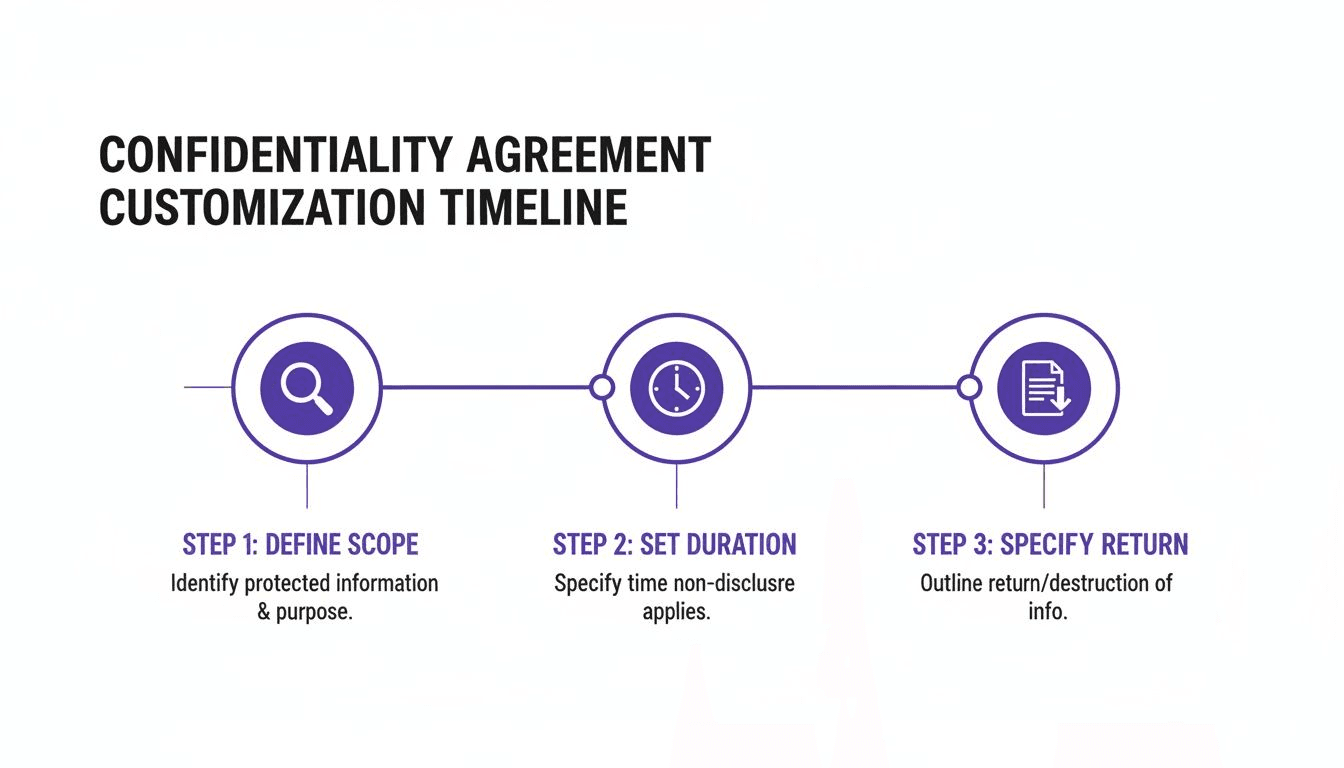
This timeline shows that creating a solid agreement isn't a one-size-fits-all job. It requires deliberate, precise steps to make sure every clause has a legitimate purpose while respecting the new legal lines. As the infographic highlights, defining the scope, duration, and return of information are the foundational pillars of an effective and lawful document.
The takeaway is straightforward: downloading a generic, old template from the web is asking for trouble. It will almost certainly be missing the mandatory legal exceptions required by the Victims and Prisoners Act 2024. Using it means you're asking an employee to sign a contract that is legally unenforceable from day one, exposing your business to legal challenges and reputational harm. A modern solution, on the other hand, has these protections built in, ensuring your agreement actually does its job.
Best Practices for Implementing and Enforcing Your Agreement

Create an NDA for free here!
Getting your employee confidentiality agreement template customised and ready to go is a huge step, but the document itself is really only half the job. How you roll it out, manage it, and ultimately enforce it is what gives the agreement its teeth. A clumsy introduction can breed distrust, whereas a clear, respectful process helps build a genuine culture of security.
The best time to introduce the agreement is during your standard onboarding process, right alongside other key employment documents. It’s crucial to frame it not as a threat, but as a standard and necessary measure to protect the company’s valuable assets—the very things that keep everyone’s job secure.
Explaining its purpose is everything. Try saying something like, "This agreement is how we protect our client information and the unique processes we've developed, which is what allows us to stay competitive and keep growing." This kind of approach fosters understanding, not fear.
Secure Storage and Consistent Application
Once the agreement is signed, think carefully about where you store it. Keeping these documents in a secure, access-controlled digital folder is non-negotiable. This not only protects the sensitive information within the agreements but also means you can find them in a hurry if an issue ever crops up.
Consistency is just as critical. The agreement should be a standard part of onboarding for every single employee who will be handling sensitive data. If you apply it selectively, you’re just asking for legal headaches and claims of unfairness down the road. Make it a routine, non-negotiable part of your HR process for every relevant new hire.
An employee confidentiality agreement is most effective when it is introduced as a routine professional safeguard, not as a tool of suspicion. The goal is to create a shared understanding of the importance of protecting business-critical information from day one.
It's also worth noting that the legal framework around these agreements is constantly tightening. For example, the Employment Rights Act 2025 has introduced more stringent restrictions on NDAs in UK employment. As of April 2026, sexual harassment allegations are specifically classified as 'Protected Disclosures' under whistleblowing laws, which further limits what an employer can legally keep under wraps. You can learn more about what these recent changes mean for employers to make sure your practices are fully compliant.
Responding to a Suspected Breach
Even with the best procedures, you might one day suspect an employee or ex-employee has breached their agreement. The worst thing you can do is act rashly. A measured, evidence-based approach is absolutely essential.
Your very first move should be to launch a discreet internal investigation. The aim here is to gather facts, not to jump to conclusions.
- Document Everything: Start a detailed timeline of events. Make a note of when you first became suspicious and what triggered it.
- Gather Digital Evidence: Work with your IT department to review email logs, file transfer records, or network access data, making sure you don't overstep employee privacy rights. Look for unusual activity, like large downloads or emails sent to personal accounts.
- Review Their Access: Pinpoint what specific confidential information the individual could access. This will help narrow the focus of your investigation and assess potential damage.
Once you’ve gathered credible evidence, the next step is usually to send a formal cease and desist letter. This letter, which should always be drafted by a legal professional, outlines the suspected breach, reminds the person of their contractual obligations, and demands they stop the infringing activity and return any company information immediately.
In many cases, this initial letter is enough to resolve the matter without ever seeing the inside of a courtroom. It shows you’re serious about protecting your information and are prepared to defend it. For highly sensitive data, especially anything that qualifies as a trade secret, you might need to consider extra layers of protection. You can read more on this in our guide to creating a trade secret protection agreement.
Frequently Asked Questions
When it comes to employee confidentiality agreement templates, a few common questions always seem to pop up. HR managers and business owners often run into the same practical sticking points, so let's clear them up with some straightforward answers.
Does a Clause in an Employment Contract Work the Same?
Yes, you can absolutely embed a confidentiality clause directly into a wider employment contract. As long as it's well-drafted and legally sound, it's just as binding as a completely separate document.
Many businesses actually prefer this route because it keeps things simple. New starters review and sign everything in one go, right at the beginning of their employment. Whether you choose an integrated clause or a standalone agreement often just boils down to your company's internal process and how complex your confidential information is.
What Happens if an Employee Refuses to Sign?
This is a classic dilemma, and the right way to handle it really depends on when it happens. If you're hiring someone new and they refuse to sign a reasonable confidentiality agreement as a condition of employment, you can usually just withdraw the job offer. Their unwillingness to protect company information is a pretty clear red flag.
It gets more complicated with your existing team. You can't typically force a current employee to sign a new agreement if it dramatically changes their terms of employment. The best path forward is to sit down with them and explain why it's necessary for the business. If their role genuinely demands access to sensitive data, a refusal could eventually lead to redeployment or, as a last resort, a fair dismissal. But be warned, this is a legally risky path that you should only take after getting professional legal advice.
The point of a confidentiality agreement is to get everyone on the same page about protecting the company’s valuable information. It’s a standard requirement for new jobs, but for current staff, it’s a conversation first.
Are Confidentiality Agreements Enforceable After an Employee Leaves?
Definitely. In fact, that's one of their main jobs—to protect your business information long after someone has handed in their notice. This is all thanks to what’s called a "survival clause".
This clause needs to state clearly that the duty of confidentiality doesn't end when the employment does. While the obligation must be reasonable, for genuine trade secrets, it can be indefinite. It's crucial to realise, though, that this only applies to your confidential business information. It never covers the general skills and industry knowledge an employee picks up on the job. An ex-employee also always keeps their legal right to make protected disclosures (whistleblowing) about things like criminal activity.
Do I Need a Different Agreement for Freelancers or Contractors?
Using a separate agreement for freelancers and independent contractors isn't just a good idea—it's essential. While the goal is the same (protecting your information), the legal relationship is entirely different. A contractor agreement must be framed as a business-to-business contract to avoid any chance of misclassifying them as an employee.
These agreements for non-employees will usually put a much heavier focus on who owns the intellectual property they create for you. They also tend to have more specific instructions on returning or destroying company materials when the project is over. Using a dedicated contractor agreement is a simple step that maintains a critical legal distinction and protects your business from multiple angles.
Ready to create a legally sound confidentiality agreement without the high costs and long waits? Robot Lawyer offers a smart, fast, and affordable way to generate custom legal documents. Answer a few simple questions and instantly get a tailored agreement that aligns with current UK law. Protect your business today with Robot Lawyer.