

Your Guide to UK Employment Contract Templates
When you’ve just made a new hire, the paperwork can feel like the final hurdle. An employment contract template is the tool that gets you over the line, turning a potentially complex legal job into a straightforward task. More importantly, it lays the groundwork for a solid professional relationship from day one.
Why a Solid Employment Contract Is Non-Negotiable

Create a Contract of Employment for Free Now!
Think of an employment contract as the rulebook for your new professional partnership. The days of a simple handshake and a verbal promise are long gone. In the UK's modern business world, a clear, written agreement isn't just 'good practice'—it's a must-have for legal clarity and protecting your business.
A well-put-together contract does far more than just satisfy a legal requirement. It builds a foundation of trust. By clearly spelling out the rights and duties of both you and your new employee, it heads off the kind of misunderstandings that can poison a working relationship. For any business, but especially startups and SMEs, that clarity is gold.
The Strategic Advantage of a Contract Template
Using a quality employment contract template gives you a real head start. It helps you set up legally sound foundations for your team without the eye-watering costs that often come with getting bespoke legal documents drafted from scratch. This is particularly vital when you're scaling up or hiring for several similar roles at once.
The perks of starting with a template are plain to see:
- Cost-Effectiveness: You dodge the high fees of creating every single contract from the ground up.
- Speed and Efficiency: It lets you get new talent onboarded quickly and professionally.
- Legal Compliance: A good template gives you a pre-checked framework that covers the essential UK legal bases.
- Consistency: It guarantees that all your employees in similar positions are brought in on the same terms.
A formal contract shows you're a professional outfit that values its people. This simple step of providing a clear, fair agreement can be a huge asset in attracting and keeping the top talent your business needs to grow.
Adapting to a Modern Workforce
The UK job market is more lively and competitive than ever. With the number of employed people hitting a high of over 33.9 million in early 2025, the race for skilled workers is fierce. At the same time, flexible working has become a core part of the employment scene, with around 4.23 million employees on flexible hours arrangements in 2024.
This shift shows exactly why a modern employment contract template has to be adaptable. It needs to easily accommodate clauses for arrangements like annualised hours or job-sharing. If you want to dig deeper into these trends, the data from Statista on the UK labour market is a great resource.
Anatomy of an Employment Contract Template
So, what exactly is an employment contract template? Think of it as the architectural blueprint for the working relationship you're about to build. It provides the essential, legally-required structure, but you still need to fill in the specific details to suit the role and your business.
A good template isn't just a generic form; it's a solid starting point. It ensures you don't accidentally miss any of the crucial components that make a contract legally sound. It guides you through the essentials, preventing simple oversights that could turn into major headaches down the line.
The Foundation: A Written Statement of Particulars
In the UK, the absolute baseline of any employment contract is the written statement of employment particulars. This isn't a "nice-to-have"—every single employee and worker is legally entitled to receive this information on or before their first day.
Consider the written statement the non-negotiable bedrock of your contract. It covers the fundamental facts of the job, and the law is very clear about what must be included. Getting this right is your first and most important step toward compliance.
These core details must include:
- The full names of the employer and employee.
- The date the employment starts and the date continuous employment began.
- The job title or a brief description of the work the employee will be doing.
- The place of work, or if there are multiple locations, where the employee is primarily based.
This information forms the legal foundation of the agreement. Without it, the contract is incomplete and fails to meet the basic standards required by the Employment Rights Act 1996.
Mandatory Clauses: The Backbone of Compliance
Building on that foundation, any decent employment contract template will include several mandatory clauses that expand on the written statement. These are the structural beams of your agreement, providing essential clarity and ensuring you meet all your legal duties. A quality template will have clear placeholders for you to fill in these specifics.
Key mandatory clauses that every contract must detail are:
- Pay: The exact amount the employee will be paid and how often (e.g., weekly, monthly).
- Hours of Work: The days and times the employee is expected to work, plus any rules on overtime.
- Holiday Entitlement: How much paid holiday the employee gets and the process for booking it. This has to meet the statutory minimum, at the very least.
- Sick Pay and Procedure: Details on company sick pay (if any) and the process for reporting an absence.
- Notice Periods: The length of notice required from both you and the employee to end the employment.
- Pension Details: Information about the workplace pension scheme the employee is eligible for.
Providing these details clearly from the start does more than just tick a legal box. It establishes a transparent relationship and shows your new hire you're an organised and trustworthy employer. This simple clarity helps prevent most common disputes over pay, hours, or holidays.
Recommended Clauses: Adding Layers of Protection
While the mandatory clauses cover the legal basics, the best templates go further. They include recommended clauses that add vital layers of protection and clarity, tailoring the blueprint specifically to your business. Think of these as the elements that protect your assets and set clear professional boundaries.
For instance, a confidentiality clause is a must-have if an employee will be handling sensitive company data, trade secrets, or client information. It creates a legal obligation for them not to share this information outside of the business.
Likewise, an intellectual property (IP) clause is crucial for anyone in a creative or technical role. This clause makes it clear that any work, ideas, or inventions an employee creates as part of their job belong to the company, not to them personally.
Other highly recommended clauses include:
- Probationary Period: Outlines an initial trial period to assess performance, where notice periods might be shorter.
- Disciplinary and Grievance Procedures: Sets out the formal steps for handling workplace issues fairly and consistently.
- Data Protection: Explains how you will handle the employee’s personal data in line with GDPR.
By including these strategic clauses, your employment contract evolves from a simple statement of terms into a robust tool that actively protects your business and makes sure everyone is on the same page from day one.
The UK Compliance Clause Checklist
When you're looking at an employment contract template, you need to know what's legally required versus what's just a good idea to include. Think of it like a house inspection: some things, like running water, are essential for it to be legally habitable. Others, like a state-of-the-art alarm system, are smart additions that boost its value and security. Your contract is no different.
To help you size up any template, let's break down the clauses into two buckets: the must-haves you need to comply with UK law, and the recommended extras that give your business another layer of protection.
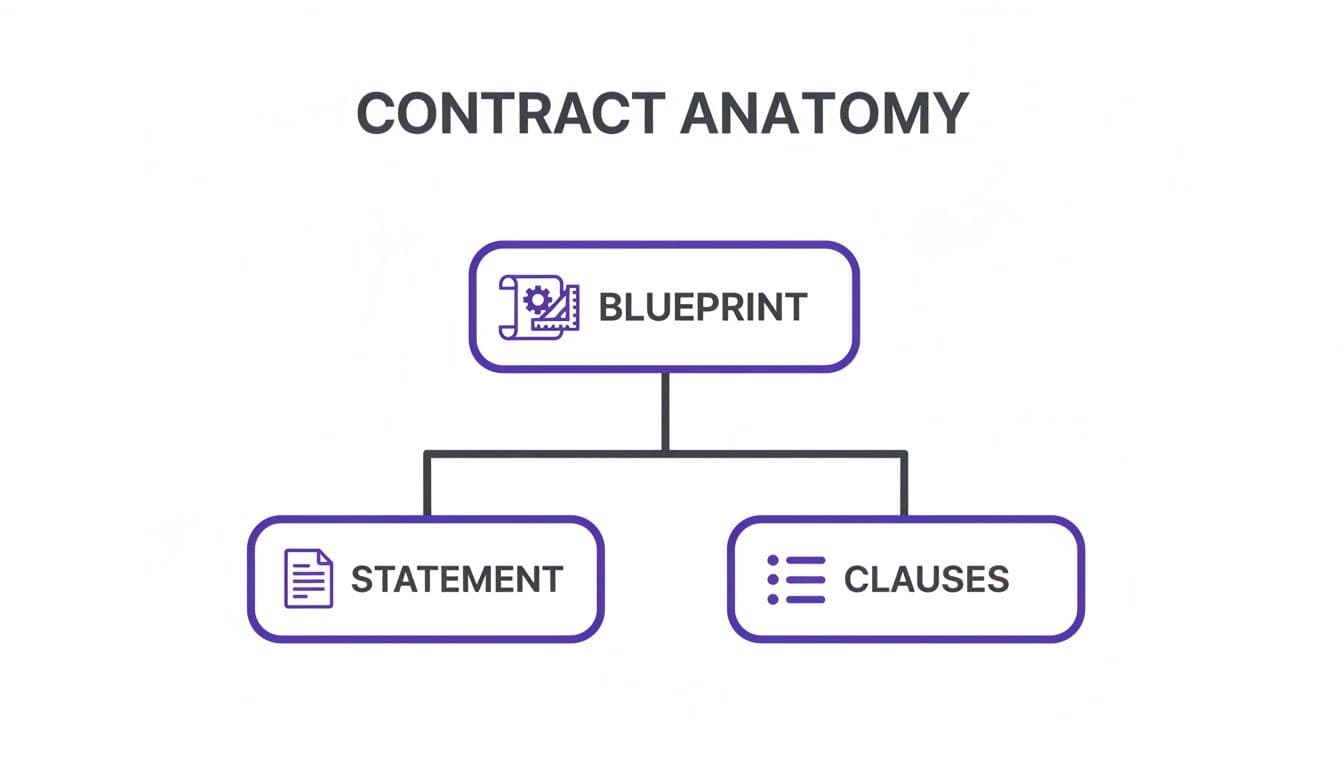
This visual shows how a solid contract is built—it starts with the basic legal framework and then adds specific clauses to build it out.
Create a Contract of Employment for Free Now!
The diagram drives home that a good contract is more than just a random list of terms. It's a carefully structured document built on a compliant foundation.
The table below gives you a quick-reference guide, separating the absolute legal requirements from the clauses that are highly recommended for business protection and clarity.
UK Employment Contract Clauses: Mandatory vs. Recommended
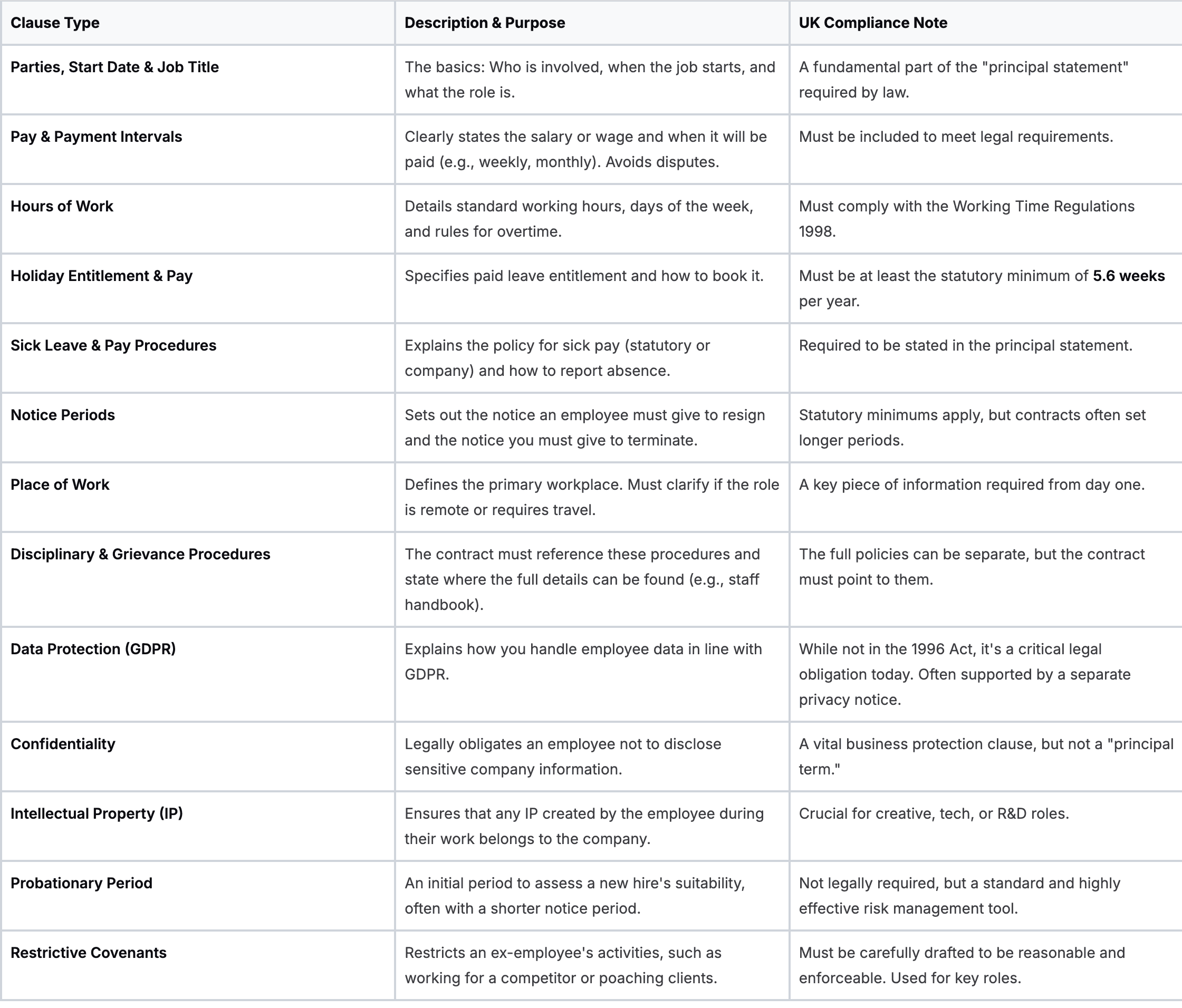
Getting both the mandatory and recommended clauses right turns a basic template into an agreement that’s not just compliant, but a real asset for protecting your business.
The Mandatory Clauses: Your Legal Essentials
These are the absolute non-negotiables. Under the Employment Rights Act 1996, every employee and worker in the UK is entitled to a "written statement of principal terms of employment" on or before their first day of work. A good contract template will have all of these built-in.
These essentials include identifying the parties and job role, clearly stating pay and working hours, and outlining entitlements for holiday and sick leave. They also cover notice periods, place of work, and where to find the disciplinary and grievance procedures.
Think of these clauses as the load-bearing walls of your contract. Without them, the whole structure is legally shaky and leaves you exposed to claims at an employment tribunal.
The Recommended Clauses: Your Strategic Safeguards
Once you have the legal foundations in place, it’s time to add clauses that protect your business interests and provide much-needed clarity. These are the elements that transform a generic template into a robust commercial tool that’s actually useful for your specific company.
A strong employment contract template should offer these as customisable options.
Data Protection and GDPR Compliance
In a world running on data, explaining how you handle employee information isn’t just good practice—it's a legal must-have under GDPR. This clause shows your commitment to privacy and spells out what personal data you collect, why you need it, and how you keep it secure.
For full transparency, you should back this up with a separate, more detailed notice. You can find out more by checking out our guide on creating an employee privacy notice to go with your contracts.
Confidentiality Clause
This is a must for pretty much any business. A confidentiality clause creates a legal duty for an employee not to share your company's sensitive information—think financial data, client lists, or business plans—both while they work for you and after they leave.
For instance, if a sales director leaves to join a rival, this clause is what stops them from taking your entire customer database with them.
Intellectual Property (IP) Ownership
If your employees create anything as part of their job—from software code and marketing campaigns to new product designs—this clause is non-negotiable. It makes it crystal clear that the ownership of any intellectual property created during their employment automatically belongs to the company, not the individual.
Probationary Period
A probationary period gives you a formal window to see if a new hire is the right fit, usually over three or six months. It normally includes a shorter notice period during this time, making it much simpler to part ways if things just aren't working out. It’s a standard and incredibly effective risk-management tool.
Restrictive Covenants
These are clauses designed to limit an employee's activities after they leave your business. They have to be drafted very carefully to be enforceable and are usually reserved for senior staff or people in client-facing roles.
Common types include:
- Non-compete clauses: Stopping an ex-employee from working for a direct competitor for a set period.
- Non-solicitation clauses: Preventing them from trying to win over your clients or customers.
- Non-poaching clauses: Barring them from convincing former colleagues to jump ship and join them.
Template vs Bespoke: Which Contract Is Right for You?
Create a Contract of Employment for Free Now!
Choosing between a template and a bespoke employment contract can feel like a big decision. Let’s make it simple. Think of it like buying a suit.
An employment contract template is the high-quality, off-the-rack option. It’s designed to fit most standard situations perfectly, maybe needing a few minor tweaks. A bespoke contract, on the other hand, is like commissioning a Savile Row tailor. It's built from the ground up for unique, high-stakes scenarios where every single detail has to be custom-made.
Knowing which one to pick will help you hire more efficiently and with greater confidence. For most small and growing businesses, a solid template is the smart choice.
When an Employment Contract Template Is the Perfect Fit
A template is your go-to when you need to be quick, consistent, and cost-effective without cutting corners on legal compliance. They're built for the everyday hiring situations that most businesses handle.
A template is probably the right call when you're:
- Hiring for standard roles. Think marketing coordinators, office administrators, or junior developers. The terms for these jobs are usually straightforward, and a template covers all the essentials without overcomplicating things.
- Scaling your team quickly. If you're in a growth spurt and hiring several people for similar jobs, templates ensure everyone gets fair, consistent, and legally sound terms from day one.
- Hiring on a tight budget. Using professionally checked templates can save startups and small businesses thousands in legal fees, freeing up cash for other parts of the business.
Templates are also incredibly useful for businesses involved in large-scale hiring initiatives. Take the UK's Restart Scheme, which had engaged 720,000 people by October 2025, with many finding jobs. Every one of those hires needs a compliant contract, and a good template lets an employer produce them quickly and accurately. You can read more about the government's findings on the Restart Scheme.
When You Must Go Bespoke
While templates are fantastic for the majority of hires, some situations absolutely require the precision of a bespoke contract. These are your high-risk or highly specialised appointments where a one-size-fits-all approach is just too risky.
A bespoke contract is a necessary investment when the role involves significant business risk, complex compensation structures, or non-standard working arrangements that a template isn't designed to handle.
You should always get a legal professional to draft a bespoke contract for these kinds of roles:
- Hiring C-suite executives. A CEO, CTO, or CFO needs a complex contract covering things like equity, share options, and performance-related bonuses. These require careful, individual drafting.
- Protecting critical trade secrets. If you’re hiring a senior engineer who will have access to your core IP, you’ll need iron-clad restrictive covenants tailored specifically to that role to make them enforceable.
- Creating unconventional employment structures. For roles with unusual commission schemes, complex international duties, or other non-standard agreements, bespoke is the only safe way forward. For example, while some atypical agreements are common enough for templates, like a zero-hours contract, a truly unique structure needs a lawyer's touch.
Create a Contract of Employment for Free Now!
How to Customise Your Employment Contract Template
Turning that template into a proper, working contract is where the real work begins. It’s about more than just slotting in a few names and dates. This is the part where you fine-tune the document to give you solid legal footing and make sure your new hire knows exactly where they stand.
Think of it like getting a suit tailored. The template is the off-the-rack suit—it has the right basic shape, but you need to adjust the sleeves, take in the waist, and make it fit perfectly. A poorly fitted contract, just like a baggy suit, just doesn’t look professional and won't do its job when you need it to.
Start with the Essentials
Before you start personalising anything, give the template itself a quick health check. An outdated document is a liability waiting to happen.
- Check the Template's Compliance: First, make sure the template is up-to-date with current UK employment law. Things like statutory pay, flexible working rights, and other regulations are always evolving, so using a document that's compliant for 2026 is a must.
- Get the Basic Details Right: Double-check every scrap of information you enter. This means the full legal name of your company, your registered address, the employee’s full name, and their start date. A simple typo here can cause a world of confusion down the line.
Nailing these first steps gives you a solid foundation. Get them right, and the rest of the customisation process will be built on steady ground.
Define the Role and How They'll Work
With the basics locked in, it’s time to get specific about the job itself. When it comes to contracts, ambiguity is your worst enemy. Your goal here should be total clarity, as this is your best defence against future disagreements over what was expected.
A precise job description within the contract is essential. Ditch vague titles and instead spell out the key responsibilities and duties the employee will actually be doing. This sets clear expectations from day one.
Next, you need to be crystal clear about the working arrangements. With the boom in flexible working, this section needs more attention than ever. In fact, flexible working arrangements have surged in the UK, with around 4.4 million employees on such deals in 2025, making it the most popular setup. If you want to dig deeper into the numbers, you can review the latest UK employment trends.
For example, when writing a clause for a remote worker, don't just put "home-based." Specify things like core communication hours, how often they'll need to attend in-person meetings, and who's responsible for providing and maintaining their equipment. This level of detail stops friction from building up later.
Tailor Pay and Protective Clauses
Finally, you get to the parts that deal with money and protection. These are often the most sensitive areas of any employment contract, so they need your full attention.
Make sure you clearly state every aspect of their compensation. This should include:
- The annual salary or hourly wage.
- How often they’ll be paid (e.g., monthly on the last working day).
- Details of any bonus schemes, spelling out how they are calculated and when they are paid out.
- Information on commission structures, if that applies.
Fair and transparent pay clauses are vital. It’s no secret that pay gaps can be a real issue, so having a clear, equitable structure outlined in the contract isn’t just good practice—it helps build a fairer workplace.
You should also tailor protective clauses, like confidentiality and non-compete agreements, to fit the specific role. An intern simply doesn't need the same tough restrictions as a senior director who has the keys to the kingdom. Overly broad or unreasonable clauses are frequently thrown out by UK courts, so customising them is the only way to make them stick. A non-compete clause that lasts too long or covers too wide a geographical area, for instance, will likely be deemed unenforceable. Making it reasonable and specific to the role gives it a much better chance of holding up if challenged.
Executing and Storing Your Contract in 2026

Create a Contract of Employment for Free Now!
You’ve done the hard part – you’ve found the right person and carefully customised their employment contract. But don’t drop the ball on the final play. The way you sign and store that contract is just as important as what’s in it, and it’s a step where many businesses unfortunately get a bit sloppy.
The good news is that the days of chasing wet-ink signatures and managing dusty filing cabinets are long gone. In the UK, electronic signatures are fully legally recognised for employment contracts, thanks to the eIDAS Regulation and the Electronic Communications Act 2000. Using a trusted e-signature platform isn’t just faster; it's often far more secure.
A Secure Protocol for Signing and Storage
A messy approach to contract management is a risk you don’t need to take. To make sure your process is smooth, secure, and legally solid, it pays to follow a simple protocol for every new hire. It's a system that protects both you and your new employee.
This straightforward, four-step process gives you a reliable framework:
- Final Review: Before anyone signs, both you and the new hire should give the final draft one last read-through. This simple check is your best chance to catch any last-minute typos and confirm everyone is on the same page.
- Trusted E-Signature: Use a reputable e-signature service to send the document. These platforms create a secure, tamper-proof audit trail, logging exactly who signed and when.
- Distribute Copies: As soon as the contract is signed, make sure both parties instantly get a fully executed digital copy for their personal records.
- Secure Storage: The final, signed contract needs to be stored somewhere safe and backed-up, like a dedicated cloud folder with restricted access so only authorised people can see it.
Following a clear protocol like this turns the signing process from a rushed formality into a secure, verifiable event. It ensures the contract is a properly executed legal document you can rely on if you ever need to.
GDPR and Long-Term Retention
Storing contracts securely isn't just about good organisation—it's a legal must. Under GDPR, you have a strict duty to protect your employees' personal data, and that absolutely includes their employment contracts. This means keeping them in a system where they are safe from prying eyes but accessible to authorised HR personnel.
You also need to hold onto these documents for a set amount of time. The standard recommendation in the UK is to keep them for at least six years after the employment relationship ends. Using a secure cloud service makes it easy to manage these retention periods and stops crucial documents from being lost or accidentally deleted.
For a related step in the hiring process, you might be interested in our guide on creating an employment offer letter.
Frequently Asked Questions
When it comes to employment contract templates, a few common but important questions always pop up. Let's walk through some practical answers to give you the confidence to finalise your documents and move forward, safely and efficiently.
Can I Just Write an Employment Contract Myself?
While you technically can, writing an employment contract from scratch is incredibly risky unless you’re a specialist in UK employment law. It's a complex area, and the rules change all the time. Using a DIY document or one from an unverified website can easily result in non-compliant terms, leaving your business wide open to legal challenges down the road.
A professionally vetted employment contract template is a much safer bet. It gives you a reliable foundation and ensures you’ve covered all the mandatory legal bases right from the start.
What If an Employee Refuses to Sign Their Contract?
This is where things can get a bit murky. If an employee starts working for you after you’ve given them the contract, they might be seen as having accepted its terms through their actions. This is a legal principle known as "implied acceptance." However, you really don't want to rely on this.
The best practice is always to have a signed agreement before their first day. If someone is hesitant to sign, take the time to sit down with them. Talk through their concerns, clarify anything that seems confusing, and make sure they understand the terms. A fair, clearly written contract usually prevents these issues from ever cropping up.
How Often Should My Contract Template Be Updated?
You should give your template a review at least once a year. It's also absolutely critical to update it whenever there are big changes to UK employment law—think new rules on the national minimum wage, shifts in statutory pay rates, or updated flexible working regulations.
The simplest way to stay compliant is to use a legal tech service that automatically updates its templates whenever the law changes. This takes the burden of tracking legislation off your shoulders and ensures your documents are always current.
Are Digital Signatures Legally Binding in the UK?
Yes, absolutely. For employment contracts in the UK, electronic signatures are completely valid and legally binding. Their status is confirmed under the eIDAS Regulation and the UK's own Electronic Communications Act 2000. Using a trusted e-signature platform is not only secure and efficient but often provides a clearer audit trail than a traditional wet-ink signature ever could.
Creating legally sound contracts is simpler than ever with Robot Lawyer. Stop worrying about compliance and generate the documents you need in minutes, all verified by legal professionals. Start your free 7-day trial and create your first contract today.