

Your Essential Power of Attorney Guide for 2026
A Power of Attorney (PoA) is a legal document that lets you appoint a trusted person to make decisions for you if you become unable to. Think of it as giving someone you trust a spare key to your most important life decisions. This guide will walk you through how it acts as a vital safety net, ensuring your wishes for your finances and health are followed, no matter what happens.
What Is a Power of Attorney and Why Is It Essential?

Create an LPA or OPoA here!
A Power of Attorney is a formal agreement where you (the donor) legally authorise someone else (the attorney) to manage your affairs on your behalf. It’s a step you take while you still have the full mental capacity to make your own choices, planning ahead for a time when you might not.
And this isn't just a concern for the elderly. A sudden illness or accident can happen to anyone, at any age. Without a PoA in place, if you lose the ability to manage your own affairs, your family could face a long and expensive court process just to get the authority to help you.
Who’s Who in a Power of Attorney
Getting a handle on the key players involved makes the whole idea much simpler. The process isn’t about giving up control; it's about carefully choosing someone who will act in your best interests when you can't.
Let’s take a quick look at the people involved and what they do.

Create an LPA or OPoA here!
Essentially, you're the one setting the rules, and your attorney is the person you trust to follow them.
A Power of Attorney is your instruction manual for the future. It ensures that even if you can't speak for yourself, your voice is still heard, and your wishes are respected by the people you trust most.
More and more people are realising how important this protection is. In the UK, the registration of Lasting Powers of Attorney (LPAs) saw a huge jump, with nearly 20% more registrations in 2022 than the year before. This shows a real shift towards proactive life planning. You can explore more data on LPA registration trends to see just how many people are securing their futures.
What Decisions Can an Attorney Make?
A Power of Attorney isn't a one-size-fits-all document. You can tailor it to cover specific areas of your life, primarily your finances and your health.
It’s quite common to set up separate PoAs for each area. You might even appoint different attorneys who are best suited for each role—for instance, choosing someone with a good head for numbers for your property and financial affairs, and a close family member for your health and welfare decisions. This approach ensures you have specialised support right where it matters most.
Choosing the Right Type of Power of Attorney
Picking the right type of Power of Attorney is a bit like choosing the right tool for a specific task. You wouldn't use a sledgehammer for a finishing nail, and the same principle applies here. You need the document that precisely matches your circumstances and what you want to achieve in the future.
In the UK, the most common and powerful options you'll encounter are Lasting Powers of Attorney (LPAs). These are specifically designed to remain valid even if you lose the mental capacity to make your own decisions. They are split into two distinct types, each covering a major area of your life.
The Two Pillars of a Lasting Power of Attorney
It helps to think of your life as resting on two main pillars: your financial security and your personal wellbeing. An LPA lets you appoint someone you trust—your attorney—to look after one or both of these pillars if you ever need them to.
The two types are:
- Property and Financial Affairs LPA
- Health and Welfare LPA
You can set up one or both, and you’re free to choose different people to act as attorneys for each. Let’s look at what each one actually does, with some real-world examples.
Property and Financial Affairs LPA Explained
This LPA gives your attorney the legal authority to manage your money and property. It’s the practical tool that keeps your financial life running smoothly when you can't manage it yourself.
For example, imagine you’re stuck in hospital for a few weeks and can’t get to a bank. With this LPA in place and registered, your attorney could step in to:
- Pay your mortgage or rent, so you don't fall into arrears.
- Manage your bank accounts and investments.
- Settle your regular bills, like council tax and utilities.
- Collect your pension or any benefits you're entitled to.
- Organise essential repairs to your home.
You can also decide whether this LPA comes into effect as soon as it’s registered (with your permission, of course) or only if you lose mental capacity. This built-in flexibility makes it an incredibly useful document for both short-term help and long-term planning. For a deeper dive into the setup, explore our detailed Lasting Power of Attorney guide.
Health and Welfare LPA Explained
While the financial LPA looks after your assets, the Health and Welfare LPA is deeply personal. It gives your chosen attorney the power to make decisions about your day-to-day care, medical treatment, and where you live. Crucially, this type of LPA can only be used if you become unable to make these decisions for yourself.
This LPA ensures that someone who knows you and understands your values makes decisions about your personal wellbeing, rather than leaving it to strangers.
If an illness like dementia or a severe injury meant you couldn't communicate your wishes, your Health and Welfare attorney would be able to:
- Decide where you should live, whether that’s in your own home with carers or in a residential home.
- Make choices about your daily routine, including your diet and social activities.
- Give or refuse consent to medical treatments on your behalf.
- Make the final call on life-sustaining treatment, but only if you have given them this specific authority in the LPA document.
Without this LPA, these profoundly personal decisions could fall to doctors or social services, who may have no idea what you would have wanted.
What About an Ordinary Power of Attorney?
There is a third, more temporary option known as an Ordinary Power of Attorney (OPA). This document is designed for short-term convenience and automatically becomes invalid the moment you lose mental capacity.
An OPA is handy if you just need temporary cover—for instance, if you're travelling abroad for a few months and need someone to manage your finances at home. But when it comes to properly future-proofing your affairs, the LPA is the essential tool you need.
How to Create and Register Your Power of Attorney
Turning your wishes into a legally sound Lasting Power of Attorney (LPA) isn't just about filling in a form. It’s a careful process, and every step needs to be followed to the letter to make sure your document is valid when it matters most. Let's break down the journey, from picking your attorneys to the final registration.
Step 1: Choose Your Attorney Carefully
This is your first, and arguably most important, decision. The person (or people) you choose will hold a huge amount of responsibility. Your choice should be rooted in absolute trust, not just a feeling of obligation.
Think about it. The ideal attorney is reliable, truly understands your values, and has the practical skills to handle the tasks you’re entrusting them with.
Ask yourself these questions when you're deciding:
- Are they trustworthy? This is the deal-breaker. You need complete faith that they will always, without question, act in your best interests.
- Are they organised? If you’re handing over your finances, they need to be on top of paperwork, bills, and deadlines.
- Do they live nearby? It’s not essential, but being close can make life much easier, especially for managing practical tasks or making health and welfare decisions on the ground.
- Are they willing to do it? Have an honest chat with them. Being an attorney is a serious commitment, and they have to agree to it willingly.
It's also a very good idea to appoint at least one replacement attorney. This is your backup plan, making sure your LPA can still be used even if your first choice can't act for any reason.
Step 2: Complete the Official LPA Forms
Once you've picked your team, the next job is to fill out the official LPA forms from the Office of the Public Guardian (OPG). Remember, you’ll need a separate form for a Property & Financial Affairs LPA and another for a Health & Welfare LPA.
The forms come with guidance, but they demand real care. This is where you can also set out specific instructions or preferences. Instructions are binding rules your attorney must follow. Preferences are your wishes, which they should consider. Be as clear as you can to avoid any mix-ups down the line.
Step 3: Sign the Document in the Correct Order
This is a classic tripwire. So many applications fail right here. The LPA has to be signed by everyone involved in a strict sequence. Get it wrong, and the OPG will reject the document, sending you back to square one.
Here is the correct signing order:
- The Donor (You): You must sign first, and you need a witness present when you do.
- The Certificate Provider: This is an independent person who confirms that you understand the LPA and are creating it of your own free will.
- The Attorney(s): Each of your attorneys must then sign the document, also in front of a witness.
A witness cannot be one of the attorneys named in the document. Getting every signature witnessed correctly and in the right order is the foundation of a valid LPA.
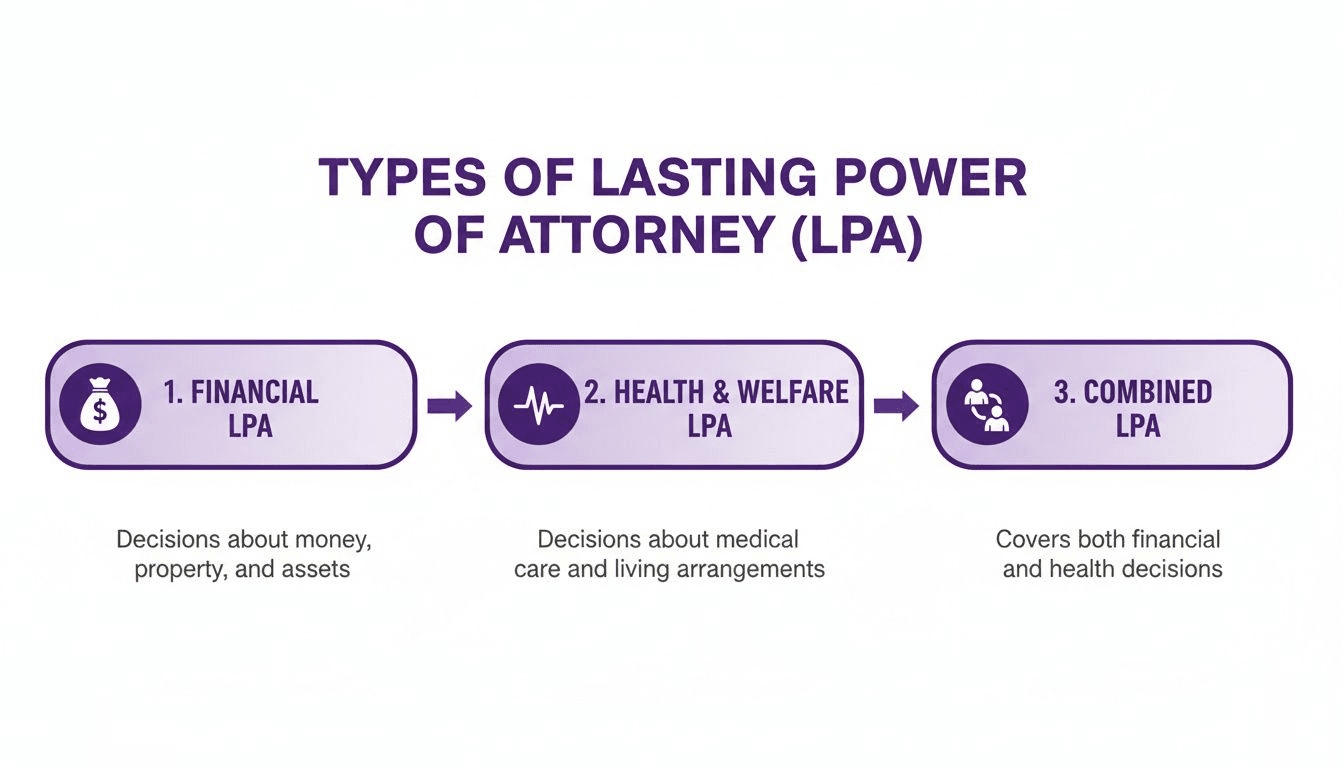
This flowchart shows the main areas an LPA can cover, helping you decide if you need one type or both.
Create an LPA or OPoA here!
By creating separate LPAs for your finances and your health, you ensure that every part of your life is looked after by someone you trust.
Step 4: Register with the Office of the Public Guardian
Here’s the final hurdle. A Lasting Power of Attorney has no legal power until it’s been registered with the Office of the Public Guardian (OPG). This step makes it an official document that banks, doctors, and other organisations will recognise. You can register it right after signing or wait, but registering straight away is almost always the smart move.
The registration process can take weeks, sometimes even months, so it pays to plan ahead. Once it's registered, the OPG stamps every page of the LPA and sends the official document back to you. This process is getting smoother, too. The UK's 'Use an LPA' service, which launched in 2020, has made a big difference. By early 2025, over two million LPAs had been added to the digital service, making it much quicker for organisations to check an attorney's authority online.
If you only need temporary authority that will end if you lose capacity, you might also consider an Ordinary Power of Attorney.
Avoiding Common Mistakes That Delay Your Application

Create an LPA or OPoA here!
Getting a Lasting Power of Attorney (LPA) sorted should bring peace of mind, not a headache. But far too often, simple mistakes on the application forms lead to long delays, extra fees, and sometimes, outright rejection by the Office of the Public Guardian (OPG). Think of this as your guide to sidestepping the common pitfalls.
The consequences of a simple slip-up are surprisingly steep. In 2024, the OPG rejected a massive 133,760 LPA applications across England and Wales. That’s a 199% jump since 2021. Those rejections have cost families an estimated £5 million in wasted application fees, often due to avoidable errors like a missed signature or incorrect witness information. You can read more about the rise in LPA rejections to see just how widespread this problem is.
Let’s make sure your application sails through by looking at the errors that trip people up the most.
The Signing Order Is Not a Suggestion
This is probably the most common reason applications get sent back, and it’s so easy to get right. The OPG is incredibly strict about the sequence in which the LPA is signed. There’s no flexibility here; get it wrong, and the document is invalid.
The correct order must be followed precisely:
- The Donor (that’s you): You always sign first, and you must do so in front of your witness.
- The Certificate Provider: Next, your certificate provider signs to confirm you understand what you're doing and aren't being pressured.
- The Attorney(s): Finally, each of your attorneys must sign, each with their own witness present. They can only sign after you and the certificate provider have signed.
Messing up this sequence means you have to start the entire process from scratch. It’s a costly and frustrating mistake.
Witnessing Rules Are Strict
Another critical step is choosing the right people to witness the signatures. A witness must be independent, meaning they can’t be anyone named in the LPA or someone who might benefit from it. Their job is to provide impartial proof that the signature is genuine.
A witness is there simply to confirm they watched you physically sign the document. They are not signing off on the content of the LPA, just the authenticity of your signature.
Here are the key rules to remember:
- Who can be a witness? Pretty much any adult over 18 who isn’t an attorney or replacement attorney in your LPA. A neighbour, friend, or work colleague is usually a safe bet.
- Who cannot be a witness? Your attorneys, any replacement attorneys, and their spouses or partners are all disqualified from witnessing your signature.
- Signatures must be 'wet': This is crucial. Your witness has to be physically in the room with you, watch you sign with a pen, and then add their own signature to the document.
Vague Instructions and Contradictions
The LPA form gives you a section to add specific instructions that your attorneys are legally required to follow. While this feature offers control, it’s also a minefield for errors. If your instructions are unclear, contradict other parts of the document, or ask your attorney to do something unlawful, the OPG will send the application back.
For example, you can't include an instruction that is illegal or makes it impossible for your attorney to do their job. A classic error is adding a clause that forces your attorney to get permission from another family member before making any decisions. This is seen as unlawfully restricting their legal duty.
A good power of attorney guide will always recommend keeping instructions direct and simple. If you have complex wishes you want to include, it’s always best to get professional advice to make sure they are worded correctly and legally sound. By paying close attention to these key details, you can dramatically improve your chances of getting your LPA registered without a hitch.
Here’s the section rewritten to sound completely human-written, following all your requirements.
Create an LPA or OPoA here!
How Modern Services Simplify the LPA Process
Tackling the Lasting Power of Attorney (LPA) process can feel overwhelming, with its mountain of paperwork and strict, unforgiving rules. Traditionally, you had two choices: brave the confusing government forms on your own, or pay a hefty fee for a high-street solicitor.
But today, there’s a much smarter middle ground.
Modern services like Robot Lawyer have stepped in to bridge that gap. They use clever technology to make drafting an LPA quicker, more affordable, and incredibly accurate. This approach provides a guided journey, turning what was once a complex legal slog into a series of simple questions.
Guided Creation to Avoid Common Errors
The single biggest headache with LPAs is getting them rejected. We’ve seen how simple mistakes in signing order, witness details, or unclear instructions can lead to major delays and extra costs. This is where a guided service really shines.
An intelligent, AI-assisted questionnaire is built from the ground up to prevent these problems before they even start. It walks you through each section, making sure you provide all the right information in the correct format. Think of it as having a digital expert looking over your shoulder.
- Intelligent Prompts: The system asks specific questions to capture exactly what you want, helping you put your wishes into clear, unambiguous language.
- Error Checking: It automatically spots when a section is incomplete or if you’ve entered contradictory information, drastically cutting down the risk of rejection.
- Structured Guidance: The process makes sure everyone involved—the donor, the certificate provider, and the attorneys—is correctly identified and their roles are crystal clear.
This guided approach takes the guesswork out of the power of attorney guide, transforming a paperwork puzzle into a perfectly manageable task. The platform helps you generate a precise document that’s built for your specific needs.
This blend of smart automation and human oversight is what makes the service so reliable for creating a rock-solid LPA.
The Peace of Mind of Expert Verification
While technology delivers speed and precision, nothing replaces the confidence that comes from a human touch. The best modern services don’t just hand you a computer-generated form; they finish the job with a review by a qualified legal professional.
Your AI-drafted document gets a final, thorough check by an expert. They ensure it’s not only legally sound but also perfectly reflects your intentions. This gives you the peace of mind that your LPA will be accepted by banks, hospitals, and other institutions without any fuss.
By combining automated accuracy with human expertise, modern LPA services offer a dependable and efficient alternative. You get the assurance of a professional review without the high costs and long waits of a traditional solicitor.
This method provides a reliable and cost-effective way to secure your future. You can confidently create a document that protects you, knowing it’s been built with both advanced technology and expert legal insight—all from the comfort of your own home.
When Your Power of Attorney Can Be Used or Changed
It’s one thing to set up a Lasting Power of Attorney (LPA), but it’s another to know exactly when it ‘kicks in’. A lot of people assume it’s an all-or-nothing switch, but the timing depends entirely on the type of LPA you’ve made. This is a critical detail for you and your chosen attorney to understand.
Think of it like this: you’re giving a trusted person a key to your affairs. But you get to decide when that key can be used. The rules are different for your finances versus your health and wellbeing.
Activation Rules for Different LPAs
When you make a Property and Financial Affairs LPA, you get a choice. You can let your attorney start helping you as soon as the document is registered with the Office of the Public Guardian (OPG), even if you still have full mental capacity.
This is incredibly practical. Maybe you need someone to manage your bills while you’re on a long trip, or you’re recovering from an operation and can’t get to the bank. As long as you give your permission, your attorney can step in to help.
A Health and Welfare LPA is different. It follows a much stricter rule: your attorney can only use it once you’ve lost the mental capacity to make those decisions yourself. It’s a safety net, pure and simple. It’s designed to make sure your wishes about your care are followed when you can no longer voice them.
The main takeaway is that an LPA doesn't mean you're giving up control. You're just making a sensible plan for how your affairs should be handled in specific situations that you get to define.
This built-in control is what protects your independence for as long as possible.
Create an LPA or OPoA here!
Changing Your Mind: Revoking a Power of Attorney
Life isn’t static, and your LPA doesn’t have to be either. Choosing an attorney is a big decision, but it isn’t set in stone. As long as you have the mental capacity to understand the legal implications, you’re still the one in charge.
If things change—maybe your relationship with your attorney breaks down, or you just don’t need the arrangement anymore—you have the right to cancel it. The formal name for this process is revocation.
To officially cancel an LPA, you need to create a legal statement called a deed of revocation.
This document makes it clear that you are cancelling the Power of Attorney. After signing it with a witness, there are two final steps to make the cancellation official:
- Send the original deed of revocation to the Office of the Public Guardian (OPG). They will take the LPA off their register, which formally ends its legal power.
- Send a copy of the deed to every attorney. This is crucial to inform them that they no longer have any authority to act for you.
This whole process shows that an LPA is a flexible tool designed around you. You have the power to put it in place, and you have the power to take it away.
Your Power of Attorney Questions Answered
Setting up a Lasting Power of Attorney (LPA) is a significant decision, so it’s completely normal to have a few questions. Getting clear on the details is the best way to feel confident. Here are some of the most common queries we see, answered in plain English.
How Much Does an LPA Actually Cost?
The cost of setting up an LPA breaks down into two main parts: the government registration fee and any professional fees for assistance.
The Office of the Public Guardian (OPG) in the UK charges £82 to register each LPA. This means if you create both a Property & Financial Affairs LPA and a Health & Welfare LPA, the total registration fee will be £164.
It’s always worth checking if you qualify for a fee reduction or an outright exemption. If you’re on certain means-tested benefits or have an annual income under £12,000, you may be eligible. This can make a real difference to the overall cost.
Professional fees for help with the forms can vary wildly. A traditional solicitor might charge several hundred pounds, whereas more modern online solutions provide a far more affordable alternative.
Can I Choose More Than One Attorney?
Yes, you can, and in many cases, it’s a smart move. Appointing more than one attorney creates a support system and lets them share the load. When you appoint multiple attorneys, you also have to specify how you want them to make decisions.
There are two primary options:
- Jointly: This structure requires all your attorneys to agree on every decision. While it encourages teamwork, it can grind things to a halt if one person is unavailable or if they simply can’t agree.
- Jointly and severally: This is a much more flexible arrangement. It allows your attorneys to act together or independently. It’s often the most practical choice, preventing delays if one attorney is away or unwell.
Think honestly about your family dynamics and what would work best in a real-world scenario before you decide.
What Happens if I Do Not Have an LPA?
This is probably the most critical question of all. If you lose mental capacity without an LPA in place, your loved ones can't just step in to manage things for you. Legally, they have no authority to access your bank accounts, pay your bills, or make choices about your medical care.
Instead, your family would have to apply to the Court of Protection to be appointed as a ‘deputy’. This process is notoriously slow, expensive, and deeply stressful. It can take many months and run into thousands of pounds in legal fees, all while your finances are effectively frozen and important decisions about your care are left hanging.
An LPA is your way of deciding who should be in charge, saving your family from a costly and emotionally draining court battle at an already difficult time.
Putting an LPA in place now gives you control and spares your family that ordeal.
How Long Does It Take to Register an LPA?
Once your signed forms are sent to the OPG, you’ll need some patience. The registration process can currently take up to 20 weeks. This timeframe fluctuates depending on the OPG's workload, which is why it's so important to get started early and not leave it until you need it. This waiting period is exactly why we advise registering your LPA as soon as it's signed. For guidance on the signing process itself, you can learn more about how to sign as a power of attorney.
Ready to create your legal documents with confidence? Robot Lawyer offers a fast, affordable, and expert-verified way to draft everything from tenancy agreements to Lasting Powers of Attorney. Start your free 7-day trial today!