
Your Essential 10-Point Contract Review Checklist for 2026
Signing a contract often feels like the final step, but the review process is what truly defines the outcome of your agreement. Whether in business, property, or employment, the small print can contain game-changing opportunities or costly liabilities. A hurried signature can easily lead to scope creep, payment disputes, or legal battles that drain your resources and damage crucial relationships. This is precisely why a systematic review is not just good practice-it's essential for protecting your interests.
This comprehensive contract review checklist is designed to empower you, whether you're a freelancer finalising a service agreement, a small business owner securing a partnership, or an individual entering a significant personal arrangement. We'll break down the ten most critical areas of any contract, from identifying the parties involved to understanding termination rights and liability clauses. Our goal is to provide a clear, repeatable framework you can use to analyse legal documents with confidence.
You will learn to spot common red flags, understand clause-by-clause checks, and identify areas for potential negotiation. By the end of this guide, you will have the tools to ensure every contract you sign is fair, clear, and works in your favour, safeguarding your assets and securing your objectives. Let's get started on turning legal jargon into a clear action plan.
1. Parties to the Contract
The very first step in any contract review checklist is to confirm the identities of every party involved. This seems basic, but it is a foundational check that, if done incorrectly, can render an entire agreement unenforceable. You must verify that each individual or company is identified by their full, correct legal name and registered address, not just a trading name or informal alias. This ensures the contract legally binds the correct entities.
Create Professionally Reviewed Contracts in Seconds Here!

Misidentifying a party can lead to significant problems, such as trying to enforce terms against a non-existent entity or an individual who isn't personally liable. This is especially critical for small businesses and freelancers where the line between a person and their business can be blurred.
Why This Is a Critical First Step
Correctly identifying the parties ensures accountability. If a dispute arises, you need to know exactly who to pursue legal action against. An agreement with "Dave's Plumbing" is far weaker than one with "David Smith, trading as Dave's Plumbing" or "Dave's Plumbing Services Ltd., Company Number 12345678, with its registered office at [Address]". The latter options provide clear legal personality and an official address for serving notices.
Actionable Checks and Examples
When reviewing this clause, be meticulous. Here are specific actions to take and what to look for:
- For Limited Companies: Check the company name and number against the Companies House register. Ensure the registered address listed in the contract matches the official record.
- Example: An employment contract should state the employer is "ABC Solutions Ltd. (Company No. 09876543)" not just "ABC Solutions".
- For Sole Traders: The contract must name the individual legally responsible for the business.
- Example: An NDA should be between "Your Company Ltd." and "Jane Doe, trading as JD Creative", not just "JD Creative".
- For Partnerships: List the full legal names of all individual partners or the official name of the Limited Liability Partnership (LLP).
- For Individuals: Use full legal names as they appear on official identification, such as a passport or driving licence.
- Example: A tenancy agreement must list all tenants by their full names, like "Thomas Jones and Maria Garcia", to make them all jointly and severally liable.
Key Takeaway: Always verify the signatory's authority. Confirm that the person signing on behalf of a company holds a position (like Director) that grants them the power to bind the organisation to the agreement. A signature from an unauthorised employee may not be legally binding.
2. Scope of Services or Goods
Once you have verified the parties, the next critical element in your contract review checklist is to scrutinise the scope of services or goods. This clause defines exactly what one party will deliver and what the other will receive. A poorly defined scope is a primary source of disputes, as ambiguity can lead to mismatched expectations, scope creep, and disagreements over what constitutes “finished.”

Create Professionally Reviewed Contracts in Seconds Here!
This section acts as the performance benchmark for the entire agreement. It must be clear, measurable, and detailed enough to leave no room for interpretation. Without it, you have no objective way to determine if a party has fulfilled its obligations, making it difficult to enforce payment terms or claim a breach of contract.
Why This Is a Critical Next Step
A precisely defined scope protects both sides. For the provider, it prevents the client from demanding extra work not originally agreed upon, a phenomenon known as scope creep. For the client, it guarantees they receive the exact deliverables, quality, and quantity they are paying for. It forms the basis for acceptance criteria, allowing you to formally approve or reject the work performed.
Actionable Checks and Examples
When reviewing the scope, look for specific, concrete, and measurable language. Vague promises like "provide ongoing support" or "deliver a high-quality website" are red flags. Here are specific checks:
- For Service Agreements: Ensure deliverables are quantified.
- Example: A freelance contract should state, "Deliver three blog posts per month, each 800-1,000 words in length, SEO-optimised for agreed keywords, and delivered by the 25th of each month."
- For Employment Contracts: Job duties must be clearly outlined.
- Example: An employment agreement should define the role as "Job Title: Marketing Manager, reporting to the Head of Sales, with primary responsibilities including [List 3-5 core duties]."
- For Goods Agreements: Specify the exact quantity, model numbers, and technical specifications.
- Example: A supply contract must list "150 units of Model X-45 computer monitors, specification sheet attached as Appendix A."
- Define Exclusions: Clearly state what is not included. This manages expectations and prevents future disputes.
- Example: A web design contract could state, "This scope excludes ongoing website hosting, maintenance, and content updates, which can be purchased separately."
Key Takeaway: Define the acceptance criteria and process. The contract should specify how the deliverables will be tested and approved, including timelines for feedback and sign-off. This creates a formal procedure for completing the project and triggering final payment.
3. Payment Terms and Conditions
The specification of payment terms is often the most contentious part of any agreement. This section defines the entire compensation structure, including how much will be paid, when it will be paid, and the conditions attached. Getting this wrong can lead to serious cash flow problems, payment defaults, and protracted disputes, making it a critical focus in any contract review checklist.

Create Professionally Reviewed Contracts in Seconds Here!
Ambiguity is your enemy here. Vague terms like "payment on completion" or "net 30" can be interpreted differently by each party. A precisely defined payment clause ensures both sides have a clear, shared understanding of financial obligations, protecting both the supplier's revenue and the client's budget.
Why This Is a Critical Step
Clearly defined payment terms prevent misunderstandings that sour business relationships. For freelancers and small businesses, prompt payment is essential for survival. A contract that specifies exact due dates, invoicing procedures, and consequences for late payment provides a powerful tool for managing finances and enforcing your right to be paid on time. Without it, you are left chasing payments with little legal backing.
Actionable Checks and Examples
Your review should ensure every financial detail is explicitly stated. Leave no room for assumptions. Here are specific actions to take:
- Specify Amounts and Structure: Clearly state the cost. Is it a fixed fee, an hourly rate, or a retainer?
- Example: A freelancer agreement should state, "£50 per hour for consulting services, invoiced monthly..." not just "consulting fees apply".
- Define Invoicing Triggers and Due Dates: Pinpoint the exact moment an invoice can be issued (e.g., project milestone, end of the month) and the deadline for payment.
- Example: Use "due within 14 days of the invoice date" instead of the ambiguous "Net 14". A tenancy agreement should specify, "Rent of £1,200 per month is due on the 1st day of each month via standing order."
- Include a Late Payment Clause: To protect your cash flow, specify interest on overdue amounts.
- Example: "Interest will be charged on late payments at a rate of 8% plus the Bank of England base rate, in line with the Late Payment of Commercial Debts (Interest) Act 1998."
- Clarify Currency and Payment Method: State the currency (e.g., GBP, EUR) and acceptable payment methods (e.g., BACS, direct debit).
Key Takeaway: Always clarify the process for handling invoice disputes. A simple clause stating that the client must raise any queries within a set period (e.g., 7 days) can prevent them from withholding the entire payment indefinitely over a minor disagreement.
4. Confidentiality and Non-Disclosure Obligations
Protecting sensitive business information is a vital part of any commercial relationship. Confidentiality and non-disclosure clauses are designed to safeguard your trade secrets, client data, and proprietary knowledge from being shared with unauthorised third parties. A breach can damage your competitive advantage, so these terms must be carefully defined and enforced.
These provisions are fundamental in a contract review checklist because they create a legally enforceable duty to keep specific information private. Without them, any intellectual property or business strategy shared could be used by the other party without restriction, posing a significant risk to your operations and market position.
Why This Is a Critical Step
Clearly defined confidentiality obligations protect your most valuable assets. If a dispute arises over leaked information, a well-drafted clause provides the legal basis for seeking an injunction or claiming damages. It sets clear boundaries on what can and cannot be shared, which is essential when working with employees, contractors, or potential investors who will be privy to your internal workings.
Actionable Checks and Examples
Be precise when reviewing these clauses to ensure they offer robust protection. Here are the specific actions to take and what to look for:
- Define 'Confidential Information' Specifically: The definition should not be vague. It must explicitly list what is covered, such as trade secrets, business plans, financial data, and client lists.
- Example: A freelance service agreement should state that "Confidential Information includes, but is not limited to, client strategies, marketing plans, and unpublished product designs disclosed by the Client".
- Specify the Duration: The obligation should last for a defined period, often even after the contract ends. A common standard is three to five years post-termination.
- Example: An employment contract might state, "The employee's duty of confidentiality shall continue for a period of 5 years following the termination of employment".
- Include Exceptions: The clause should permit disclosure for information that is already public, independently developed, or required by law. This prevents the clause from being unreasonably restrictive.
- Align with Data Protection Law: If personal data is involved, ensure the clause and your practices align with GDPR. You must have a legitimate basis for processing the data and meet all regulatory requirements.
Key Takeaway: Always include a clause that requires the other party to return or certify the destruction of all confidential materials upon contract termination. This simple step prevents sensitive documents from lingering and creating future risks. For more guidance, you can find a solid framework in a Non-Disclosure Agreement.
5. Term and Termination Provisions
Every contract must have a defined lifespan. This section of your contract review checklist focuses on specifying the contract's duration (the "term"), how it can be renewed, and the precise conditions under which either party can end the agreement (the "termination"). Clear term and termination provisions prevent ambiguity and provide a structured exit route if the relationship sours or circumstances change, protecting you from being locked into an unworkable arrangement.
Failing to define these terms can lead to significant disputes. You might assume a contract ends after a project, while the other party believes it auto-renews. This can result in unexpected invoices or legal obligations. A well-drafted termination clause is your safety valve, allowing for a controlled end to the agreement.
Why This Is a Critical Step
Clarity on term and termination provides certainty and control. It defines the commitment period and outlines the "rules of separation," ensuring that if things go wrong, the process is predictable and fair. This is crucial for managing risk, whether it’s an employment contract, a service agreement, or a tenancy. Without it, you could face a costly and lengthy legal battle to extricate yourself from a bad deal.
Actionable Checks and Examples
When reviewing these clauses, look for specifics and avoid vagueness. Here are key actions to take:
- Specify the Term and Renewal: The contract must state its start and end date. If it renews, clarify how. Is it an automatic renewal ("auto-renews") unless notice is given, or does it require active agreement to extend?
- Example: A freelance agreement might state: "This agreement shall commence on 1st June 2024 for an initial term of three (3) months and will automatically renew for subsequent three-month periods unless either party provides written notice of non-renewal at least 14 days prior to the end of the current term."
- Define Notice Periods: State notice periods in calendar days (e.g., "30 days") rather than months to avoid confusion. Specify how notice must be delivered (e.g., "by email to a designated address").
- Example: An employment contract should specify: "Either party may terminate this agreement by providing no less than four (4) weeks' written notice to the other party."
- Distinguish Termination Types: Include clauses for "termination for convenience" (ending the contract for any reason with notice) and "termination for cause" (ending it immediately due to a serious breach).
- Example: A service contract could say: "The Client may terminate this agreement for convenience with 30 days' written notice. Either party may terminate immediately upon written notice if the other party commits a material breach."
- Clarify Post-Termination Obligations: What happens after the contract ends? This includes final payments, return of company property or data, and any transition support.
- Example: For a tenancy, this involves the return of the deposit and ensuring the property is left in good condition, as outlined in the tenancy agreement and compliant with the Housing Act.
Key Takeaway: Always define what constitutes a "material breach." Vague terms lead to disputes. Instead of just saying "breach of contract," list specific triggers, such as failure to pay an invoice within 14 days, non-delivery of key services, or a breach of the confidentiality clause. This makes enforcement far more straightforward.
Create Professionally Reviewed Contracts in Seconds Here!
6. Liability, Indemnity, and Insurance
Provisions defining responsibility for losses, damages, or claims are among the most critical in any agreement. These clauses, covering liability, indemnity, and insurance, work together to allocate risk and protect parties from unexpected financial exposure. A poorly drafted clause can leave you responsible for enormous costs far beyond the value of the contract itself.
These clauses determine who pays for what when things go wrong. Whether it's a service failure, an accident on a property, or an intellectual property dispute, these terms define the financial consequences. This makes them a fundamental part of any robust contract review checklist.
Why This Is a Critical Check
Carefully reviewing these clauses is essential for managing risk. An indemnity clause might require you to cover all the other party's legal costs for a claim, while a limitation of liability clause could cap your potential recovery after a breach. Understanding this risk allocation allows you to decide if the contract's potential rewards are worth the financial exposure you are accepting.
Actionable Checks and Examples
When reviewing these clauses, you must analyse the potential financial impact. Here are specific actions to take:
- Liability Caps: Look for clauses that limit financial liability. Are the limits reasonable? A common approach is to cap liability at the total fees paid over a certain period (e.g., 12 months) or a fixed multiple of the contract value.
- Example: An IT service agreement might state, "Our total liability is limited to the fees paid in the preceding 12 months, and we exclude all liability for indirect or consequential losses like business interruption."
- Indemnity Clauses: Identify any obligations to 'indemnify' or 'hold harmless' the other party. This means you agree to cover their losses. Ensure these are specific and not overly broad.
- Example: A freelance agreement could require that the "Contractor indemnifies the Client against any third-party copyright infringement claims arising from the work delivered." To understand the specifics, you can learn more about creating an indemnity agreement.
- Insurance Requirements: Check if the contract requires you to hold specific types of insurance, such as professional indemnity or public liability, and verify the minimum coverage amount.
- Example: A tenancy agreement might state, "The Tenant agrees to indemnify the Landlord for any third-party claims arising from the Tenant's use of the property."
Key Takeaway: Be aware that the law may render certain liability exclusions unenforceable. For example, you generally cannot exclude liability for death or personal injury caused by your negligence. Similarly, exclusions in consumer contracts must be fair and reasonable.
7. Intellectual Property Rights and Ownership
One of the most valuable assets a business can have is its intellectual property (IP). This clause determines who owns the IP created during the performance of a contract, including copyrights, patents, trademarks, and trade secrets. Getting this wrong can lead to costly disputes over creative work, loss of competitive advantage, and ambiguity over who benefits from innovation.
Failing to clearly define IP ownership can have serious consequences. A company might pay for a new logo only to find the designer has sold a similar one to a competitor, or a developer could walk away with the core code they built for a client's new software. This part of your contract review checklist is crucial for protecting your creations and investments.
Why This Is a Critical Step
Clarity over IP rights prevents future conflicts and secures the value of work performed. A well-drafted clause specifies whether ownership is transferred outright or if a licence to use the IP is granted. For creators, it protects their portfolio and pre-existing tools; for clients, it ensures they have the rights needed to use and commercialise what they paid for. Without this, you risk a third party claiming ownership or the creator reusing your bespoke work elsewhere.
Actionable Checks and Examples
When reviewing the IP clause, pay close attention to the specific language used for ownership versus licensing. Here are specific actions to take:
- For Freelance Agreements: Clearly state what happens upon final payment. Distinguish between ownership and portfolio rights.
- Example: "Upon full and final payment, the Client will own the copyright to the final logo design. The Designer retains the right to display the work in their professional portfolio."
- For Software Development: Differentiate between the developer’s existing tools and the new code created for the project.
- Example: "Developer retains all IP rights in its pre-existing development tools ('Background IP'). Client shall own all rights to the custom code created specifically for this project ('Foreground IP')."
- For Employment Contracts: Ensure the contract states that work-related inventions and creative output belong to the company. This is a standard term to protect company assets.
- Example: "All inventions, discoveries, designs, and copyrights made by the Employee during the course of their employment shall be the sole property of the Employer."
- For Content Creation: Specify the scope of use. An exclusive licence can be as powerful as ownership for many practical purposes.
- Example: "Creator grants the Client an exclusive, perpetual, worldwide licence to use, reproduce, and distribute the articles on its digital platforms."
Key Takeaway: Always distinguish between 'Background IP' (pre-existing work) and 'Foreground IP' (work created under the contract). The creator often retains ownership of their background IP, while the client owns the foreground IP. A formal copyright transfer agreement may be necessary to document this transfer legally.
8. Data Protection and GDPR Compliance
In any agreement where personal data is exchanged or processed, ensuring compliance with regulations like the GDPR and the Data Protection Act 2018 is non-negotiable. Failing to address data protection can expose your business to severe regulatory fines and reputational damage. This part of the contract review checklist confirms that all data handling is lawful, transparent, and secure.
Provisions must clarify how personal data (of customers, employees, or users) will be collected, used, stored, and deleted. This is essential for service agreements where one company processes data for another, employment contracts, or any online service.
Why This Is a Critical Step
Ignoring data protection isn't an option. The Information Commissioner's Office (ICO) can issue fines of up to £17.5 million or 4% of a company's annual global turnover for serious breaches. A well-drafted contract clause demonstrates due diligence and allocates responsibility, defining who is the 'data controller' (who determines the purpose of processing) and who is the 'data processor' (who acts on the controller's behalf). This clarity is your first line of defence in a regulatory investigation.
Actionable Checks and Examples
When reviewing a contract, check for a dedicated data protection clause or, ideally, a separate Data Processing Agreement (DPA). Here are the specific actions to take:
- Define Roles: Ensure the contract clearly states whether each party is a data controller, data processor, or joint controller.
- Example: A service agreement should state: "The Client acts as the Data Controller, and the Provider acts as the Data Processor for the purposes of delivering the Services."
- Specify Lawful Basis: The reason for processing data must be identified (e.g., performance of the contract, consent, legitimate interest). This should be documented.
- Check for Processor Obligations: If you are the controller, the contract must legally bind the processor to specific duties.
- Example: A clause should require the processor to "only process personal data on the documented instructions of the controller" and to "notify the controller without undue delay after becoming aware of a personal data breach."
- International Transfers: If data is sent outside the UK, verify that appropriate safeguards are in place, such as the UK’s International Data Transfer Agreement or Adequacy Regulations.
- Sub-Processor Approval: The contract should state that the processor cannot engage another processor (a sub-processor) without the controller's prior written consent.
Key Takeaway: A contract must include a clear data retention and deletion schedule. Never agree to terms that allow a processor to retain personal data indefinitely. The clause should specify that data will be returned or securely deleted at the end of the contract term.
9. Representations, Warranties, and Disclaimers
These clauses form the backbone of trust and accountability in any agreement. Representations are statements of fact at the time of signing, while warranties are promises about future conditions or performance. Alongside these, disclaimers serve to limit a party’s liability. Getting this section right in your contract review checklist is essential for managing risk and setting clear expectations.
A breach of a representation can lead to a claim for misrepresentation, whereas a breach of warranty typically results in a claim for damages. These clauses define what each party is guaranteeing, establishing a clear basis for recourse if promises are broken or facts turn out to be untrue.
Why This Is a Critical First Step
Understanding these terms is vital for allocating risk. A strong warranty protects you from subpar performance or products, while a fair disclaimer protects the provider from unreasonable claims. For example, a software provider warrants their service will meet a certain uptime, but disclaims liability for issues caused by your own internet connection. This establishes a clear, enforceable standard of service.
Actionable Checks and Examples
When reviewing these clauses, your focus should be on clarity, fairness, and enforceability. Vague promises are difficult to enforce.
- Distinguish Representations from Warranties: A representation is a statement of current fact, while a warranty is a promise about the future.
- Example (Representation): In an employment contract, an employee represents that they have the legal right to work in the UK.
- Example (Warranty): A freelance writer warrants that all submitted work will be original and free from third-party intellectual property infringement.
- Check for Specificity: Vague terms like "high-quality" are subjective. Look for measurable standards.
- Example: A SaaS agreement should warrant "a service uptime of 99.9% per calendar month" rather than "reliable service".
- Review Disclaimers: Ensure disclaimers are reasonable and do not attempt to exclude liability for things like fraud or gross negligence, which is often unlawful. For B2C contracts, confirm disclaimers do not override consumers' statutory rights.
- Example: A contract for the sale of goods may disclaim warranties for damage caused by the customer’s misuse, but it cannot disclaim the implied warranty that the goods are of merchantable quality.
- Define Remedies: The contract should specify the consequences of a breach. This might be a repair, replacement, refund, or service credit before escalating to financial damages.
Key Takeaway: Pay close attention to the "survival period" of any representation or warranty. This clause dictates how long after the contract ends you can still make a claim based on those statements. A typical period is 12-24 months, but this is negotiable.
10. Governing Law, Dispute Resolution, Amendment, Assignment, and Entire Agreement
These crucial "boilerplate" clauses are often grouped at the end of a contract, but they form the operational rulebook for the agreement. They dictate which laws apply, how you resolve disagreements, whether the contract can be changed or transferred, and confirm that the document you are signing is the final word, superseding all prior conversations. Getting these wrong can create expensive and frustrating procedural hurdles if a problem ever arises.
Neglecting these terms means you could be forced into a costly legal battle in an inconvenient location, under an unfamiliar legal system. This section of your contract review checklist ensures you maintain control over the contract's lifecycle and enforceability.
Why This Is a Critical Final Check
These clauses provide certainty and a clear path forward for managing the contractual relationship. The Governing Law clause prevents arguments over which country's or region's laws should be used to interpret the contract. The Dispute Resolution clause creates a pre-agreed process to handle conflict, potentially avoiding court. Amendment, Assignment, and Entire Agreement clauses ensure the contract remains stable, preventing informal changes or unapproved transfers of obligations.
Actionable Checks and Examples
Pay close attention to the specific wording in these administrative but powerful clauses.
- Governing Law & Jurisdiction: Be precise. For UK contracts, specify the correct legal system.
- Example: A B2B service agreement should state, "This agreement and any dispute or claim arising out of it shall be governed by and construed in accordance with the law of England and Wales." Avoid the vague term "UK law."
- Dispute Resolution: Look for a multi-tiered approach that encourages resolution before litigation.
- Example: An employment contract might state disputes will first be subject to ACAS early conciliation, and only then proceed to an Employment Tribunal.
- Amendment: Ensure changes require formal, written consent. This prevents one party claiming a verbal agreement altered the terms.
- Example: "This agreement may only be amended by an instrument in writing signed by duly authorised representatives of both parties."
- Assignment: Control who can take over the contract. Prohibit assignment without your consent to avoid being forced to work with an unknown third party.
- Example: "Neither party may assign, transfer, or subcontract any of its rights or obligations under this agreement without the prior written consent of the other party."
- Entire Agreement: This clause makes the written contract the definitive source of truth, excluding any promises made during negotiations.
- Example: "This agreement constitutes the entire agreement between the parties and supersedes all previous discussions, correspondence, or agreements."
Key Takeaway: For international contracts, consider specifying a neutral and well-regarded jurisdiction for dispute resolution, like London. Also, consider adding a mandatory mediation step before resorting to more costly arbitration or court proceedings; it is often a faster and cheaper way to resolve issues."
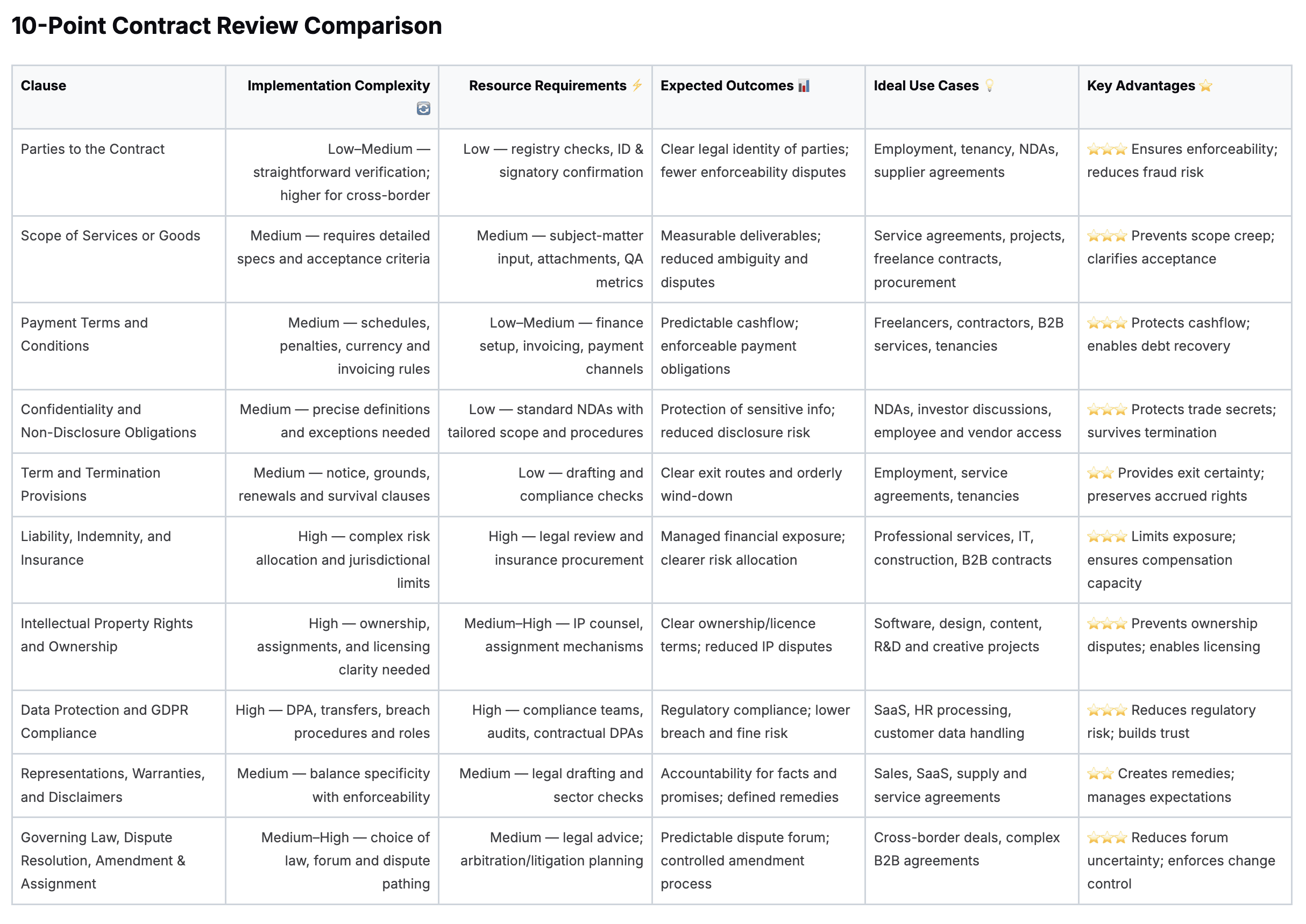
Create Professionally Reviewed Contracts in Seconds Here!
From Checklist to Confidence: Your Next Steps
You've just navigated the intricate world of legal documents, armed with a comprehensive contract review checklist. This journey through ten critical clauses, from identifying the parties involved to clarifying the final governing law, has demystified the process. The purpose was never to transform you into a solicitor overnight. Instead, the goal is to equip you with the knowledge and structure needed to approach any agreement not with apprehension, but with analytical confidence.
This guide has provided a methodical framework. By systematically checking each point, you can turn a dense, intimidating document into a series of clear, answerable questions. You now understand the importance of scrutinising payment terms, the long-term implications of intellectual property clauses, and the protective necessity of well-defined liability limits. This isn't just about avoiding bad deals; it's about making good deals even better. You are now better prepared to spot ambiguities, question one-sided terms, and negotiate for clauses that protect your interests, whether you're a freelancer, a small business owner, or an individual entering into a personal agreement.
Key Takeaways: From Knowledge to Action
Mastering your contract review process is a significant step towards professional and personal security. Moving forward, embed this checklist into your standard operating procedures. Don't treat it as a one-off exercise.
Here are the most important takeaways to put into practice immediately:
- Never Skim, Always Scrutinise: The most dangerous assumption is that a contract is "standard". Your detailed review is your first and most effective line of defence. Pay special attention to Term and Termination, Liability, and Payment Terms, as these areas often contain the highest financial and operational risks.
- Context is King: The importance of each clause shifts with the nature of the agreement. For a software development contract, the Intellectual Property section is paramount. For a tenancy agreement, the Term and Termination and maintenance clauses demand the closest inspection. Always adapt your focus to the specific context of the deal.
- Documentation is Your Ally: If you negotiate a change, no matter how small, ensure it is reflected in the final written agreement. A verbal promise or an email confirmation is not a substitute for an amended clause. The "Entire Agreement" clause, as we discussed, explicitly invalidates any such external discussions.
- Embrace the Power of "Why?": The most powerful negotiation tool is a simple question. If a clause seems unclear, unfair, or unusual, ask "Why is this included?" This can open a dialogue, reveal the other party's intentions, and create an opportunity to propose a more balanced alternative.
Your Path to Contracting with Certainty
The true value of this contract review checklist lies in its consistent application. Make it a habit. For simple, low-stakes contracts, this methodical approach may be all you require to proceed with a clear understanding of your commitments. You can sign with the assurance that you've done your due diligence.
However, as the complexity, value, or risk of an agreement increases, so does the need for expert validation. High-stakes business partnerships, significant financial transactions, or contracts with unconventional clauses often contain nuances that a non-lawyer might miss. In these situations, relying solely on a checklist introduces a level of risk that could have severe consequences.
This is where a hybrid approach provides the optimal solution. By combining your own informed review with professional oversight, you get the best of both worlds: you remain in control and knowledgeable about your agreements, while a legal expert provides the final layer of protection and nuanced insight. This dual strategy is the gold standard for securing your interests and ensuring that your contracts are not just legally sound, but also strategically advantageous. Your diligence, paired with expert reinforcement, is the pathway to signing every document with absolute confidence.
Ready to move from checklist to certainty on your most important agreements? Robot Lawyer offers AI-powered document creation and analysis, backed by verification from a qualified legal professional, giving you speed, affordability, and peace of mind. Visit Robot Lawyer to see how our services can provide the expert reinforcement you need to sign with confidence.