

What to Include in a Will: Your 9-Point Checklist for 2026
Creating a last will and testament can feel like a monumental task, but it is one of the most crucial steps you can take to protect your loved ones and secure your legacy. Many people know a will distributes assets, but what to include in a will to make it truly effective and legally sound in the UK? A thorough document does more than just name heirs; it provides a clear roadmap for your executor, minimises potential family disputes, and ultimately reflects your values.
Neglecting key details can lead to legal complications, unintended consequences, and significant emotional and financial strain on your family during an already difficult time. This is why a simple declaration of who gets what is often not enough. Your will needs to account for modern assets, potential life changes, and the practical realities of settling an estate.
In this guide, we will go beyond surface-level advice and break down the essential components your will needs to be robust. We will cover everything from the fundamental tasks, like appointing the right people, to often-overlooked details, such as managing your digital footprint and providing for pets. This checklist will empower you to create a document that provides complete peace of mind. We will explore each element with practical examples, common pitfalls to avoid, and actionable steps you can take today, ensuring every aspect of your estate is handled exactly as you intend.
1. Executor Appointment
The first and arguably most foundational decision when determining what to include in a will is appointing your executor. This individual or entity will be legally responsible for carrying out your final wishes. Their role is to administer your estate, which involves everything from gathering your assets and paying off any outstanding debts to filing tax returns and distributing the remaining property to your beneficiaries as you’ve directed.
An executor’s duties are significant and carry a fiduciary responsibility, meaning they must act in the best interests of the estate and its beneficiaries. Without a nominated executor, the court will appoint an administrator, a choice that may not reflect your preferences and can cause delays and additional stress for your loved ones.
Who Should You Choose?
Selecting the right executor is critical for a smooth probate process. Your choice should be someone you trust implicitly, who is organised, and has a good head for finances and paperwork.
- Family Member or Friend: A common choice is a spouse, adult child, or a trusted sibling. They know you well but may find the role emotionally challenging.
- Professional Executor: For complex estates involving business assets, overseas property, or potential family disputes, appointing a solicitor, accountant, or a professional trust company can be a wise move. Their expertise ensures neutrality and efficient administration, though they will charge a fee for their services.
- A Combination: You can also appoint more than one executor to act jointly, such as a family member alongside a professional, to balance personal insight with expert knowledge.
Key Takeaway: Always discuss the role with your potential executor before naming them in your will. You must ensure they are willing and able to take on this significant responsibility. It is also crucial to name a substitute executor in case your first choice is unable or unwilling to act. Robot Lawyer's guided questionnaire simplifies this process, helping you clearly document your primary and alternate executor choices.
2. Asset Distribution and Beneficiary Designation
After appointing your executor, the next essential component determining what to include in a will is the clear designation of your beneficiaries and the distribution of your assets. This section forms the core purpose of your will, specifying precisely who receives what from your estate. This includes everything from real property and financial accounts to personal possessions and business interests.
Clearly defining your beneficiaries and their entitlements is fundamental to ensuring your wishes are honoured. Ambiguity can lead to disputes among loved ones, costly legal challenges, and significant delays in the probate process. A well-drafted will leaves no room for interpretation, providing your executor with a precise roadmap for distributing your legacy.
How Should You Distribute Your Assets?
The way you structure your asset distribution should reflect your unique family circumstances and financial situation. You have complete flexibility in how you divide your estate, but clarity is paramount.
- Specific Bequests: You can leave a specific item or a set amount of money to a particular person or organisation. For example, leaving a classic car to a sibling or a £5,000 gift to a favourite charity.
- Percentage-Based Distribution: A common approach is to divide the entire estate (or what remains after specific bequests) by percentages. For instance, leaving 40% to your spouse and 20% to each of your three children ensures a fair split, regardless of the estate's final value.
- Conditional Gifts: You might create a trust that distributes funds to a grandchild only upon reaching a certain age or graduating from university. This allows you to support their future while providing a degree of control.
Key Takeaway: Be meticulously specific. Instead of "my investment portfolio," specify the account numbers and financial institutions. When gifting personal items, describe them in detail to avoid confusion. Reviewing and updating your beneficiary designations after major life events, such as a marriage, divorce, or birth, is also crucial. Robot Lawyer's guided questionnaire helps you itemise and clearly assign all significant assets, ensuring your instructions are unambiguous.
3. Guardianship Designation for Minor Children
For parents of children under 18, naming a guardian is often the most critical reason for creating a will. This designation determines who will have legal custody and responsibility for raising your children if you (and any other person with parental responsibility) were to pass away. It grants them the authority to make vital decisions about your children's health, education, and general well-being.

Create a Will Here!
This is one of the most personal and impactful decisions you will make, directly shaping your children's future. Without a formally appointed guardian in your will, the courts will be forced to make this decision on your behalf. This can lead to a prolonged and stressful process, with a result that may not align with your wishes or your children's best interests.
Who Should You Choose?
Selecting the right guardian is a decision that requires careful thought and open communication. You are choosing the person who will step into your role as a parent, so the choice must be based on deep trust and shared values.
- Family Member or Close Friend: A sibling, a cousin, or a best friend are common choices. Consider who shares your parenting philosophy, has a stable home life, and possesses the emotional and financial capacity to take on the role.
- Splitting Roles: It is possible to appoint a personal guardian (responsible for day-to-day care and upbringing) and a separate property guardian or trustee (responsible for managing the child's inheritance). This can be a practical solution, placing a trusted family member in the caring role and a financially astute person, like an accountant or grandparent, in charge of the finances.
- Successor Guardians: Always name a backup. Your first choice may be unable or unwilling to serve when the time comes, so appointing a successor guardian ensures your children are still cared for by someone you have chosen.
Key Takeaway: You must have an honest and detailed conversation with your potential guardians before naming them in your will. Ensure they understand what the role entails and are genuinely willing to accept the responsibility. Documenting your parenting philosophy and your children's needs in a separate letter of wishes can provide invaluable guidance for them.
4. Digital Assets and Online Accounts
A crucial and often-overlooked element of what to include in a will is the management of your digital assets. These include everything from social media profiles and email accounts to cryptocurrency holdings, cloud storage, domain names, and online banking details. These intangible assets can hold immense financial and sentimental value, yet without clear instructions, they can be lost forever, locked away, or even misused after you're gone.

Create a Will Here!
Failing to address your digital legacy can create significant hurdles for your executor, who may struggle to access, manage, or close your accounts. This can complicate the administration of your estate and cause distress for your family, who might be unable to retrieve precious digital photos or manage your online presence.
What Should You Document?
Creating a plan for your digital footprint ensures a smooth transition and protects your legacy. Your instructions should cover both the practical and the personal.
- Financial and Business Assets: This includes cryptocurrency wallets (and access keys), online investment platform logins, websites or blogs that generate income, and domain names. An entrepreneur might leave instructions for their business website to be transferred to an heir or sold.
- Personal and Sentimental Assets: Document your cloud storage accounts containing family photos and videos, social media profiles, and email accounts. You can specify whether a social media account should be memorialised, its content downloaded, or deleted entirely.
- A "Digital Executor": While not a formal legal role in the UK, you can name a person in your will who is tech-savvy and trusted to help your main executor manage this specific task. This could be a younger family member or a friend who understands the platforms you use.
5. Guardianship for Pets
For many, pets are cherished family members, and considering what to include in a will should extend to their future wellbeing. A pet guardianship clause formally designates a caregiver for your animals if you pass away. This ensures your beloved companions are looked after by someone you trust, rather than being surrendered to a shelter or left in an uncertain situation.
This part of your will is vital for providing continuity of care. Without explicit instructions, your executor may not know your wishes, and your pets could face a stressful and unsettling future. Legally, pets are considered property in the UK, so clearly stating who should inherit them, and under what terms, is the only way to guarantee they receive the care you intend.
Who Should You Choose?
Selecting a guardian for your pet requires careful thought. The ideal person is not just an animal lover but is also in a position to take on the responsibility. Your choice should be someone whose lifestyle and home environment are suitable for your pet's needs.
- Family Member or Friend: A common and often ideal choice, as they may already have a bond with your pet. Ensure they have the space, time, and financial stability to provide proper care.
- Animal Charity or Sanctuary: Some organisations, like The Cinnamon Trust or the RSPCA's Home for Life scheme, offer services to care for pets after an owner's death. This can be an excellent backup plan or primary choice if you have no suitable individuals.
- A Pet Trust: For more complex situations, such as multiple pets, long-lived animals like parrots, or those with significant medical needs, you can establish a pet trust. This formal legal arrangement sets aside funds managed by a trustee specifically for your pet's care, ensuring financial resources are available throughout their life.
Key Takeaway: Always have an open conversation with your chosen pet guardian before naming them in your will. You need their explicit agreement. It is also wise to provide a separate, detailed document with your pet’s care plan, including diet, medical history, vet details, and behavioural quirks. Robot Lawyer’s platform can guide you in adding these crucial provisions to your will, ensuring you name both a primary and a successor guardian.
6. Debt and Liability Clearance Instructions
A critical element when considering what to include in a will is providing clear instructions for settling your debts and liabilities. Before any assets can be passed to your beneficiaries, your executor must legally settle all outstanding financial obligations, including mortgages, loans, credit card balances, and final expenses. Explicit instructions in your will prevent confusion and ensure your estate is administered efficiently.
Without this guidance, your executor might struggle to determine which assets should be sold to raise funds, potentially leading to the liquidation of a property you intended for a loved one. Clearly outlining your wishes protects your beneficiaries and ensures that creditors are paid according to legal requirements, preventing delays in the probate process and potential disputes.
How Should Debts Be Settled?
Specifying your debt settlement strategy provides your executor with a clear roadmap. This ensures that liabilities are managed in a way that aligns with your overall intentions for your estate.
- From the Residuary Estate: The most common approach is to direct that all debts and expenses be paid from the residuary estate, which is everything left after specific gifts have been distributed.
- From a Specific Fund: You can earmark a particular asset, such as a savings account or investment portfolio, specifically for settling debts. This can protect other assets from being sold.
- Life Insurance Proceeds: A life insurance policy can be an effective tool to provide the necessary liquidity to cover a large mortgage or significant business debts, allowing a property or company to be passed on free and clear.
- Property-Specific Debts: You can state that a property is passed to a beneficiary "subject to" its mortgage, meaning the beneficiary inherits both the asset and the responsibility for the associated debt.
Key Takeaway: Your will should explicitly state how your debts, funeral expenses, and taxes should be paid. Organising your financial records and creating a clear list of all liabilities will make your executor's job significantly easier. Robot Lawyer's guided questionnaire helps you document your financial obligations and specify which assets should be used for repayment, ensuring your instructions are clearly recorded.
7. Specific Instructions and Personal Wishes
Beyond the legal framework of distributing assets, an essential part of determining what to include in a will involves documenting your specific instructions and personal wishes. While a will is a formal legal document, it can also serve as a final message to your loved ones, providing guidance on matters that extend beyond finances. These instructions can cover everything from your desired funeral arrangements to expressing personal values and sentiments.

Create a Will Here!
While many of these personal wishes may not be legally binding in the same way as an asset distribution clause, they provide invaluable direction for your executor and comfort for your family. Including them ensures your final farewell reflects your personality and values, helping to prevent disputes or uncertainty among grieving relatives.
What Should You Include?
This is your opportunity to add a personal touch and provide clarity on non-financial matters. It transforms the will from a purely administrative document into a true reflection of your life.
- Funeral and Burial Preferences: Specify whether you prefer burial or cremation, the type of service you’d like (religious, secular, a celebration of life), and even details like music or readings. Setting a cost limit can also guide your executor.
- Organ Donation: Clearly state your wishes regarding organ and tissue donation. While you should be a registered donor, including it in your will reinforces your decision for your family.
- Personal Letters: A 'letter of wishes' can be written separately and stored with your will. You can write individual letters to your children, spouse, or other beneficiaries to explain your decisions, share life lessons, express love, or pass on family memories.
- Care for Pets: Although a formal pet trust is the most secure method, you can express your wishes for who should care for your pets and provide information on their routines and needs.
Key Takeaway: Separate legally binding instructions from personal preferences to avoid confusion. Personal letters should be written in your authentic voice to provide emotional closure and prevent misunderstandings, especially if your will contains unequal distributions. You can update these personal instructions at any time without formally altering your will, though if you make a significant change to a related legal clause, a codicil to amend your will may be necessary. Robot Lawyer's platform allows you to clearly document these preferences alongside the legal components of your will.
8. Trust Provisions and Property Protection
For those with more complex family situations or significant assets, deciding what to include in a will goes beyond simple bequests. Incorporating trust provisions establishes a legal framework to manage and distribute your assets according to specific rules, offering far greater control and protection than a direct inheritance. These provisions allow you to dictate how and when beneficiaries receive their inheritance, safeguarding it from creditors, divorce, or irresponsible spending.
A trust created through your will is known as a testamentary trust, which only becomes active after your death. This legal structure appoints a trustee to manage the assets on behalf of the beneficiaries. It is an effective tool for protecting vulnerable beneficiaries, minimising tax liabilities, and ensuring your wealth is managed wisely for generations to come.
When Should You Consider a Trust?
Establishing a trust is a strategic decision that provides solutions for many common estate planning challenges. It offers peace of mind that your assets will be used exactly as you intend, long after you are gone.
- Minor Children: Instead of a minor inheriting a large sum outright at 18, a trust can release funds in stages, for example, for university fees, a house deposit, or upon reaching a more mature age like 25.
- Beneficiaries with Special Needs: A specially designed trust can provide for a beneficiary with disabilities without jeopardising their eligibility for government benefits.
- Spendthrift Beneficiaries: If you are concerned a beneficiary might squander their inheritance, a spendthrift trust allows a trustee to manage the funds and make distributions for their benefit, protecting the principal sum.
- Complex Assets or Tax Planning: Trusts are invaluable for managing business assets or properties, and they can be structured to minimise inheritance tax for your estate.
Key Takeaway: A trust requires the careful selection of a trustee, who has a fiduciary duty to manage the assets prudently and in line with your instructions. This could be a trusted relative, a professional such as a solicitor, or a corporate trustee. For those considering this route, you can learn more about setting up a trust and how it compares to provisions within a will. Clearly defining the trust’s purpose and distribution rules is essential for it to function correctly.
9. Power of Attorney and Healthcare Decisions
While a will addresses your affairs after you die, a crucial part of estate planning involves preparing for a time when you might be alive but unable to make decisions for yourself. Considering what to include in a will often brings to mind these essential companion documents: a Lasting Power of Attorney (LPA) and an Advance Decision. These legal instruments ensure your wishes are followed for financial and medical matters during your lifetime if you lose mental capacity.
These documents are not part of your will itself, but are prepared alongside it to create a complete plan. A Lasting Power of Attorney appoints someone you trust (an ‘attorney’) to make decisions on your behalf. An Advance Decision (sometimes called a living will) lets you refuse specific medical treatments in the future. Without these, your loved ones may have to apply to the Court of Protection to make decisions for you, a process that can be costly, slow, and stressful.
What Documents Should You Prepare?
Creating these documents ensures your personal autonomy is respected even when you cannot voice your preferences. There are two main types of LPA in the UK, plus the Advance Decision.
- Property and Financial Affairs LPA: This allows your chosen attorney to manage your finances, such as paying bills, collecting benefits, or selling your home. You can decide if it takes effect immediately or only once you have lost capacity.
- Health and Welfare LPA: This gives your attorney the power to make decisions about your daily routine, medical care, and life-sustaining treatment. This type of LPA can only be used once you are unable to make your own decisions.
- Advance Decision to Refuse Treatment: This is a separate, legally binding document that specifies medical treatments you wish to refuse in certain circumstances. It is distinct from a Health and Welfare LPA but can work alongside it.
Key Takeaway: Powers of Attorney and Advance Decisions are about protecting your interests while you are still alive. Discuss your wishes in detail with the people you appoint to ensure they understand their responsibilities and your values. It's vital to have them legally documented. For guidance on setting up these protections, you can learn more about Lasting Power of Attorney and how Robot Lawyer can help generate the necessary documents.
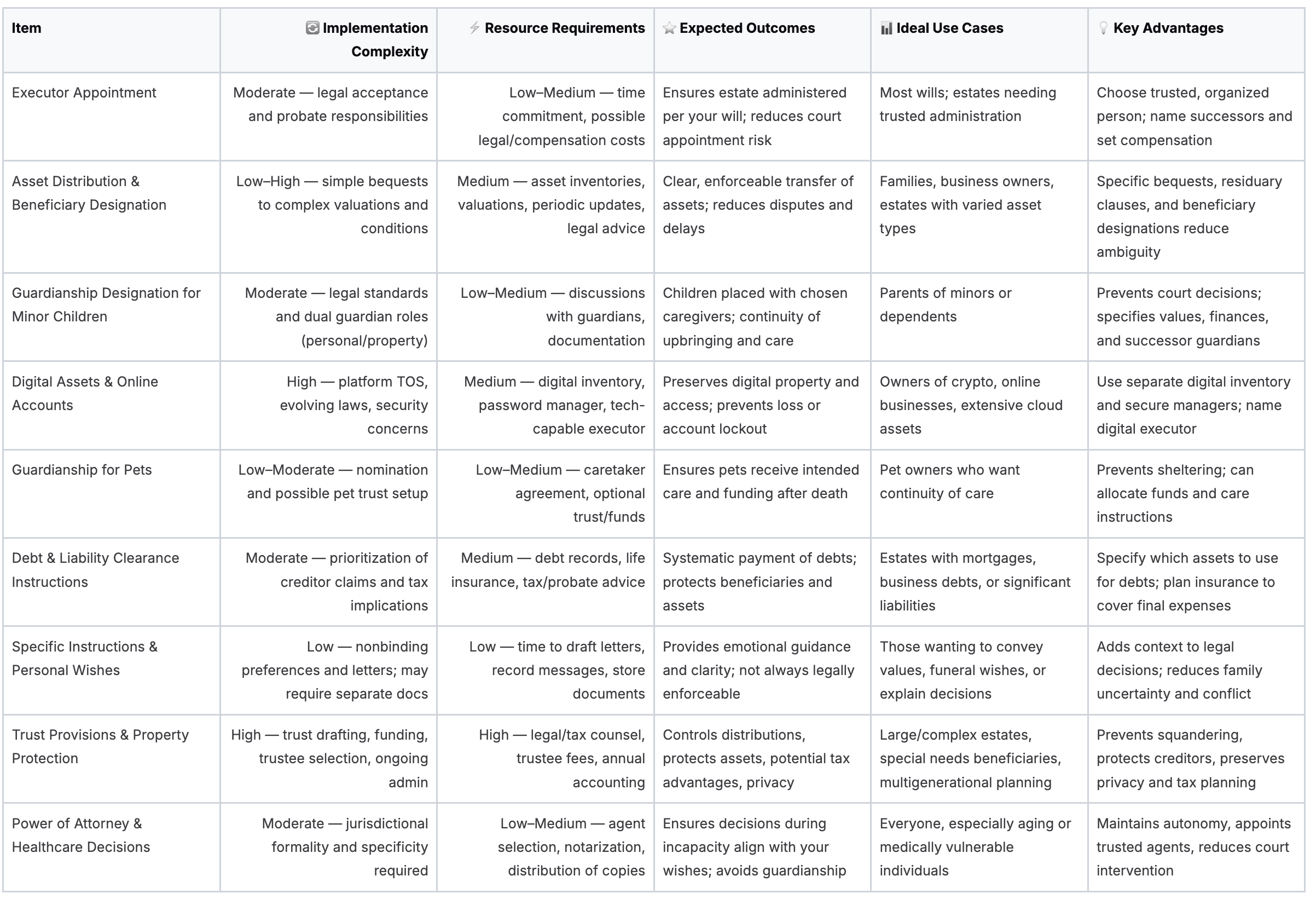
9-Item Will Content Comparison
Create a Will Here!
Finalising Your Will: From Document to Done
You have now journeyed through the essential landscape of estate planning, exploring the critical elements of what to include in a will. From the practical appointment of an executor to the deeply personal designation of guardians for your children, each component serves as a building block for a secure future for your loved ones. We have covered the foundations: distributing your assets, managing digital legacies, and even providing for your pets.
However, understanding these components is only half the battle. A will is not merely a document of intentions; it is a legally binding instruction set. The final, and arguably most crucial, stage is formalisation. Without this, your carefully considered wishes may hold no legal weight, leaving your estate vulnerable to the default, often impersonal, rules of intestacy.
Turning Intentions into Ironclad Instructions
The process of finalising your will is a precise ceremony governed by law. In the UK, this involves more than just a simple signature. Your will must be signed in the presence of two independent witnesses.
- Who can be a witness? Your witnesses must be over 18 and of sound mind. Critically, they (and their spouses or civil partners) cannot be beneficiaries of the will. If a beneficiary witnesses your will, they will lose their inheritance.
- The Signing Process: You must sign the will, or acknowledge your signature, in the presence of both witnesses, who are both present at the same time. They must then each sign the will in your presence. This specific sequence is vital for the will's validity.
Key Insight: The witnessing process is not a mere formality; it is a legal safeguard designed to prevent fraud and undue influence. A mistake at this stage can invalidate the entire document, undoing all your careful planning.
Once signed and witnessed correctly, the document's physical safety becomes paramount. Your original will should be stored in a place that is both secure from damage (fire, flood) and accessible to your executor when the time comes. Common options include a fireproof safe at home, a secure document storage service, or lodging it with your solicitor or the Probate Service. Remember to inform your executor of its location; a will that cannot be found is of no use.
The Living Document: Why Your Will Needs Regular Reviews
Completing your will should not be a 'one-and-done' task. Your life is dynamic, and your will should reflect its evolution. It is wise to review your will every three to five years to ensure it still aligns with your wishes and circumstances.
More importantly, certain life events should trigger an immediate review:
- Marriage or Civil Partnership: In England and Wales, getting married or entering a civil partnership automatically revokes any existing will, unless it was made with the marriage specifically in mind.
- Divorce or Dissolution: While divorce does not revoke a will, it does treat your ex-spouse as if they had died, meaning any gift to them will fail. This may not be your intention and can lead to unintended consequences for the rest of your estate.
- New Additions: The birth of a child or grandchild may require you to update guardianship clauses or beneficiary designations.
- Significant Financial Changes: A major inheritance, the sale of a business, or the purchase of a new property can all impact the structure of your estate and how you wish to distribute it.
By treating your will as a living document, you ensure it remains a true and accurate reflection of your legacy, providing clarity and protection no matter how your life changes. It is the final act of care for those you leave behind, transforming a piece of paper into a powerful tool of protection and peace of mind.
Ready to create a will that covers all these crucial points with confidence? Robot Lawyer offers an intelligent, user-friendly platform that guides you through every step, from appointing executors to handling digital assets. Our system helps you build a legally sound Last Will and Testament tailored to your unique circumstances, and for complete assurance, our Premium plan includes verification by a qualified legal professional.
Secure your legacy with Robot Lawyer today.