
What Is a Will and Why Do You Absolutely Need One in 2026
A will is a legal document that sets out your final wishes, detailing how your money, property, and possessions—what’s known as your estate—should be shared out after you’re gone. Think of it as your personal instruction manual for the future, making sure your life's work is handled exactly as you’d want.
Your Will Is Your Voice: What Is a Will, Explained Simply

Create a free Will & Testament Here!
Picture your home, your savings, even those treasured family heirlooms. Without clear instructions from you, what happens to them when you’re no longer around? Answering that question is what a will is all about. It’s so much more than a dry legal form; a will is your personal script, giving you the final say over your legacy.
It’s probably the most important set of directions you will ever write. Getting it down on paper provides incredible peace of mind, protecting both your assets and your loved ones from a future filled with uncertainty.
Understanding the Key Players
To really get what a will does, it helps to know the main people involved. These are the individuals you’ll be trusting to carry out your plan.
- Testator: This is just the legal term for you—the person making the will.
- Executor: This is the person or institution you choose to be in charge of your estate. It’s their job to follow your instructions, pay off any outstanding debts, and make sure your assets get to the right people.
By picking an executor, you’re appointing someone you trust to manage everything, rather than leaving that huge responsibility to a court-appointed administrator who doesn’t know you or your family.
More Than Just a Document
Despite how crucial it is, a shocking number of people in the UK haven’t put a plan in place. In fact, only 37% of adults currently have a will. This means a staggering 63% are at risk of leaving their estate to be dealt with by rigid intestacy laws, which often don't reflect what they would have wanted at all.
For those who do make a will, the reason is simple: 70% are motivated by the desire to have their estate distributed precisely as they see fit. You can dig into more of these trends in the National Wills Report 2024 from Boxlegal.co.uk.
A will is not an admission of mortality; it is an act of profound care for those you leave behind. It transforms ambiguity into clarity, ensuring your final wishes are honoured and your loved ones are secure.
The Core Components Inside Every UK Will
Thinking about what actually goes into a will can feel a bit overwhelming, but it’s much more straightforward when you break it down into its essential parts. A will isn't just one single instruction; it’s a collection of crucial decisions that all work together to make sure your wishes are followed and your legacy is protected.
Getting to grips with these components is the first step toward crafting a document that genuinely reflects what you want. At its core, a will is all about clearly stating who’s in charge and who gets what. These aren't just minor details—they’re the legal pillars that give your will its power.
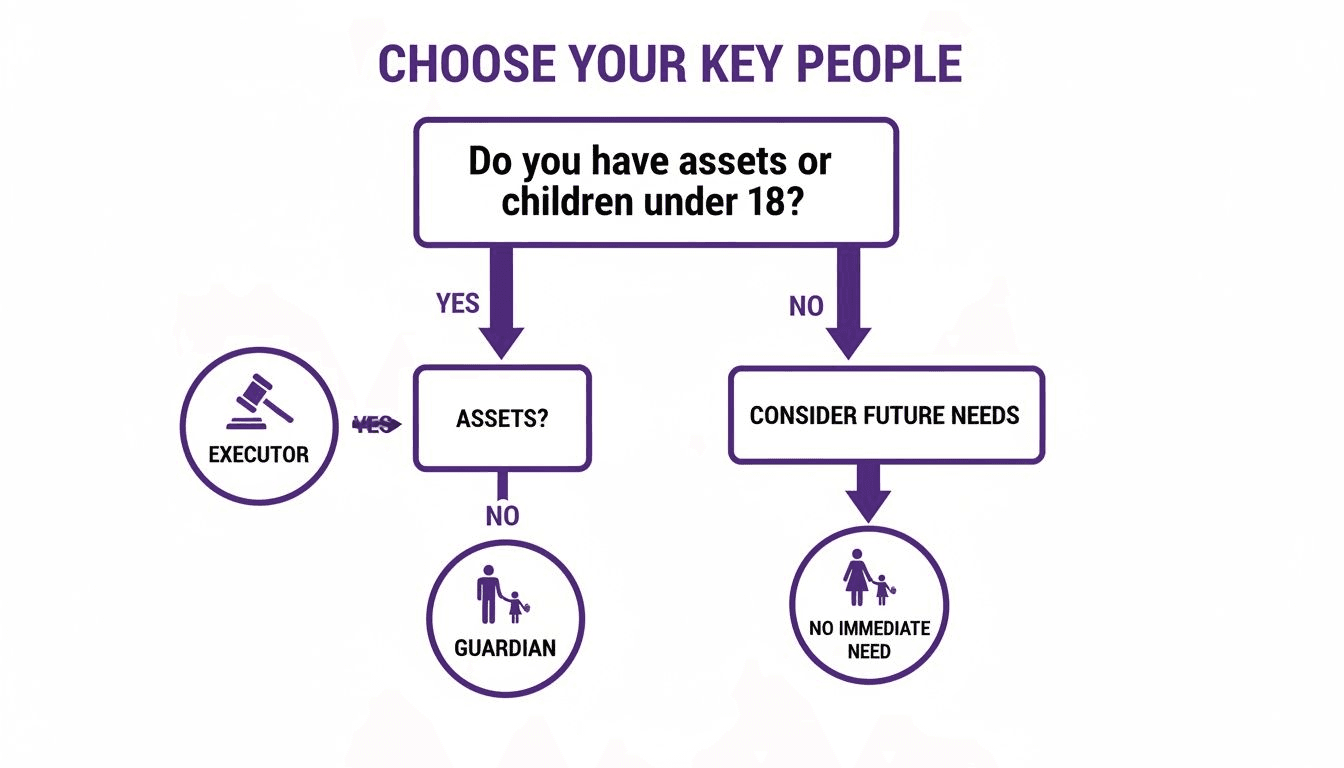
Assigning Your Key People
Your first major task is to appoint the people who will have critical roles to play after you're gone. These individuals are legally responsible for carrying out your instructions, so it's vital you choose them with care.
- The Executor: This is the person (or people) you nominate to manage your estate. Their job covers everything from tracking down all your assets and paying off any outstanding debts to distributing whatever is left to your beneficiaries. Your executor is your trusted representative, so you need to pick someone who is organised, trustworthy, and up to the task.
- Guardians for Children: If you have children under 18, this is arguably the single most important decision you will make. Appointing a guardian in your will is the only way to legally state who you want to raise your children if you pass away. Without this in place, that decision could be left up to the courts.
These appointments aren't just suggestions; they are legally binding instructions. Your will also contains other elements that will guide your executor and your family.
Your will is your opportunity to nominate the right people for the most important jobs—managing your estate and caring for your children. These aren't just suggestions; they are legally recognised appointments that provide essential structure and security when your family needs it most.
Outlining Your Gifts and Wishes
Once you've chosen your key people, the next step is to spell out exactly how you want your assets distributed. This is where you specify who gets your property, money, and personal belongings.
It's very common to give specific gifts, which are known as legacies. These can be a fixed amount of money (a pecuniary legacy) or a particular item, like a piece of jewellery or a car (a specific legacy).
After all the specific gifts, debts, and taxes have been taken care of, whatever is left over is called the residue of your estate. Your will must state who is to receive this residue, often specified in percentages. This ensures every last bit of your property is accounted for.
While it’s also common to include your wishes for your funeral, it’s important to know these are not legally binding, but they do offer helpful guidance for your family. Decisions about your health and care while you're still alive are handled differently—you can learn more about this by reading our guide on a Lasting Power of Attorney.
Choosing the Right Type of Will for Your Life
Create a free Will & Testament Here!
There’s no such thing as a one-size-fits-all will. The right document for you is one that reflects your unique life, family, and finances. Choosing the correct type is the only way to make sure your instructions are clear, legally watertight, and achieve exactly what you want them to.
Think of it this way: you wouldn’t use a city runaround for a cross-country family holiday. You’d need something bigger, more robust. Your will is no different. It has to be suited to the complexity of your personal journey. What works for a single person just starting out will be very different from the needs of a couple with young children or a blended family.
Simple Wills for Straightforward Estates
The most common starting point is the Simple Will. It's designed for people with a clear and uncomplicated vision for what happens after they're gone. It lets you name your executor, state who gets your assets, and appoint guardians for any children under 18.
A Simple Will is often the perfect fit for:
- Single individuals without complex financial assets.
- Young professionals who want to ensure their savings go to specific people or charities.
- Anyone whose wishes are direct, like leaving everything to one or two beneficiaries.
For instance, a young freelancer could use a Simple Will to leave their business equipment to a sibling and their savings to their parents. It’s a clean and effective way to put your wishes in writing without getting bogged down in legal complexities.
Mirror Wills for Couples
For couples, Mirror Wills are an extremely popular and practical choice. These are two separate but almost identical wills, where each partner leaves their estate to the other. If the worst should happen and both partners pass away together, the wills then direct the assets to the children or other chosen beneficiaries.
They’re called “mirror” because they reflect each other's intentions. It’s important to realise, though, that a Mirror Will doesn’t legally bind the surviving partner. Once the first person passes away, the survivor is completely free to update or change their will.
Mirror Wills create a brilliant, unified plan for a couple's estate, giving the surviving partner security and clarity. But they do rely on mutual trust, as the survivor can alter their own will at any time after their partner’s death.
Living Wills and Testamentary Trusts
Beyond these common types, you’ll find documents designed for more specific situations. A Living Will, known officially in the UK as an Advance Decision, has nothing to do with property. Instead, it’s a powerful document that outlines your wishes for future medical treatment if you ever become unable to communicate them yourself.
For more complicated estates, you can build a Testamentary Trust into your will. This sets up a trust managed by a trustee on behalf of your beneficiaries. It gives you far greater control and protection, which is incredibly useful if you want to provide for:
- Young children who aren't old enough to manage a large inheritance.
- Beneficiaries with disabilities, without jeopardising their eligibility for state benefits.
- A partner from a previous relationship, while making sure your own children are the ultimate beneficiaries.
To help you decide, let's break down these common options in a quick comparison.
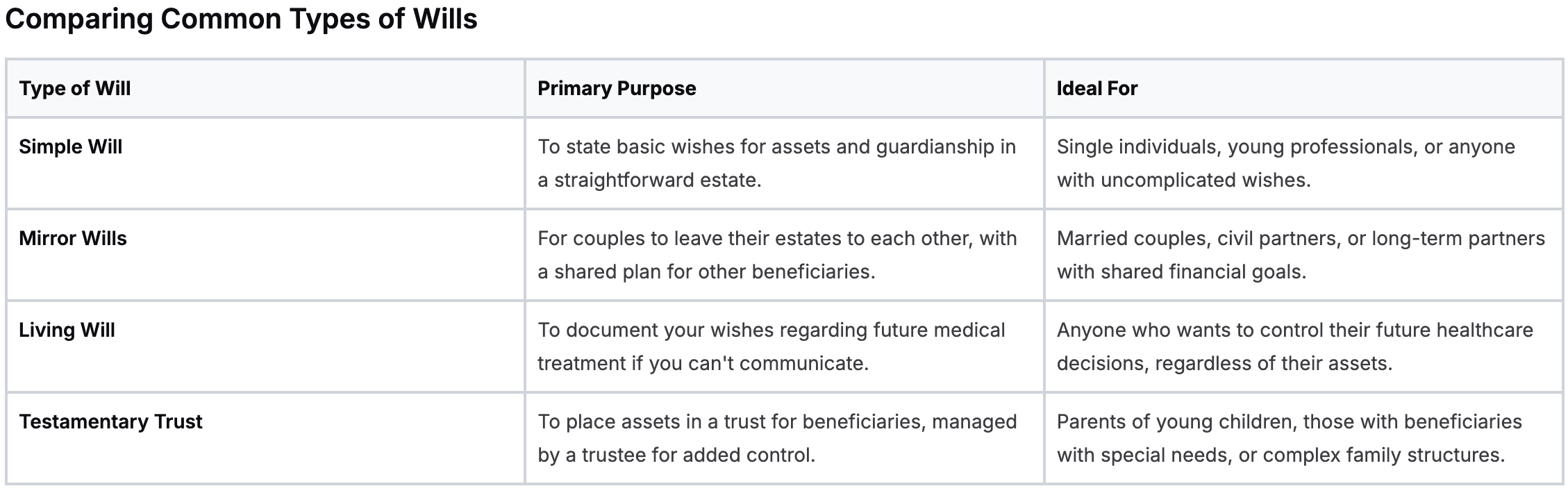
Each of these serves a distinct purpose, and for those thinking about more advanced estate planning, it pays to understand the details of structures like a living trust and the extra layers of protection they can offer.
The Reality of Dying Without a Will in the UK

Create a free Will & Testament Here!
When someone passes away in the UK without a valid will, they’re legally considered to have died intestate. This doesn’t make their money and property disappear. Instead, it means they've lost all say in who gets what. The government then applies a rigid, impersonal set of instructions called the Rules of Intestacy.
Think of these rules as a strict, one-size-fits-all formula for distributing your life's work. They don't care about your unique relationships, your spoken promises, or who you truly wanted to look after. The law simply carves up your estate based on a predetermined family tree.
The Strict Rules of Intestacy
The outcomes of the intestacy rules can be genuinely shocking and often go against what most people would expect. The way your assets are divided depends entirely on which family members survive you.
A common and painful misconception, for example, is that a long-term partner will be automatically taken care of. That couldn’t be further from the truth.
- Unmarried Partners: Under intestacy law, an unmarried partner is entitled to absolutely nothing. It makes no difference if you’ve shared a home for 30 years or have children together. Legally, they have no claim.
- Married or Civil Partners: If you're married and have children, your spouse or civil partner will inherit the first £322,000 of your estate, plus half of everything that remains. The other half is then split equally among your children.
This inflexible formula can cause huge financial hardship and emotional pain, especially for partners who thought their future was secure.
Dying intestate means giving up your voice. The law steps in with a cold, detached formula that can leave the people you love most—like an unmarried partner—out in the cold with nothing. Your will is the only way to override this default setting.
Real-World Consequences
The fallout from dying intestate is about more than just who gets the money. The entire process can become a source of immense stress for your family, frequently leading to frustrating delays and piling up legal costs. Without an executor named in a will, your family has to apply to the court to be appointed as an 'administrator', adding another layer of bureaucracy to an already difficult time.
Although a recent UK consumer report found that will ownership has crept past 40% for the first time, that still leaves more than half of adults without one. The research also shows that while most people find the probate process straightforward, nearly a quarter face delays—a problem often made much worse when there's no clear will to follow. You can read more about the latest trends in will and probate consumer research here.
Ultimately, not having a will doesn't just complicate your finances. It forces the people you leave behind to navigate a complex legal maze while they are still grieving.
Common Will Writing Mistakes and How to Avoid Them
Creating a will is one of the most thoughtful things you can do for your family. But simple, easy-to-make mistakes can unravel your best intentions, leading to the will being declared invalid or even sparking bitter family disputes.
Knowing what these common pitfalls are is the first step to making sure your will is solid and legally sound.
One of the most frequent—and critical—errors is improper execution. For a will to be legally valid in the UK, you (the testator) must sign it in the presence of two witnesses. They must then also sign it in your presence. Crucially, these witnesses can't be beneficiaries in the will, nor can they be married to a beneficiary. A slip-up here can make the entire document worthless.
Ambiguous language is another major headache. Using vague phrases like "leave a fair share to my children" or "give my most valuable items to my brother" is a recipe for disaster. This kind of wording creates confusion and can easily lead to costly legal battles. Your will needs to be precise, clearly identifying who gets what.
Keeping Your Will Current and Contest-Proof
Think of a will as a living document, not a "set it and forget it" task. A huge mistake is failing to update it after major life events. Getting married, for instance, automatically cancels any will you already have, unless it was specifically written in contemplation of that marriage.
Other key moments to update your will include:
- The birth of a child or grandchild.
- Getting divorced or separating from a partner.
- The death of an executor or beneficiary you've named.
- A significant change in your finances, like buying a house.
Forgetting these updates means your will might not reflect what you want or who's in your life anymore, which can lead to some truly unintended consequences. Imagine an ex-spouse inheriting assets you had earmarked for your children.
Failing to appoint a backup executor is another common oversight. If your chosen executor is unable or unwilling to act, and you haven't named an alternative, the court will have to step in to appoint an administrator, causing delays and added stress for your loved ones.
The Rising Tide of Will Disputes
The need for a properly prepared will has never been more critical. Recent data shows a sharp increase in will-related legal challenges across the UK, with probate challenges surging by 56% over five years. Applications to block probate jumped from 7,268 in 2019 to a worrying 11,362 in 2024.
While 43% of people with wills used a solicitor, DIY kits come with a high risk of being invalidated. To make matters worse, nearly 30% of people haven't even told their family where their will is stored. You can discover more about how to protect your family with these UK contested will statistics.
These figures highlight just how important it is to not only make a will, but to get it right and ensure it can be found when needed.
How to Create Your Will in Minutes

Feeling ready to get your affairs in order? The great news is that creating a will isn't the stuffy, time-consuming affair it used to be. You no longer need to schedule expensive appointments weeks in advance. Thanks to modern online platforms, what once took an age can now be sorted in just a few minutes, right from your own home.
The path from thinking about your will to holding a finalised, legally sound document has never been more straightforward. With services like Robot Lawyer, the entire process kicks off with a simple, intuitive questionnaire. Think of it as a guided conversation, where our system asks you plain-English questions to understand your exact situation and what you want to happen.
From Questionnaire to Completed Will
This isn't about wrestling with a confusing, one-size-fits-all template. Instead, the questionnaire is smart—it adapts based on your answers, ensuring every important detail is captured without ever feeling overwhelming.
- It helps you list your assets and decide exactly how they should be distributed.
- It walks you through the crucial steps of appointing executors and guardians.
- It lets you specify any particular gifts and clarifies who will inherit the remainder of your estate.
As soon as you’ve answered the questions, the platform instantly generates a customised document tailored to you. This completely removes the guesswork and the legal jargon, making it easy to create a will that truly reflects your wishes. And for that extra layer of confidence, you have the option to have your last will and testament reviewed by a qualified legal professional.
A modern will-writing platform brings together the speed of technology with the precision of legal expertise. It gives you the power to create a document in minutes that is built for your life, providing genuine peace of mind without the old barriers of high costs and complexity.
This efficient approach tackles the most common hurdles people face: not enough time, worries about cost, and legal uncertainty. By blending smart automation with the option of expert verification, you can confidently secure your legacy and protect your loved ones with a robust and reliable will.
Frequently Asked Questions About Wills
Once you've decided to write a will, a few practical questions naturally pop up. That's perfectly normal. Getting a handle on these details is often the final step before you're ready to put your plans into action.
Let's walk through some of the most common queries we hear. We'll clear up any lingering doubts you might have.
Can I Write My Own Will and Is It Legally Binding?
Yes, you can absolutely write your own will, and as long as you follow the rules, it will be legally binding. For a will to be valid in the UK, it has to meet three key conditions: it must be in writing, signed by you, and then signed by two witnesses who aren't beneficiaries.
But a word of caution. While DIY wills are tempting, they're a bit like doing your own electrical work – one small mistake can have big consequences. A simple error in how it's worded or signed could make the whole document invalid. If that happens, your estate falls back under intestacy rules, which is exactly what you were trying to avoid in the first place.
How Much Does It Cost to Make a Will in the UK?
The cost of making a will can vary quite a bit, depending on the route you take. Going down the traditional solicitor route can set you back anywhere from £200 to over £1,000. The price usually climbs if your estate is complex, involving things like trusts or lots of different assets.
Online will-writing services, on the other hand, offer a much more affordable and often quicker alternative. You'll typically find prices ranging from under £100 to a few hundred pounds. This usually depends on the level of service you need and whether you want a legal professional to give it a final look-over.
When Should I Update My Will?
Think of your will as a living document, not a one-and-done task. It needs to keep pace with your life. A good rule of thumb is to review it every five years, but you must update it after any major life event.
These are the key moments when an update is non-negotiable:
- Getting married or entering a civil partnership. This event usually invalidates any will you made before it.
- Getting divorced or separating from a long-term partner.
- Having a child or grandchild you want to include.
- Buying a significant asset, like a house.
- If an executor or a beneficiary named in your will passes away.
Keeping your will current is the only way to ensure it accurately reflects what you want to happen.
Ready to create a will that's clear, legally sound, and tailored to you in minutes? With Robot Lawyer, you can confidently protect your family and secure your legacy. Start your free trial today at https://robotlawyer.co.