
What Is a Shareholder Agreement and Why It Matters
Think of a shareholder agreement as a ‘business pre-nup’. It’s a private contract drawn up between a company’s shareholders that clearly lays out their rights, responsibilities, and the ground rules for running the business. It’s all about creating a roadmap for the big decisions and heading off disputes before they even have a chance to start.
Understanding What a Shareholder Agreement Is

Imagine your company is a ship. The shareholders are the key crew members sailing it. Your official company documents, like the Articles of Association, are like the ship's public logbook—everyone can see it. But the shareholder agreement? That's the private map and rulebook the crew agrees on before setting sail. It's a confidential document that stays between the owners.
This agreement is a crucial safety net. It provides a pre-agreed plan for tackling the sensitive situations and tough "what if" questions that every business eventually runs into. This ensures there's a fair and structured way to handle things when the pressure is on.
Create a free shareholder agreement here!
Why It Is More Than Just a Legal Formality
Without one, shareholders are left to rely on the default, often vague, rules of UK company law. That can quickly lead to expensive and damaging legal fights over disagreements that could have been sorted out easily if there had been a clear plan in place. A well-written agreement sets the rules of engagement from day one.
It works by getting specific about different scenarios, like:
- Shareholder Exits: What happens if a co-founder wants out, can no longer work, or passes away? The agreement spells out exactly how their shares are valued and sold.
- Decision-Making: It can state which major decisions need a 100% unanimous vote versus a simple majority. This is vital for protecting minority shareholders from being steamrolled on key issues.
- Funding and Investment: The document lays out the process for future funding rounds, preventing arguments over share dilution when you bring in new investment.
- Dispute Resolution: It creates a clear process for breaking a deadlock, stopping the business from grinding to a halt if the owners can’t agree.
A shareholder agreement transforms potential conflicts from business-ending crises into manageable processes. It provides clarity and certainty, allowing founders to focus on growing the company instead of worrying about internal disputes.
At its core, what a shareholder agreement is comes down to being a proactive risk management tool. It’s a sign of smart planning that helps keep relationships between the owners strong and ensures the business journey stays on course, even when the waters get choppy.
To give you a clearer picture, the table below shows just a few common business challenges and how an agreement neatly solves them.
Common Business Challenges a Shareholder Agreement Solves
This table highlights how a shareholder agreement provides concrete solutions to real-world business problems that can easily derail a company without a plan in place.

Create a free shareholder agreement here!
By anticipating these issues, the agreement ensures that stressful situations are handled according to a predetermined and fair process, protecting everyone's interests.
Key Clauses Your Shareholder Agreement Must Have
A shareholder agreement gets its real power from its specific clauses. These aren't just legal boilerplate; they're the pre-agreed rules of the game for when things get complicated. Think of them as the company's instruction manual for navigating its most challenging moments.
Getting these components right is what turns a simple document into a powerful tool for stability and fairness. It gives everyone a clear path forward, no matter what happens down the road. Let’s break down the absolute must-haves for any solid shareholder agreement.
Rules for Transferring Shares
One of the most critical jobs of a shareholder agreement is to control what happens when someone wants to sell or give away their shares. Without clear rules, you could find out your co-founder has sold their stake to a total stranger—or worse, a direct competitor. This clause stops that kind of chaos before it starts.
The most common way to handle this is with a Right of First Refusal (ROFR).
This clause says that any shareholder who wants to sell their shares must first offer them to the existing shareholders. The offer has to be on the exact same terms as the one they received from an outside buyer. It’s a simple, effective way for the original owners to keep control over who joins their company.
- Example Scenario: Imagine Sarah, who owns 25% of a tech startup, gets an offer from a huge, aggressive corporation to buy her shares. Because of the ROFR clause in her agreement, she can't just accept it. She has to first offer those shares to her co-founders at the same price. They get the first shot at buying her out, keeping ownership within the founding team.
Protections During a Company Sale
Getting an offer to buy the entire company is exciting, but it can also be a massive headache. What if the majority wants to sell, but a minority shareholder digs in their heels and blocks the deal? On the flip side, what if a minority shareholder feels like they're being forced out of a great opportunity? This is exactly why drag-along and tag-along rights exist.
These clauses are designed to create fairness and unity when a sale is on the table. They protect both majority and minority interests, preventing one person from derailing a deal that benefits everyone else.
Drag-Along Rights are there to protect the majority shareholders. If a big enough percentage of shareholders (say, 75%) agrees to sell the company, this clause lets them 'drag' the remaining minority shareholders into the sale on the same terms. It stops a small holdout from blocking a strategic sale that everyone else wants.
Tag-Along Rights (sometimes called co-sale rights) do the opposite—they protect the minority. If a majority shareholder finds a buyer for their shares, this clause gives the minority shareholders the right to 'tag along' and sell their shares to that same buyer, at the same price. This ensures they aren't left behind with a new, unknown partner and get to cash in on a good deal.
Resolving Deadlock Situations
A 50/50 partnership can be a dynamic duo, but it comes with a massive risk: deadlock. This is what happens when two equal partners just can't agree on a critical decision, grinding the entire business to a halt. A deadlock resolution clause is your essential tie-breaker.
Without one, a simple disagreement can spiral into a costly legal fight that paralyses the company. The clause lays out a step-by-step process for breaking the impasse. It usually looks something like this:
- Formal Discussion: The first step is to get the directors or shareholders in a room to formally try and sort it out within a specific timeframe.
- Mediation: If talking doesn't work, the next step is often to bring in a neutral third-party mediator to help find a middle ground.
- Final Resolution Mechanism: If even mediation fails, the agreement triggers a final, binding outcome. This could be a "shoot-out" provision (where one partner has to buy the other out) or even an orderly process to wind up the company.
Defining Company Management and Decisions
While the Articles of Association lay out the basic skeleton of company management, the shareholder agreement adds the real meat to the bones. It gets specific about how the business will be run day-to-day and, crucially, which big decisions need more than a simple majority vote.
This is your chance to protect minority shareholders from being railroaded on major issues. The clause can create a list of reserved matters—these are critical decisions that require a higher threshold of approval, like a 75% supermajority or even a 100% unanimous vote from all shareholders.
Reserved matters often include things like:
- Issuing new shares (which would dilute everyone's ownership).
- Taking on major debt or selling off key company assets.
- Changing the fundamental nature of the business.
- Appointing or firing a director.
By spelling these things out, the agreement ensures that the company can't be steered in a radical new direction without broad agreement. While these clauses manage ownership, it's also worth knowing about the document that actually executes the sale. For more on that, check out our free share purchase agreement. This clear governance structure builds trust and gives every shareholder a say when it counts.
Shareholder Agreement vs Articles of Association
When you're setting up a company, two documents will always come up: the Shareholder Agreement and the Articles of Association. It’s easy to mix them up, but they do completely different jobs. Confusing them is a common—and potentially very costly—mistake.
Let's use a simple analogy. Think of your company as a new house.
The Articles of Association are the official blueprints you file with the council (in this case, Companies House). They lay out the basic, public facts: the number of floors, the overall size, and the core structure. They’re a legal requirement for every UK limited company, and anyone can look them up.
The Shareholder Agreement, on the other hand, is the private agreement between the people living in the house. It's where you decide who’s in charge of decorating, how bills are split, what happens if one person wants to move out, and how you’ll sort out arguments over who left the lights on. This is a completely confidential document, made to fit your unique situation.
The Public Constitution vs The Private Treaty
Your Articles of Association are a public record. Anyone—including your competitors, clients, or curious neighbours—can pop onto the Companies House website and download a copy. For this reason alone, you only include the bare essentials needed to satisfy the law. You’d never put sensitive details like how you value shares or a founder's specific duties in a public document.
This is exactly where the shareholder agreement comes in. It acts as a private, confidential rulebook for the owners. It’s a contract signed only by the shareholders and contains all the nitty-gritty, customised rules they agree to live by. The distinction is vital: while company law gives the Articles final say on some matters, the shareholder agreement governs the personal promises and obligations the owners make to each other.
In short, the Articles set the company's public rules, while the shareholder agreement sets the shareholders' private ones. A well-run business needs both to be properly protected.
This is why critical, private matters—like rules for transferring shares or resolving a major disagreement—are almost always handled in the shareholder agreement.

As the visual shows, the agreement creates a clear roadmap for dealing with major events, whether it's a founder leaving, a 50/50 dispute, or an offer to buy the company.
Shareholder Agreement vs Articles of Association at a Glance
The best way to get your head around their separate roles is to see them side-by-side. The table below breaks down the key differences, showing why you can’t just rely on the Articles. While you can dive deeper into the public document with our guide to the Articles of Association, this comparison makes their relationship crystal clear.
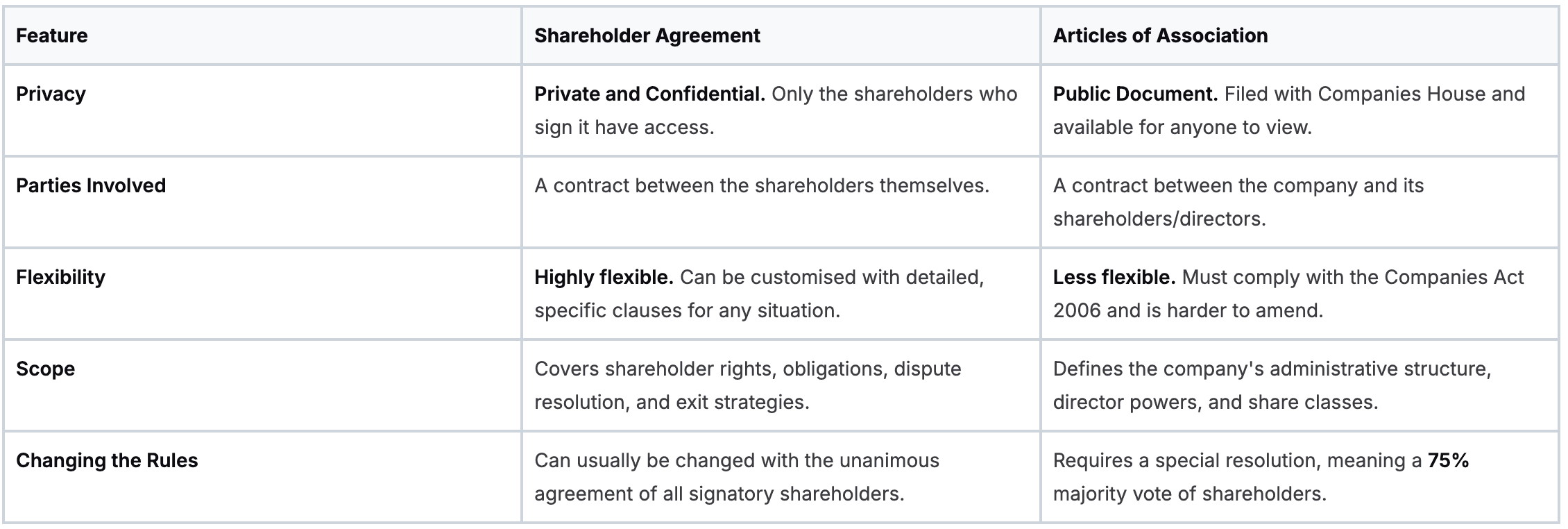
Ultimately, the Articles of Association legally establish your company, but the shareholder agreement is what keeps it running smoothly. The first is a requirement; the second is a sign of smart, forward-thinking founders.
Real-World Scenarios Where an Agreement Is a Lifesaver
Legal clauses and abstract concepts only get you so far. The real worth of a shareholder agreement smacks you in the face when a genuine business crisis hits. It’s the difference between a calm, structured process and a chaotic, expensive mess that can easily kill the company.
Let’s step away from the theory. These are the kinds of stories we see all the time, and they show why this document is one of the best insurance policies your business can ever have.
Scenario One: A Key Shareholder Wants Out
Picture a tech startup founded by two friends, Alex and Ben, who own the business 50/50. After three gruelling years, Alex’s personal life takes a turn—he needs to move abroad and wants to sell his shares, fast.
Without an Agreement: It's pure chaos. Desperate for cash, Alex finds an outside buyer willing to pay over the odds. The problem? This buyer is an aggressive investor with a reputation for asset-stripping. Ben is horrified. He’s facing a hostile new partner who could dismantle everything they’ve built. He can't afford to match the offer, and with no rules in place, he has no legal power to block the sale. The dispute gets personal and expensive, spiralling towards a legal fight that bleeds the company of its cash and morale. The business they poured their lives into is on the brink of collapse.
With an Agreement: The situation couldn’t be more different. Their shareholder agreement includes a Right of First Refusal clause and a pre-agreed valuation method. This means Alex must offer his shares to Ben first, at a price set by a fair formula they both agreed on when things were good. The agreement also gives Ben 90 days to get the financing together. This creates a clear, orderly path that protects Ben, gives Alex a fair exit, and keeps the company’s future in safe hands. The business doesn’t miss a beat.
A shareholder agreement turns a potential catastrophe into a predictable procedure. It provides a script for events that, without one, would be entirely unscripted and destructive.
Scenario Two: The Unexpected Acquisition Offer
Think of a successful marketing agency with three shareholders: a 60% majority owner and two junior partners holding 20% each. A huge competitor tables a generous offer to buy the whole company. The majority owner sees it as the perfect payday exit, but the two junior partners believe the business has way more growth potential and want to reject the deal.
Without an Agreement: Complete deadlock. The majority owner can’t force the sale without risking a lawsuit from the minority shareholders claiming their interests are being steamrolled. At the same time, the junior partners can effectively veto the deal, creating massive frustration and resentment. The lucrative offer expires, the relationship between the partners is shattered, and a golden opportunity is lost forever. The company is now paralysed by infighting.
With an Agreement: The document includes drag-along rights. This clause states that if a shareholder (or group) with more than a set percentage (say, 55%) of shares agrees to sell, they can "drag" the others into the deal on the exact same terms. The majority owner accepts the offer, triggering the clause. The junior partners are now obligated to sell their shares at the same excellent price. Everyone gets a fantastic return, and the acquisition goes through without a hitch.
Scenario Three: The Strategic Deadlock
Let’s go back to our 50/50 co-founders, Alex and Ben. A year in, they hit a major crossroads. Alex is convinced they need to pivot into a new, high-risk, high-reward market. Ben is adamant they should stick to the original, more stable business plan. Neither will budge.
Without an Agreement: The company grinds to a halt. As equal owners, neither can outvote the other. Critical decisions don't get made, and the business drifts without direction. Frustration boils over until the only options left are dissolving the company (destroying most of its value) or starting a long, costly court battle to force a resolution.
With an Agreement: Their deadlock resolution clause gives them a way forward. First, it compels them to enter formal mediation with a neutral third party to try and find a compromise. If that doesn’t work after 30 days, it triggers a "shoot-out" provision (sometimes called a Texas Shootout). Alex has to name a price at which he’d be willing to either buy Ben’s shares or sell his own. Ben then gets to decide: either buy Alex's shares at that price or sell his own shares to Alex at that same price. This mechanism guarantees a fair and final outcome, allowing one founder to take full control while the other gets a clean, equitable exit. The business survives to fight another day.
Common Mistakes to Avoid When Creating Your Agreement

A shareholder agreement is only as good as the thought and care that goes into it. Just having one isn't the goal; it has to be the right one for your business. Stumbling into common traps can make the document completely useless right when you need it most, leading you straight into the legal battles it was supposed to prevent.
One of the worst mistakes is using fuzzy, ambiguous language. Phrases like "a fair market price" or "reasonable efforts" might sound harmless when everyone's friends, but they become battlegrounds in a dispute. A solid agreement swaps ambiguity for crystal-clear instructions, defining exactly how shares will be valued or what specific actions must be taken.
Another huge oversight is failing to plan for a total breakdown. This isn't just about exit strategies; it's about preparing for complete operational paralysis.
Failing to Address Deadlock
For companies with an even number of owners, especially 50/50 partnerships, forgetting to include a deadlock clause is a rookie error with catastrophic consequences. When two equal partners dig their heels in on a fundamental issue, the entire business can grind to a halt with no way forward.
A proper deadlock clause is simply non-negotiable. It gives you a pre-agreed process—like mandatory mediation or a 'shoot-out' provision—to break the stalemate and get things moving again. Without it, you're leaving the company’s future to chance and the mercy of incredibly expensive court proceedings.
Using a Generic Template
Grabbing a "one-size-fits-all" template off the internet might feel like a smart way to save a few quid, but it's a massive gamble. These cookie-cutter documents can't possibly understand your company's unique setup, your industry, or the specific dynamics between your shareholders.
A shareholder agreement isn't a box-ticking exercise; it's a strategic tool shaped by your business's DNA. A generic template that doesn't fit is worse than nothing—it gives you a false sense of security.
Here’s what you risk with a generic document:
- Irrelevant Clauses: It might be full of terms that have nothing to do with your business, creating more confusion than clarity.
- Missing Protections: It will almost certainly lack the specific safeguards you desperately need, like rules tailored to your industry.
- Legal Clashes: The template may not even align with UK company law or your own Articles of Association, creating a legal mess.
Forgetting to Review and Update
Perhaps the most common slip-up is treating the shareholder agreement as a "set it and forget it" task. But businesses don't stand still. New shareholders come on board, the company strategy pivots, or financial situations change. An agreement you drafted five years ago is probably out of touch with the reality of your business today.
Not reviewing it regularly—say, every couple of years or after a big event like a funding round—leaves you with an outdated and toothless document. This can be a costly oversight. As shareholder litigation trends in the UK show, courts tend to favour companies with solid, current agreements. Clearly defined approval thresholds and buyout rules are vital, especially as your business evolves.
Dodging these pitfalls is key. A carefully crafted, customised agreement ensures your business is protected not just for today, but for whatever comes next.
How to Get a Tailored Shareholder Agreement
Create a free shareholder agreement here!
Knowing you need a shareholder agreement is one thing. Actually getting one that properly protects your business is another challenge altogether. It's tempting to grab a free template off the internet, but that's a shortcut fraught with risk. A generic document can never truly grasp the unique details of your company, your shareholder dynamics, or your vision for the future.
An off-the-shelf template might feel like a solution, but it often creates a false sense of security. The dangerous gaps and loopholes only tend to show up when a crisis hits, and by then, it’s too late. The only real answer is an agreement built around the reality of your business.
A Modern Approach to Legal Protection
The good news? Getting a bespoke agreement no longer means enduring weeks of back-and-forth with solicitors and racking up enormous legal bills. Modern platforms have completely changed the game, offering a smart blend of speed, affordability, and legal rigour.
This new way of doing things is incredibly straightforward. You start by answering a simple online questionnaire about your business—things like who the shareholders are, how voting rights will work, and what happens if someone wants to exit. The platform's AI then instantly uses your answers to draft a precise, customised shareholder agreement that fits your situation perfectly.
This approach has some serious advantages over the old way:
- Speed: You can have a draft ready in minutes, not weeks.
- Cost-Effectiveness: It provides access to high-quality legal documents for a fraction of what you'd typically pay.
- Customisation: Your own answers directly shape the clauses, so the final document is genuinely relevant to you.
Ensuring Complete Confidence and Compliance
For that extra layer of peace of mind, many services offer a final check by a human expert. A qualified legal professional can review your AI-generated document to confirm it’s robust, compliant, and perfectly aligned with your goals. This gives you the best of both worlds: the lightning speed of automation backed by the assurance of expert oversight.
This is more important than ever, especially in the context of UK corporate governance. As recent analysis shows, shareholder agreements are crucial for keeping everyone aligned during fundraising and takeovers, with trends suggesting UK corporates will drive over 40% of firm offers. For startups and SMEs, this shines a spotlight on the need for precise agreements that protect against dilution and clearly define voting rights—exactly the kind of protections modern platforms deliver instantly. You can read more about UK takeover trends and corporate insights.
By combining intelligent automation with an optional legal review, you can secure a shareholder agreement that not only protects your business today but also supports its growth for years to come.
This streamlined process makes sure your company is built on a solid legal foundation from day one. To get a better handle on the different legal structures for businesses, you might find our overview ofcorporate law services useful.
Got Questions? We’ve Got Answers
Even with a solid grasp of what a shareholder agreement does, founders often have a few lingering questions before they dive in. That’s completely normal. Getting these final details sorted is the last step to building your business on a rock-solid legal foundation.
Here are the most common queries we hear from founders just like you.
When Is the Right Time to Create an Agreement?
Ideally, you should get a shareholder agreement in place right at the very beginning—as soon as the company is formed. It’s always easier to agree on the rules of the game when everyone is still excited and aligned on the future.
But let's be realistic. Sometimes things get missed in the early rush. The golden rule is: it’s never too late. If your company is already up and running without one, putting an agreement in place now is far better than waiting for a problem to force your hand. Think of it as protecting the value you’ve already worked so hard to build.
Do Small Companies Really Need One?
Absolutely. In fact, you could argue they need one more than larger companies. Businesses with just two owners on a 50/50 split are the most vulnerable to complete paralysis. It's a classic recipe for deadlock, where one single disagreement can grind the entire business to a halt.
For a two-person company, a shareholder agreement isn't just a good idea—it's a mission-critical survival tool. It provides the tie-breaker mechanism you need to resolve disputes and keep the business moving forward when the founders simply can't agree.
Can We Change the Agreement Later?
Yes, a shareholder agreement isn't set in stone. It's a living document that can, and should, evolve as your business grows. The process for making any changes will be clearly laid out within the agreement itself.
Just be aware that it typically requires the unanimous written consent of every single shareholder who signed it. This high bar is there for a reason—it protects everyone. But it also highlights how important it is to get the initial terms right, because you can't just change the rules later without getting everyone on board.
Are Agreements Created Online Legally Binding?
Yes, as long as they are drafted to comply with UK law and are properly signed by everyone involved, an agreement created using a reputable online platform is a fully enforceable contract.
Modern tools have made it much simpler and more affordable to create a customised, legally sound document without the traditional cost. The trick is to use a trusted service that ensures the agreement is genuinely tailored to your business and ticks all the necessary legal boxes, giving you the exact same protection as a document from a high-street solicitor.
Ready to create the clear, fair, and legally sound framework your business deserves? With Robot Lawyer, you can generate a custom shareholder agreement in minutes, tailored specifically to your company's needs. Start your 7-day free trial and protect your business today.