
What Is a Force Majeure Clause? A 2026 UK Guide
Ever signed a contract feeling confident, only to have a global crisis, a natural disaster, or some other jaw-dropping event completely derail your plans? If so, you’ll know the panic of realising you might be on the hook for something you physically can’t deliver. This is where a force majeure clause comes in.
Think of it as your contract's pre-agreed emergency plan. It’s a provision that essentially hits the ‘pause button’ when a truly unforeseeable and uncontrollable event makes it impossible for you to fulfil your obligations. It can excuse you from performing without being slapped with a breach of contract penalty.
Understanding the Basics of Force Majeure
Let’s make this real. Imagine you’re an event planner who has spent months organising a massive music festival. You've sold thousands of tickets, booked the headline acts, and lined up all your suppliers. Then, just one week before showtime, the government announces a sudden national lockdown, banning all large gatherings.
Without a well-drafted force majeure clause, you could find yourself in a world of legal and financial pain, facing breach of contract claims from artists, suppliers, and ticket holders. This clause is your legal shield. It’s the part of the agreement that acknowledges some things are so far beyond anyone's control that holding you to the original terms would be completely unreasonable.
But be warned: it's not a get-out-of-jail-free card for any minor inconvenience or poor planning.
The UK Legal Standpoint
Here’s a critical point for any UK-based freelancer, founder, or small business: force majeure is not an automatic right under English law. Unlike in many other legal systems, there’s no implied or default protection for these kinds of events. If a force majeure clause isn't explicitly written into your contract, you can't rely on it. Period.
This makes the precise wording of your agreements absolutely crucial. It's a stark reminder of why grabbing a vague template off the internet or relying on a handshake deal is such a massive gamble. For a deeper dive, it's worth reading up on recent clarifications from theUK Supreme Court that reinforce this very point.
Key Takeaway: In the United Kingdom, there is no automatic legal protection for "force majeure" events. If it isn't written into your contract, it doesn't exist for your agreement. This makes proactive and careful contract drafting non-negotiable.
What Does a Force Majeure Clause Actually Do?
When a force majeure event is triggered, it doesn’t just make the contract vanish. Instead, it sets off a pre-agreed chain of events, which should be clearly defined within the clause itself.
Typically, this can include one or more of the following:
- Suspending Obligations: It temporarily freezes a party's duty to perform their side of the bargain for as long as the disruptive event continues.
- Extending Deadlines: It pushes back delivery dates and milestones, giving you more time to complete the work once things are back to normal.
- Allowing Termination: If the event drags on for an extended, specified period (say, 90 days), the clause might give one or both parties the right to walk away from the contract without penalty.
In short, it provides a clear, structured roadmap for navigating a crisis. This helps prevent disputes from escalating into bitter, expensive legal battles.
A Quick Summary of the Clause's Components
To build a solid force majeure clause, you need to know what goes into it. This table breaks down the essential parts.
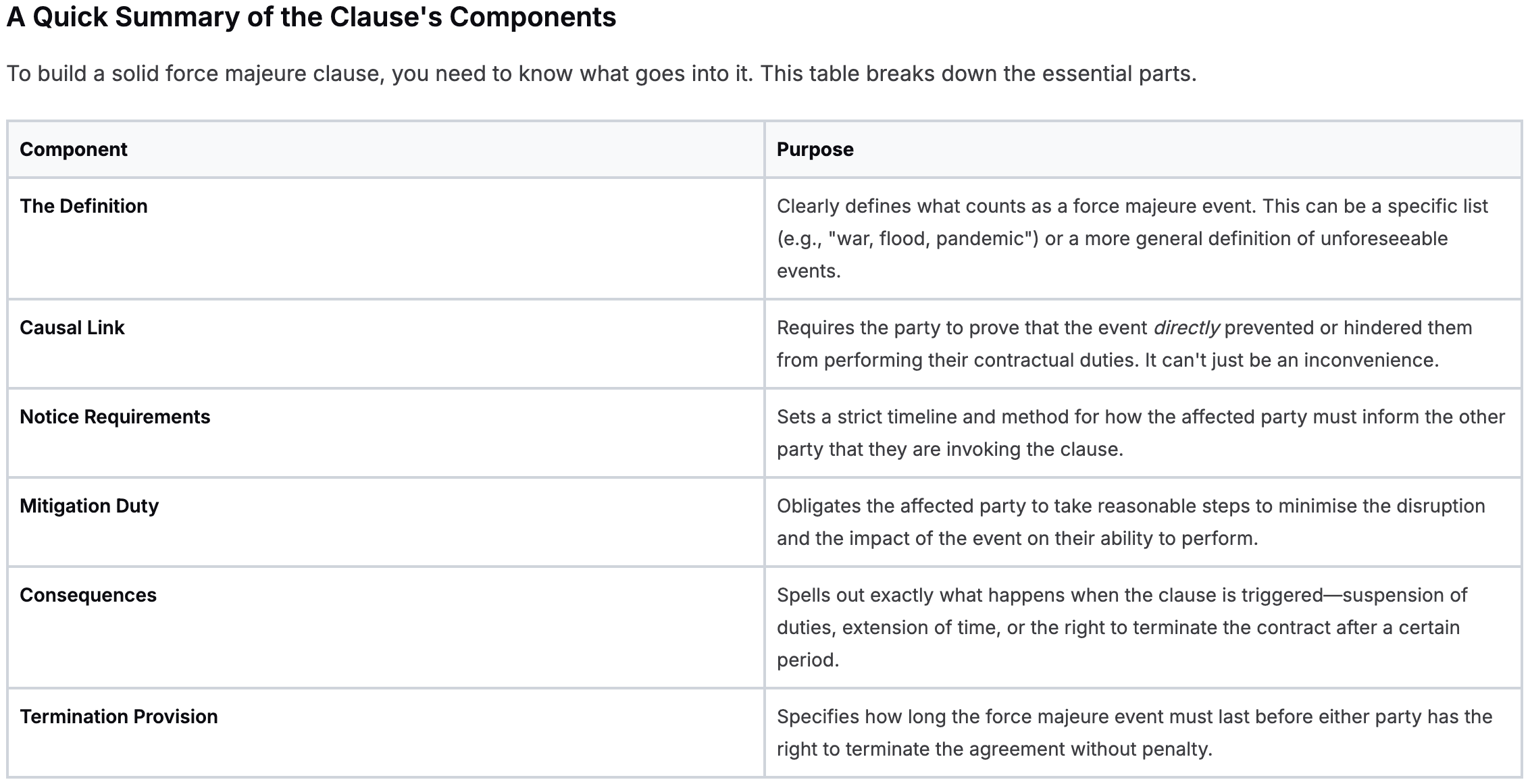
Having these elements clearly defined from the outset turns a potential disaster into a manageable situation, providing certainty when you need it most.
How a Force Majeure Clause Actually Works
Knowing what a force majeure clause is and understanding how it functions in the real world are two very different things. Simply having the clause in your contract isn’t enough; to successfully use it, the affected party has to pass a series of stringent tests in a UK court. It's a high bar to clear.
Think of it like making an insurance claim. You can't just report a problem and expect a payout. You must provide evidence and prove that the incident meets the specific conditions laid out in your policy. With force majeure, the burden of proof is squarely on the shoulders of the party looking to be excused from their contractual duties.
The Three Crucial Tests for Invoking the Clause
When a dispute lands in court, a judge will scrutinise your claim against a few key principles. To have a shot, you generally need to prove that the event was unforeseeable, completely beyond your control, and made it impossible to perform your side of the bargain.
- Unforeseeable: The event must be something you couldn't have reasonably predicted or planned for when you signed the contract. A freak tsunami hitting the Thames? Unforeseeable. A typical winter storm in Scotland? A court would likely say that's just business as usual.
- Beyond Your Control: You must show that you had no power to stop the event from happening. A national employee strike might qualify. But if the strike is a direct result of your company’s poor management, a court is unlikely to accept that as a force majeure event.
- Renders Performance Impossible: This is often the hardest test to pass. The event has to make fulfilling your contractual duties truly impossible, not just more difficult, more expensive, or less profitable.
This final point is where so many claims fall flat. If a supply chain disruption makes your usual materials 25% more expensive, that's just a business risk you have to manage. If those materials become completely unavailable worldwide due to a new trade embargo, you're getting much closer to the legal definition of impossibility.
Understanding Causation and Mitigation
For a claim to succeed, you must also establish a direct line of causation. This means proving the force majeure event was the actual cause of your failure to perform. If your business was already struggling and the event was just the final nail in the coffin, your claim might be on shaky ground.
On top of that, you have a duty to mitigate. You can't just sit back and watch the disaster unfold. The law expects you to take all reasonable steps to minimise the event's impact and find alternative ways to meet your obligations.
A landmark UK Supreme Court case, RTI Ltd v MUR Shipping BV, brought critical clarity to this. The court ruled that "reasonable endeavours" to mitigate don't require a party to accept non-contractual performance. In that case, MUR wasn't obligated to accept payment in Euros when the contract specifically demanded US dollars, even though sanctions made dollar payments impossible.
This case is a huge deal. It reinforces that while you must try to lessen the damage, you're not forced to agree to a completely different deal just to get the job done. It's a vital protection for businesses. You can see how these kinds of obligations are structured in other agreements by reviewing examples like a comprehensive Service Level Agreement.
This decision tree gives you a bird's-eye view of the initial thinking process when you're considering a force majeure claim in the UK.
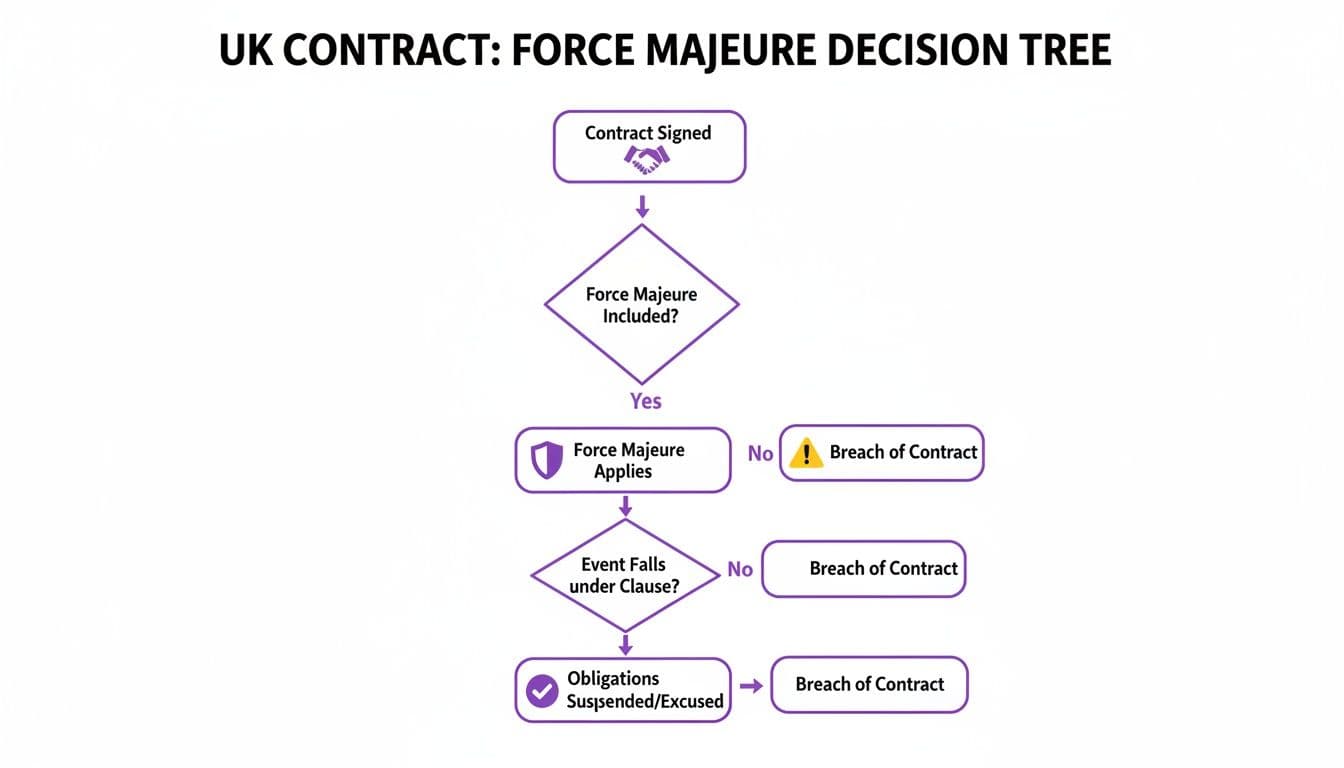
As the chart highlights, the first and most critical step is simply confirming the clause actually exists in your contract. Unlike in some countries, UK law provides no default protection if you haven't included one.
Which Events Should Your Force Majeure Clause Cover?

A force majeure clause is only as strong as the events it specifically names. Because UK law doesn't provide any default list, it's completely up to you to define what counts as a "superior force" that excuses you from your obligations. Just grabbing a generic template is a massive risk—it could leave you completely exposed right when you need protection the most.
Think of your clause as a bespoke toolkit, built for your specific business. A freelance graphic designer's risks look nothing like those of a construction firm or a letting agent. You've got to sit down and think hard about your unique vulnerabilities and list the events most likely to throw a spanner in the works.
That means going beyond the old-fashioned lists of yesteryear and considering modern-day disruptions. While "Acts of God" is a familiar starting point, today’s world demands more precise language to cover everything from digital threats to global health emergencies.
Specific Events Versus Catch-All Phrases
When you're drafting your clause, you have two main tools at your disposal: a list of specific, named events, and a broad, "catch-all" phrase. The best clauses use a combination of both. Starting with a clear list of specific events gives you certainty and makes it much easier to trigger the clause if one of those things happens.
Commonly listed events include:
- Natural Disasters: Things like floods, earthquakes, hurricanes, or extreme weather that physically stop work from happening.
- Human Actions: This covers war (declared or not), acts of terrorism, riots, civil unrest, or malicious damage.
- Governmental Actions: This could be changes in law, new sanctions, embargoes, or the imposition of lockdowns and quarantines.
- Labour Issues: National or industry-wide strikes and labour disputes usually count (but not strikes exclusive to your own company).
- Infrastructure Failures: Widespread power cuts, failure of telecoms networks, or major transport disruption.
After this list, many people add a catch-all phrase like, "...or any other event beyond the reasonable control of the parties." The idea is to cover genuinely unforeseeable situations that you didn't explicitly name. But you need to be very careful with this wording.
The Danger of Vague Language: The Ejusdem Generis Rule
Relying too heavily on that catch-all phrase can seriously backfire. This is because of a legal principle known as the ejusdem generis rule. In plain English, it means "of the same kind." If your catch-all phrase follows a list of specific events, a court might decide it only applies to other events of a similar type to those you've already listed.
For example, in the well-known case of Channel Island Ferries Ltd v Sealink UK Ltd, the court looked at a clause listing "strikes, lockouts, or any other cause whatsoever." It decided that a separate business decision to make ships unavailable wasn't covered, as this was not "of the same kind" as a labour dispute.
This is a critical lesson. If your list only mentions natural disasters, a court could easily rule that a major cyber-attack isn't covered by your general catch-all wording. This is precisely why being specific and thinking ahead is so vital.
Tailoring Your Clause for Modern Risks
The world has changed, and your force majeure clause needs to keep pace. Events that seemed far-fetched a decade ago are now very real risks. Since 2020, explicitly including terms like "pandemic," "epidemic," and "quarantine" has become standard practice. The consequences of not doing so can be huge.
The COVID-19 pandemic highlighted this perfectly. A 2020 review by Fountain Court Chambers of over 50 English law cases found that a tiny 15% of pandemic-related force majeure claims actually succeeded. The successful ones were almost all from contracts that had explicitly listed 'epidemics' or 'government-mandated quarantine'. The other 85% failed because their clauses were simply not good enough. You can read more about thesefindings on force majeure drafting in the UK.
So, what should you be thinking about now? Consider adding modern, industry-specific risks like:
- Cyber-attacks and major data breaches
- Imposition of tariffs or trade wars
- Widespread failure of cloud computing services
- Significant supply chain collapse
By being specific, you strip out ambiguity and give yourself the best possible chance of using your what is a force majeure clause defence when you really need it. It transforms your contract from a generic document into a precise shield, built for your business reality.
Practical Steps for Drafting a Strong Force Majeure Clause
Knowing what a force majeure clause is and actually writing one that protects you are two very different things. A poorly worded clause is often worse than having no clause at all—it gives you a false sense of security that can vanish the moment it’s tested in court. So, let’s move from theory to practice and walk through how to build a clause that’s specific, clear, and, most importantly, enforceable.
Getting this right is all about precision. Each part of the clause needs to work together to create a clear game plan for when a crisis hits. Your goal is to leave as little room for argument as possible, making sure both you and the other party know exactly what to do.
Define the Force Majeure Events with Precision
The list of qualifying events is the heart of your clause. As we’ve covered, vague terms like "Acts of God" are a recipe for disaster. Your first job is to create a list of events that is both specific and directly relevant to your line of work.
Start with the classic events, but don't stop there. Get practical. What could actually stop you from fulfilling your end of the bargain? This is where you need to ditch the generic templates and think about your specific business reality.
A solid list should include:
- Specific Natural Disasters: Don't just say "Acts of God." Spell it out: floods, fires, earthquakes, epidemics, or pandemics.
- Clear Governmental Actions: Be explicit. Mention acts of government, changes in law, sanctions, embargoes, lockdowns, or quarantines.
- Modern Disruptions: Think about today’s world. Add events like terrorism, war, widespread failure of public utilities or communication networks, and major cyber-attacks.
The idea is to be descriptive without being so exhaustive that you accidentally exclude something. The best approach is often a detailed list combined with a well-phrased "catch-all" to cover unforeseen circumstances.
Weak vs Strong Drafting: A Comparison
Let’s see how a few small tweaks in wording can make a world of difference.
WEAK Clause Example:
"A party is not liable for failure to perform if such failure is as a result of Acts of God or other circumstances beyond their reasonable control."
This is dangerously vague. It leans on the ambiguous "Acts of God" and a catch-all that a court could easily interpret very narrowly. Worse, it gives no instructions on what to do next.
STRONG Clause Example:
"A 'Force Majeure Event' means any event beyond a party's reasonable control, which by its nature could not have been foreseen, or, if it could have been foreseen, was unavoidable, including but not limited to pandemics, acts of government, cyber-attacks, or national strikes. The affected party shall provide written notice within 10 days and shall use all reasonable endeavours to mitigate the effect of the Force Majeure Event."
This version is far better. It sets a standard for what counts as "foreseeable," gives a non-exhaustive list of modern events, and crucially, includes the next steps for giving notice and trying to fix the problem. If your business situation changes after you've signed, you might need to make adjustments. You can find out how to formally update your agreements with a contract addendum.
Outline the Procedural Requirements
Simply having a force majeure event happen isn’t enough—it doesn't trigger the clause automatically. Your clause must spell out the exact procedure to follow. Miss a step, and you could lose your right to claim protection, even if the event was legitimate.
Here are the key procedures to include:
- Notice Requirement: Be specific about how and when the affected party must tell the other. For instance, "written notice must be provided within 14 calendar days of the event's occurrence."
- Duty to Mitigate: Make it clear that the person invoking the clause must take reasonable steps to minimise the disruption. This shows good faith and that you’re not just trying to get out of the contract.
- Consequences: Define what happens next. Is the contract suspended? Are deadlines pushed back? Be clear about the immediate effects.
- Termination Rights: Add a long-stop date to prevent the contract from being in limbo forever. For example, "If the Force Majeure Event continues for more than 90 consecutive days, either party may terminate this agreement by providing written notice."
These steps create a clear roadmap, reducing panic and disputes when things go wrong. And make no mistake, these claims are tough to win. A review of over 200 English High Court cases between 2015 and 2022 found that only 28% of force majeure claims succeeded, often because the party couldn’t prove the event was genuinely impossible to overcome. You can read more about the challenges of successfully invoking force majeure clauses.
For small businesses and freelancers, using a professionally vetted template from a trusted source can be a game-changer. It helps you sidestep the common drafting traps that make clauses unenforceable, giving you a solid foundation that already accounts for these critical legal details.
Understanding Force Majeure vs Frustration of Contract
It’s easy to get force majeure mixed up with its close legal cousin, the doctrine of frustration. Both come into play when an unexpected event throws a spanner in the works, making a contract difficult or even impossible to perform. But here's the thing: they are fundamentally different, and for any UK business, knowing how they differ is absolutely critical.
Think of it like this. A force majeure clause is a custom-built fire extinguisher you decided to install in your kitchen. You chose its size, what kind of fire it can handle, and exactly where to put it for easy access. Frustration, on the other hand, is like watching your building go up in flames and just hoping the fire brigade eventually turns up. One is a proactive tool you control; the other is a last-ditch plea with a very high bar and an outcome you can't predict.
A Tale of Two Remedies
The biggest difference comes down to where they come from. Force majeure is a creature of contract. It only exists if you and the other party agreed to write it into your agreement. You get to define what counts as a trigger event, the procedure for invoking it, and what happens next – whether that's pausing work, extending deadlines, or eventually walking away. This gives you a massive amount of flexibility.
Frustration is a totally different beast. It’s a common law doctrine, a legal concept created by judges over centuries. It’s not something you put in your contract; it’s an argument you might make in court when things have gone catastrophically wrong, and—crucially—your contract is silent on the matter. You don't "invoke" frustration; you ask a judge to declare it, and hope they agree.
Key Distinction: Force majeure is a contractual tool you create and control. Frustration is a legal doctrine applied by a court as a last resort when no contractual provision exists.
Relying on frustration is a huge gamble. The legal test is notoriously tough to pass. A court will only find a contract is frustrated if the new situation makes performance "radically different" from what was originally agreed upon. The fact that a project has become more expensive or less profitable is never, ever enough.
The All-or-Nothing Outcome of Frustration
Perhaps the most dangerous difference, especially for small businesses and freelancers, is the consequence. A well-written force majeure clause can offer a range of sensible, flexible solutions. It can allow you to hit pause for a few weeks to ride out a crisis and then pick up where you left off, preserving the commercial relationship.
Frustration has no such nuance. If a court decides a contract has been frustrated, the result is automatic and absolute: the entire contract is immediately terminated. It ends, right there and then, for everyone. This blunt instrument rarely fits the commercial reality of a situation, killing any chance of resuming the project once the disruptive event has passed.
The doctrine of frustration is a vital part of English contract law, but it's a very different beast from a force majeure clause. This table breaks down the main differences you need to know.
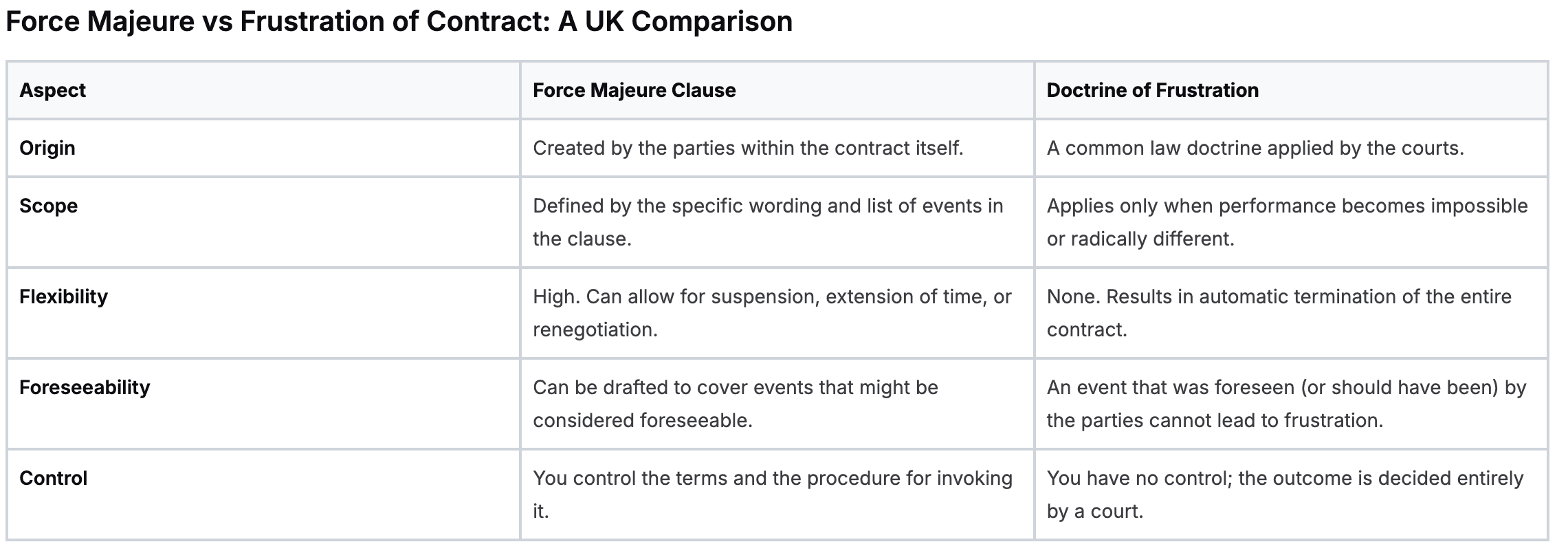
The lesson here for any freelancer, startup, or SME is crystal clear. The doctrine of frustration is an unreliable safety net that often fails in UK courts. Proactively drafting a specific, robust force majeure clause is the only sensible way to manage risk and shield your business from the unpredictable.
What to Do When a Force Majeure Event Occurs
When a crisis hits, it's easy for chaos to take over. But if you think a force majeure event has happened, your best defence is to take a deep breath and follow a clear, methodical process. A simple procedural mistake can sink an otherwise solid claim, so acting with precision isn’t just a good idea—it’s crucial for protecting your legal and financial position.
Think of this as your practical checklist for the moment disaster strikes. Don’t panic. Instead, get organised and work through these steps methodically to give your claim its best chance of success.
Step 1: Read the Clause Again
Your first move must be to find and read the force majeure clause in your contract—not once, but several times. Pay extremely close attention to the specific list of qualifying events and, most importantly, the exact procedures it lays out.
Does the event that just happened actually match a listed item like "pandemic" or "government action"? What is the deadline for sending notice? Your contract is the only rulebook that matters right now, and understanding its specific instructions is the foundation of your entire claim.
Step 2: Gather Your Evidence
Next, it's time to build your case. The burden of proof is on you to show that a force majeure event has genuinely occurred and that it's the direct cause of you being unable to fulfil your contractual duties.
You need to collect evidence that proves:
- The event happened: This could be anything from news reports and government announcements to official meteorological data.
- It prevents performance: Document how the event has made your work impossible, not just more difficult or expensive. You need to show that you have no reasonable alternative.
- The timing: Create a clear timeline showing when the event started and when its impact on your operations began.
Step 3: Provide Formal Notification
This is a critical, time-sensitive step where many claims fall apart. Your clause will almost certainly specify a deadline for sending a formal notice to the other party, such as "within 10 working days" of the event. Follow the notification instructions to the letter, including the delivery method it requires (like registered post or a specific email address).
Your notice should be clear, professional, and state exactly which part of the force majeure clause you are invoking. If you are thinking about ending the contract under this clause, you'll need to follow a similar process. For a little help, you can see how to structure aforce majeure contract termination letterto make sure you include all the necessary information.
Step 4: Document All Mitigation Efforts
Finally, you have a legal duty to mitigate—or lessen—the event’s impact. You can't just down tools and wait for things to get better. You must actively and reasonably try to work around the disruption.
Meticulously document every single action you take. This includes records of attempts to find other suppliers, communications with your team about potential workarounds, and any other steps you take to get the project back on track. This evidence proves you've acted in good faith and shows you aren't just using the clause as a convenient excuse to get out of your obligations.
Frequently Asked Questions About Force Majeure
Even after you get your head around what a force majeure clause is, specific questions always pop up when you start looking at actual, real-world contracts. Let's tackle some of the most common ones to give you a bit more clarity.
This is all about reinforcing the main points and helping freelancers, small business owners, and anyone else juggling contracts in the UK to navigate this tricky area with more confidence.
Can I Add a Force Majeure Clause to an Existing Contract?
Yes, but it’s not a one-sided affair. You can only do this if every single person who signed the original agreement gives their consent. You can't just slip a new clause into a contract that's already in force; it would have no legal weight. The proper way to do it is with a formal contract amendment or a variation agreement, which everyone has to sign.
This really drives home why it's so important to get a solid force majeure clause in there from the very beginning. Trying to renegotiate terms when a crisis is already hitting is incredibly tough and leaves you in a very weak bargaining position.
Does Force Majeure Cover Economic Hardship?
Almost never. UK courts have been very consistent on this: a force majeure clause isn’t a get-out-of-jail-free card for a bad deal or a sudden downturn in the market. If a contract simply becomes more expensive to fulfil or less profitable than you’d hoped, that’s considered a standard commercial risk you’re expected to take on.
The whole point of the clause is to offer a lifeline for events that make carrying out your side of the bargain impossible or illegal—not just financially painful. Unless your clause has some extremely specific and unusual wording about price swings (which is rare), a simple economic downturn won't cut it as a reason to invoke force majeure.
Important Reminder: The bar for force majeure is impossibility, not unprofitability. A deal turning sour is a business risk, not a "superior force."
What Happens if My Contract Has No Force Majeure Clause?
If your UK contract doesn't mention force majeure, then you simply don't have one to use. Your only potential way out is to argue that the contract has been terminated under the common law doctrine of frustration.
Frankly, this is a very high-risk strategy. The legal test for frustration is much, much stricter than for most force majeure clauses. It requires an event so completely game-changing that it makes performance "radically different" from what was originally agreed. On top of that, frustration is a blunt instrument—it automatically kills the entire contract, giving you no flexibility to just pause things and pick them up again later.
Is a Pandemic Automatically a Force Majeure Event?
No, nothing is ever automatic in contract law. Whether something like the COVID-19 pandemic counts as a force majeure event comes down to one thing: the specific wording of your clause. If you were sharp enough to include terms like ‘pandemic’, ‘epidemic’, or ‘government action’ (like a lockdown), you’re on much firmer ground.
If that specific language isn't there, you're left trying to argue that the pandemic fits under a general "catch-all" phrase. That's a much harder legal fight to win. After everything that happened in 2020, it’s now considered essential practice to make sure these terms are explicitly listed in any new contract you sign.
Managing legal complexities like force majeure is a challenge for any business. Robot Lawyer offers a smart, fast, and affordable way to create professionally vetted legal documents, helping you build strong contracts from the start. Skip the jargon and high costs—generate the precise agreements you need in minutes. Protect your business today at https://robotlawyer.co.