
UK Service Agreement Template & Guide 2026
Let's be honest, what exactly is a service agreement template? Put simply, it’s a ready-made contract that lays out the rules of the game between you (the service provider) and your client. It’s the foundational rulebook for your professional relationship, making sure everyone is on the same page about their roles and responsibilities before any work kicks off.
Why a Service Agreement Is Your Business’s Best Friend
Imagine this: you pour weeks of hard work into a client project, deliver everything on time, and then... radio silence when the invoice is due. This isn't just a nightmare scenario; it's a very real—and costly—risk that thousands of UK freelancers and small businesses face every year. A handshake deal or a quick email might feel easy at the start, but they leave dangerous gaps for misunderstandings to creep in.
Create a Service Agreement Here!

Think of a service agreement less as an intimidating legal document and more as the blueprint for a successful partnership. It’s about making sure you and your client are playing the same game with the same end goal in mind. A solid service agreement template gives you the structure for that blueprint, and in doing so, becomes one of the most important shields for your business.
Create a Service Agreement Here!
Defining Boundaries and Managing Expectations
At its core, a service agreement is all about setting crystal-clear expectations from day one. It gets every critical detail of the arrangement down on paper, eliminating the kind of ambiguity that so often leads to arguments later.
By starting with a template, you can quickly define:
- The Scope of Work: What you will do, and just as importantly, what you will not do. This is your number one defence against "scope creep"—that slow, painful, and often unpaid expansion of a project's demands.
- Payment Terms: Exactly how much you’ll be paid, when you’ll be paid, and how. This is where you lock in deposit requirements, payment milestones for bigger jobs, and late payment fees.
- Project Timelines: Key deadlines and deliverables that both you and the client have agreed on. This creates a shared road map for the project's pace and completion date.
Getting this clarity upfront stops friction before it can even start. When everyone knows what to expect, the relationship begins on a footing of trust and professionalism.
A great agreement is proactive, not reactive. It anticipates the most common points of friction—like payment delays or requests for extra work—and builds in a clear, pre-agreed process for dealing with them. It turns a potential shouting match into a simple contractual step.
Providing a Safety Net for Your Revenue
When it comes down to it, a service agreement is a powerful tool for protecting your income. For so many businesses in the UK, late or unpaid invoices are a constant threat to cash flow. In fact, recent reports show a huge percentage of small businesses struggle with payment disputes, highlighting a vulnerability that a formal contract directly solves.
With a signed agreement, you have legal standing if a client doesn't pay up. It transforms a messy "he said, she said" argument into a straightforward case of a broken contract. This legal recourse is your ultimate safety net, ensuring your hard work actually gets rewarded. It also sends a clear signal to clients: you’re a professional who takes your business—and their investment in it—seriously.
Who Absolutely Needs a Service Agreement
It’s a dangerous myth that contracts are just for big corporations. The truth is, the smaller your operation, the more you stand to lose without one. For freelancers, small agencies, and contractors across the UK, a service agreement template isn't just a piece of professional polish—it's a fundamental tool for survival.
Just think about the sheer number of professionals who depend on these documents every single day. They are the quiet foundation of countless successful client relationships in dozens of industries.
Freelancers and Consultants
If you’re a solo professional, like a freelance creative or an IT consultant, a service agreement is your lifeline. Imagine you're a graphic designer hired for a new logo. Without an agreement, that "simple" project can quickly descend into endless revision cycles—a classic case of scope creep. A contract puts a stop to that by defining exactly how many revisions are included, saving you from unpaid work and the client from frustration.
For a business consultant, it's about locking in payment milestones to ensure you have consistent cash flow. The agreement clearly states that payment is due when you hit specific targets, turning vague promises into reliable income. It’s what transforms your professional service into a structured, respected business.
A service agreement is your professional shield. It weeds out clients who aren’t serious, prevents the misunderstandings that kill relationships, and gives you a clear, legal path to getting paid for your hard work. It's the difference between running a hobby and running a business.
Agencies and Contractors
For small agencies and building contractors, the stakes are even higher. A marketing agency, for instance, needs to be crystal clear about responsibilities and who owns what. The agreement will specify who owns the final campaign assets, who is responsible for ad spend, and how results will be measured. This heads off disputes over ownership and performance before they even start.
Contractors, from builders to software developers, use service agreements to define what "finished" actually means. It outlines project completion in measurable terms, lists all the deliverables, and establishes a final sign-off process. This prevents that all-too-common nightmare where a project drags on forever because the finish line was never clearly marked out.
This isn't just theory; the numbers back it up. The UK's dynamic economy, where 4.2% of the workforce is self-employed, runs on these agreements. Yet, a shocking 68% of small businesses have been tangled in payment disputes, with the total value of late payments reaching an eye-watering £22.4 billion. These figures show just how critical a well-drafted service agreement template is for securing your payment terms and protecting your financial health. You can dig into more data by reviewing insights on professional project management templates.
At the end of the day, whether you’re a one-person show or a growing team, a service agreement isn’t about mistrust—it’s about building trust. It signals that you're a professional who values clarity, respects the client's investment, and is serious about delivering a successful outcome. It's simply an indispensable tool for preventing non-payment, defining boundaries, and laying a professional foundation for every single project.
Building Your Agreement With Essential Clauses
A service agreement is only as strong as the clauses inside it. Think of them less as legal jargon and more as the ground rules for your professional relationship, designed to prevent misunderstandings before they start.
Getting these core components right is what turns a simple document into a powerful safety net for your business.
Create a Service Agreement Here!
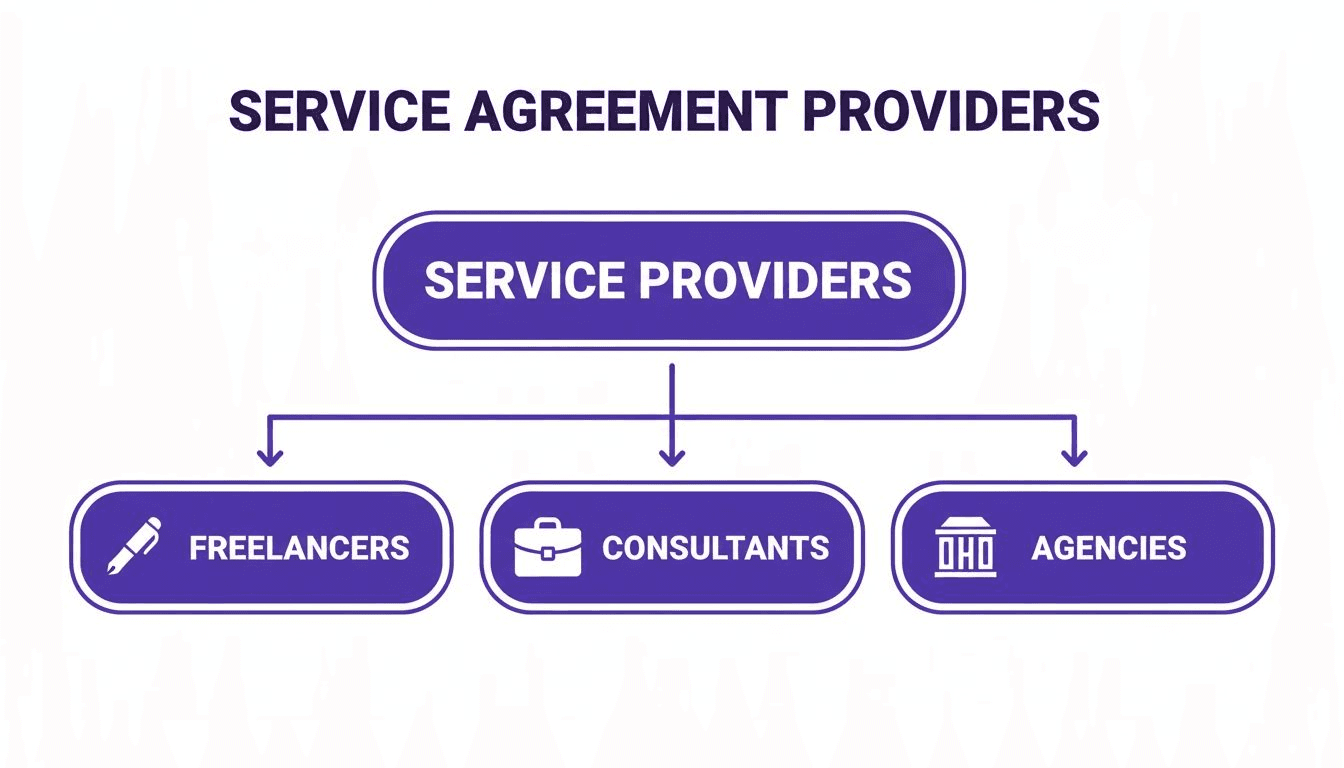
Whether you’re a solo freelancer, a specialist consultant, or a growing agency, these clauses are your first line of defence against the most common business headaches. Let’s break down what you absolutely need to include.
Defining the Scope of Services
This is, without a doubt, the most important part of your agreement. It’s where you spell out exactly what you’re going to deliver. More importantly, it’s where you state what’s not included.
Ambiguity here is a one-way ticket to ‘scope creep’—that all-too-familiar situation where a project slowly expands, but your invoices don’t. A vague promise like "provide marketing support" is asking for trouble.
Instead, get specific:
- Deliverables: "Create and schedule 12 social media posts per calendar month (8 for LinkedIn, 4 for X)."
- Revisions: "This fee includes two rounds of revisions for each post batch. Any further changes will be billed at my standard hourly rate."
- Exclusions: "This work does not cover community management, responding to comments, or managing paid ad campaigns."
This level of detail leaves no wiggle room. The client knows exactly what they’re getting for their money, and you’re protected from doing weeks of unpaid work. For bigger, more complex projects, it's often wise to attach a more detailed document. You can find out how in our guide to creating a Statement of Work (SOW).
Clarifying Payment Terms
Getting paid on time is the lifeblood of any business, but it’s a massive point of friction. The numbers are staggering. A 2026 PwC UK study found that poor payment practices cost the freelance economy £4.2 billion a year. 37% of freelancers reported unpaid invoices, with the average loss being a painful £3,200 each.
A rock-solid payment clause is your best defence. It needs to clearly state:
- The total project cost or your hourly/day rate.
- The payment schedule (e.g., 50% upfront, 50% on completion).
- Which payment methods you accept.
- What happens if they pay late, usually referencing the Late Payment of Commercial Debts (Interest) Act 1998.
A simple clause can make a world of difference. According to the Federation of Small Businesses (FSB), businesses with clear, standardised agreements see their cash flow improve by 25% and get paid 14 days faster on average.
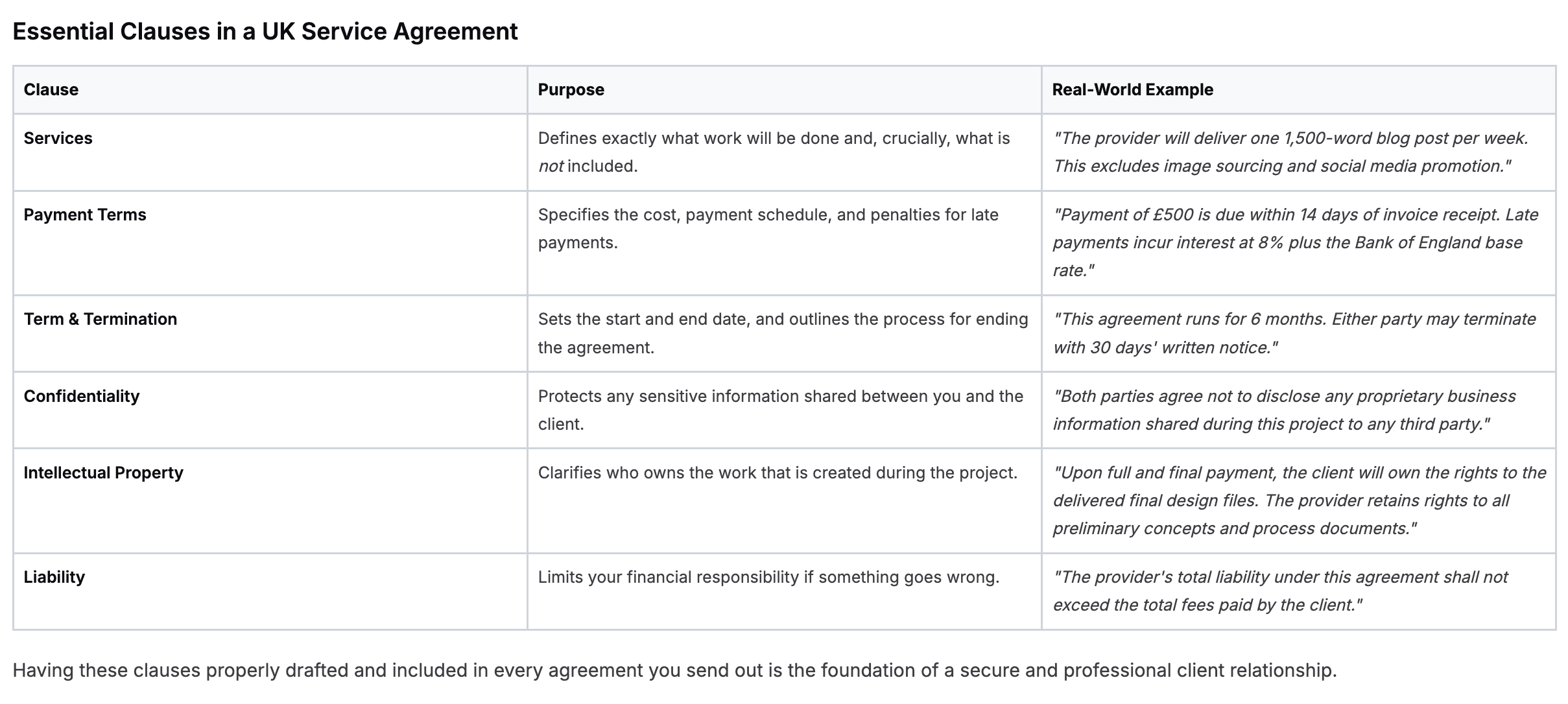
To protect yourself, a well-written service agreement needs to be crystal clear on every single one of these points. Here’s a quick overview of the non-negotiables for any UK agreement.
Create a Service Agreement Here!
Having these clauses properly drafted and included in every agreement you send out is the foundation of a secure and professional client relationship.
Setting the Term and Termination
Every project has a start and an end. The ‘Term’ clause defines the lifespan of the agreement, whether it's for a one-off project or a rolling monthly retainer. The ‘Termination’ clause, on the other hand, is your pre-planned exit strategy.
Think of the termination clause as a professional prenup for your business. It maps out a fair and orderly way to part ways if things go south, preventing a messy and expensive breakup down the line.
This section should specify:
- The notice period required from either party to end the contract (e.g., 30 days’ written notice).
- The grounds for immediate termination, such as a serious breach of contract or consistent non-payment.
- What happens when the contract ends (e.g., final payment is due, all work files are handed over).
Protecting Confidentiality and Intellectual Property
As a service provider, you’ll often be trusted with sensitive client information, from financial data to trade secrets. A Confidentiality clause is a legal promise from both sides to keep that information under wraps. It's a fundamental part of building trust, and it's non-negotiable for clients in sectors like tech, finance, or healthcare.
Just as crucial is the Intellectual Property (IP) clause. This answers the all-important question: "Who owns the work?" The standard approach is that the client owns the final, delivered product after they’ve paid for it in full.
However, you retain ownership of your underlying methods, tools, and any preliminary work that didn't make the final cut. This protects your unique process while giving the client exactly what they paid for.
Tailoring Your Template With Advanced Clauses
While a standard service agreement template gets the job done, you’ll want to move beyond the basics to properly protect your business. Adding a few advanced clauses isn't about creating legal fluff; it’s about adding powerful tools that give you an extra layer of protection, manage specific risks, and turn a generic document into one that’s built for you.
Going beyond the essentials like scope and payment means you can get ahead of potential problems and decide, right now, how you'll handle them. It’s a proactive step that strengthens your position and shows clients you’re a serious professional. This is how you build a contract that truly works for you.
Capping Your Financial Risk
One of the most important clauses you can add is the Limitation of Liability. Just imagine a worst-case scenario: your work accidentally causes a huge financial loss for your client. Without this clause, you could be sued for an unlimited amount of money, which could easily put your entire business on the line.
This clause puts a sensible cap on how much you could owe. A common and fair approach is to limit your liability to the total fees paid under the contract. It's a standard practice that protects you from a catastrophic loss while still keeping you accountable for your work.
Another powerful addition is an Indemnification clause. This one has your back if something your client does gets you dragged into a lawsuit. For example, say a client gives you copyrighted images to use in a project, and the real owner decides to sue for infringement. This clause makes sure the client is the one who has to cover your legal fees and any damages.
"A tailored contract isn't about creating barriers; it's about building guardrails. Advanced clauses like Limitation of Liability and Indemnification don't hinder the relationship—they protect it by defining the boundaries of risk for both parties from the outset."
Planning for Disagreements and Specific Industries
Nobody goes into a project expecting it to fail, but it's always smart to have a plan for disagreements. A Dispute Resolution clause outlines an agreed-upon process for sorting things out, often starting with mediation or arbitration before anyone thinks about going to court. This can save a massive amount of time, money, and stress, and can often save the business relationship.
What's more, your specific industry will have its own needs. If you’re a UK-based developer handling user data, a Data Processing Addendum (DPA) is non-negotiable for GDPR compliance. For a creative agency, you might add a detailed schedule of deliverables with specific review cycles to keep complex projects on track. The type of service also matters, which you can read more about in our guide on the differences in a Service Level Agreement.
These customisations are vital for staying compliant and keeping your operations clear. Recent data from the UK's Department for Business and Trade highlighted that 42% of SMEs failed initial contract compliance checks in trade audits, often because of vague scope definitions. A 2026 Law Society report also noted that well-drafted templates cut non-compliance incidents by 55% among freelancers, showing just how powerful it is to have clauses aligned with UK law like the Unfair Contract Terms Act 1977. You can dig into the numbers yourself by reading the full statistical analysis of service agreements.
By carefully choosing and customising these advanced clauses, you’re turning your service agreement template from a simple form into a strategic tool that actively defends your business.
Common Mistakes to Avoid When Using a Template
Grabbing a service agreement template is a smart move, but it's not a silver bullet. A great template is like a professional chef’s recipe – the quality of the final dish still comes down to the ingredients you choose and how carefully you follow the instructions. A few common, avoidable slip-ups can quickly turn your protective document into a source of major headaches.
Think of this as your pre-launch checklist. By spotting these potential pitfalls now, you can feel confident your agreement is ready to protect your business when it matters most.
The Dangers of Vague Language
This is hands-down the most common trap. Words that feel harmlessly flexible at the start can become weapons in a dispute later on.
- The Mistake: A web designer’s contract promises "ongoing support" after a website goes live.
- The Potential Disaster: The client believes this means 24/7 technical help for a year. The designer, however, just meant they’d answer a few emails. This gap in understanding breeds resentment, scope creep, and a soured professional relationship.
- The Simple Fix: Swap vagueness for precision. Instead of "ongoing support," specify "one hour of technical support per calendar month for three months post-launch, delivered via email with a 48-hour response time."
Specificity is your best friend when it comes to managing expectations. Every service, deliverable, and timeline needs to be defined in language that leaves no room for doubt.
"A contract is a tool for creating clarity, not a place for wishful thinking. Every vague phrase like 'reasonable efforts' or 'as needed' is a potential argument waiting to happen. Define everything."
Forgetting Critical Details
Sometimes, the real danger isn't what's in the agreement, but what's been left out. Just a few missing clauses can leave your business wide open to risk.
A classic example is forgetting to specify the Governing Law. If you’re a UK-based agency working with a client in the USA, which country’s laws apply if things go wrong? Without this clause, you could be dragged into an expensive and complex international legal mess. The fix is simple: add a clause stating, "This agreement shall be governed by and construed in accordance with the laws of England and Wales."
Another frequent oversight is fuzzy payment details. Just listing the total project cost is not enough. Your agreement must map out the entire payment journey:
- The exact due dates for each invoice.
- What happens if a payment is late (e.g., interest charges, work stoppage).
- Any deposit required before the project kicks off.
And finally, the most fundamental mistake of all: not getting it signed before you start the work. An unsigned agreement is just a well-written suggestion. If you start a project on a verbal "go-ahead," you’ve begun work without any of the protections you so carefully put in place. Always, always wait for that signature.
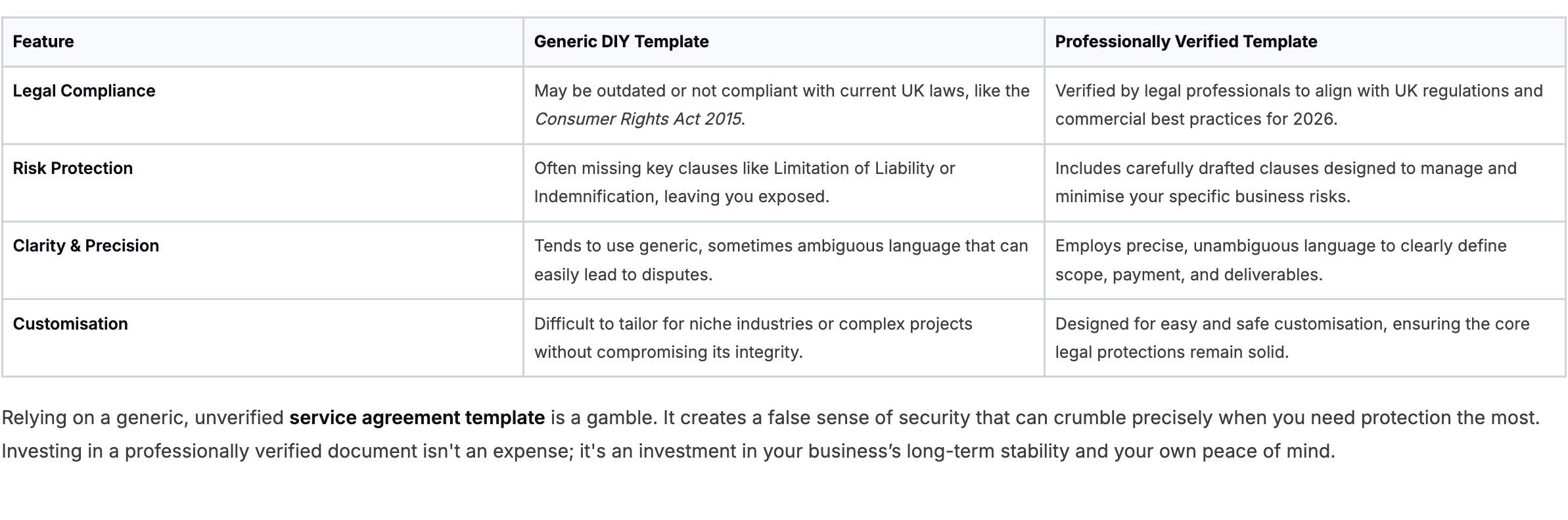
DIY Template vs Professionally Verified Template
It’s tempting to think all templates are more or less the same, but that’s a risky assumption. A generic file you download from a random website might look the part, but it often lacks the robust, jurisdiction-specific clauses that a professionally verified document contains.
Create a Service Agreement Here!
How to Create Your UK Service Agreement
Alright, you’ve seen what goes into a solid agreement and the common pitfalls to sidestep. So, how do you actually put one together without the headache and expense of a traditional solicitor?
Let's move from theory to practice. Creating a professional contract that properly protects your business doesn't have to be a long, drawn-out affair. With the right approach, you can go from a blank page to a finished, signed document in minutes.
Generate Your Custom Draft in an Instant
Getting your first draft sorted is incredibly quick. We’ve designed the process to be as straightforward as possible, boiling it down to just three simple steps:
- Pick Your Document: Start by finding and selecting the ‘Service Agreement’ from our document library.
- Answer a Few Questions: We’ll guide you through a short set of questions about your services, your client, and the specifics you’ve agreed on, like the scope of work, payment terms, and key deadlines.
- Generate Your Agreement: Once you’ve filled in the details, the system instantly creates a customised draft built around your answers.
This gives you a strong starting point. The draft already includes all the essential clauses needed for UK service providers, saving you from the hassle of starting from scratch and ensuring the core legal protections are baked in from the get-go.
The Value of Professional Verification
While a well-generated template is a huge time-saver, nothing beats the confidence that comes from a qualified legal expert giving it the final once-over. This is where professional verification makes all the difference. It ensures your agreement isn’t just good, but watertight under UK law.
Think of it as the final quality check before shipping a critical product. Automation gets you 99% of the way there, but a human expert’s review catches the nuances that make the document completely secure and fit for purpose.
This "human-in-the-loop" model gives you the best of both worlds: the speed and affordability of automation combined with the assurance of expert legal review. It removes any doubt, letting you move forward knowing your business is properly protected.
Ready to lock in your next project with confidence? Get started by creating your own freelance services agreement today and build stronger, more secure business relationships.
Create a Service Agreement Here!
Your Service Agreement Questions, Answered
Got a handle on the basics but still have a few nagging questions? That's completely normal. Let's tackle some of the most common queries we hear from freelancers and small businesses across the UK.
Is a Service Agreement Legally Binding in the UK?
Yes, it absolutely is. As long as it ticks the right boxes to be a proper contract, a service agreement is fully enforceable in a UK court.
For any contract to hold water, it needs a few key ingredients: an offer (you'll do the work) and acceptance (your client agrees to your terms). Something of value must be exchanged – usually your services for their money, which lawyers call consideration. Finally, both you and the client must genuinely intend to create a legally serious relationship.
Once you both sign on the dotted line, you’ve got a document that protects everyone involved.
What Happens If I Don't Use a Service Agreement?
Honestly? It's like tightrope walking without a safety net. You might make it to the other side, but you’re taking a massive, unnecessary risk with your business.
Working without a signed agreement is a direct invitation for scope creep, payment disputes, and fights over who owns the finished work. You're left completely exposed and a simple misunderstanding can quickly spiral into a costly legal mess.
Without a contract, you have no clear path to chase an unpaid invoice, no firm boundaries to stop a project from ballooning with endless "small" revisions, and no proof that you own the intellectual property you created. It's a recipe for damaged client relationships and serious financial headaches. A simple service agreement template gets rid of all that uncertainty from day one.
Can I Use One Agreement for International Clients?
You can, and you absolutely should. In fact, a solid agreement is even more crucial when your client is in another country. The last thing you want is a complex and eye-wateringly expensive legal battle across borders.
The secret is to include a Governing Law and Jurisdiction clause. This is the part of your agreement where you clearly state that the contract is governed by the laws of a specific part of the UK (like "England and Wales" or "Scotland") and that any legal action has to happen there. This simple clause ensures you're always playing on home turf, within a legal system you know and understand.
Do I Need a Solicitor to Draft My Agreement?
While hiring a solicitor is the gold standard for really complex or high-value deals, it's often overkill for the day-to-day work of most freelancers, consultants, and small agencies.
For most standard projects, a high-quality, professionally verified service agreement template is a much more practical and cost-effective choice. These templates are specifically designed to give you solid legal protection for common business scenarios, letting you formalise things with clients quickly and confidently, without the hefty legal bill.
Stop gambling with generic templates. With Robot Lawyer, you can generate a legally robust service agreement tailored to your needs and verified by a legal professional. Create your secure service agreement now.