
UK Online Will Writing Services Explained for 2026
An online will writing service is the modern, digital way to create a legally valid will, all from the comfort of your own home. For many people with straightforward estates, it's a much faster, more affordable, and convenient alternative to hiring a traditional solicitor.
The Rise of Online Will Writing Services in the UK
Let's be honest, the idea of writing a will can feel a bit daunting and complicated. It’s one of those important life tasks that many of us put off, but delaying can leave your loved ones facing the complex and often expensive rules of intestacy. A big shift is happening in the UK, though. More and more people are taking control and securing their family's future, largely thanks to the rise of accessible online solutions.
Think about the way you manage your money now compared to a decade ago. You probably use a banking app instead of queuing at a bank branch. An online will writing service offers that same kind of leap for estate planning. It takes a process that was once time-consuming, expensive, and full of legal jargon and turns it into a simple, manageable task you can tick off your list from your sofa.
The Modern Approach to Estate Planning
This shift to digital will writing isn't just a fleeting trend; it’s a response to the demands of modern life. People want more control over their personal affairs, and these online platforms deliver exactly that. The main reasons people are making the switch are clear:
- Cost-Effectiveness: Online services come with clear, fixed-fee pricing. This is often just a fraction of what you might pay a traditional solicitor.
- Convenience and Speed: There's no need to schedule appointments. You can create or update your will whenever and wherever suits you, often in under an hour.
- Simplicity and Clarity: Forget dense legal forms. These platforms guide you through with a simple question-and-answer format, which removes the guesswork and confusion.
And this isn't just a feeling; the numbers back it up. Recent data shows a growing number of people not only realise how important a will is but are using digital services to get it done. According to the UK Wills & Probate Consumer Research Report 2025, a record 41% of UK adults now have a will, up from 38% the year before. That means around 22 million people have taken this vital step, with many turning to online options. You can take a closer look at the UK will writing market trends.
An online will writing service empowers you to protect your assets and loved ones without the traditional barriers of time, cost, and complexity. It puts you in control of your legacy.
Ultimately, the growth in online will writing shows how technology is making essential legal tasks accessible to everyone. It gives individuals and families the confidence to take charge of their estate planning, ensuring their wishes are clearly recorded and legally binding for the future.
How an Online Will Writing Service Actually Works
The idea of writing a will online might sound a bit daunting, but it’s far more straightforward than you’d think. Forget dusty law books and confusing legal jargon. The best way to picture it is as a guided conversation, where a smart platform walks you through every question you need to answer.
It’s all designed to feel intuitive. Think of the service as an expert assistant whose only job is to gather all the necessary details to draft your will correctly, asking simple, clear questions along the way.
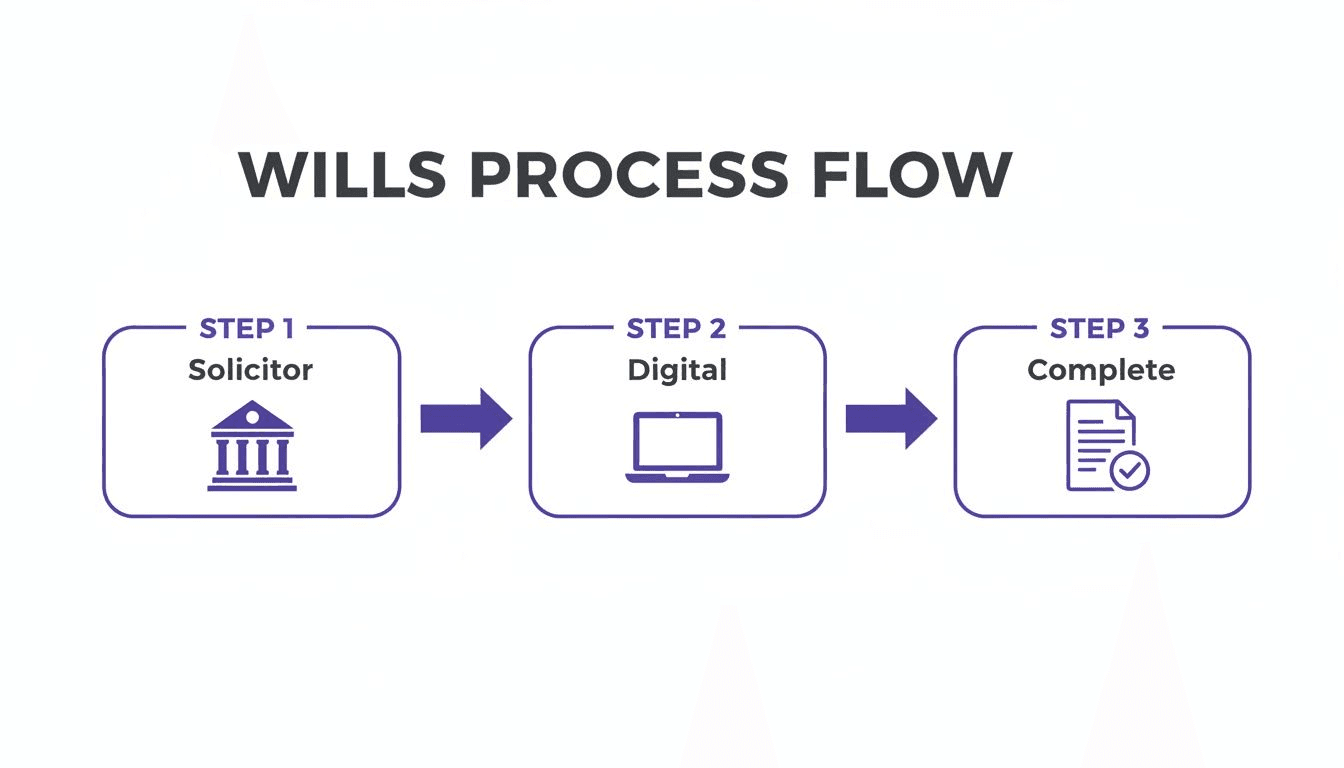
This diagram shows just how much the process has evolved, shifting from the old-fashioned solicitor's office to a direct, user-friendly digital experience.
Create a Verified Will here!
As you can see, the path to getting a legally sound document has become much more direct. You're in control from start to finish.
The Guided Digital Interview
So, how does it start? You'll begin by answering a series of structured questions about your life and your wishes. This isn't a test; it’s more like a fact-finding chat to build the foundations of your will.
The questions usually fall into three main categories:
- Your Assets: You’ll be asked to list what you own—things like property, savings, investments, and any significant personal belongings. You don’t always need to have exact, to-the-penny figures, but a clear picture is key.
- Your Beneficiaries: This is where you name the people (or charities) you want to inherit from your estate. The service makes sure you identify everyone clearly to prevent any confusion down the line.
- Your Executors: You’ll need to choose one or more people you trust to be your executors. These are the individuals responsible for making sure your wishes are carried out exactly as you’ve stated.
While you’re providing these answers, the software is doing the heavy lifting in the background. It takes your information and slots it into a legally watertight will template, which has been drafted and vetted by qualified legal experts. This process ensures all the correct legal clauses are included and personalised to your circumstances.
The real magic of an online will service is its ability to turn your simple answers into a precise, bespoke legal document, effectively removing the risk of drafting errors.
Once you’ve finished the questionnaire, the service generates your completed will. You then get to read through the whole document to double-check that it’s a perfect reflection of what you want. If you're curious to see this in action, you can learn more about how Robot Lawyer works and its step-by-step approach.
Making It Legally Binding
Getting the document drafted is the first major milestone. But for your will to be legally valid in the UK, it has to be signed and witnessed in a very specific way. This is the most critical part of the entire process, and any good service will give you crystal-clear instructions on how to get it right.
The Attestation Clause
This is the formal name for the signing section at the end of your will. It’s the part that makes it official. Here’s the procedure you must follow in England and Wales:
- Print Your Will: First, you must print a physical copy. In the UK, a will cannot be signed digitally.
- Gather Your Witnesses: You need two independent witnesses, both present with you at the same time. They must be over 18 and cannot be beneficiaries (or married to beneficiaries) in your will.
- Sign in Their Presence: You must sign the will while both of your witnesses are in the room, watching you do it.
- Witnesses Sign in Your Presence: Immediately after you’ve signed, your witnesses must add their own signatures in the designated spaces, all while you are watching them.
By following these four steps precisely, you turn the document you created online into a fully legal and binding testament. It’s this final, formal act that gives your will its legal power and provides peace of mind for you and your family.
Comparing Costs: Online Will Service vs Solicitor
Choosing how to write your will often boils down to one critical factor: the cost. It’s easy to just look at the price tags of an online service versus a traditional solicitor, but the real story is in the details. A proper financial breakdown shows you not just the initial payment, but the total value you’re getting, helping you figure out which path is truly right for you.

Create a Verified Will here!
The traditional route means hiring a solicitor for bespoke, face-to-face advice. While this personalised service is incredibly thorough, it definitely comes at a premium. On the other hand, the new wave of online will writing services has created a far more affordable and accessible option for most people.
The Upfront Price Difference
The most obvious contrast between these two options is what you pay right at the start. When you hire a solicitor, you’re paying for their time and expertise, either by the hour or as a fixed fee. This kind of one-on-one legal guidance is essential for complex estates, but it carries a significant price tag.
An online service, however, works on a completely different model. By using smart technology to guide you, these platforms can deliver a legally sound will for a fraction of the cost. The difference isn't just a few quid; it’s a total game-changer for making estate planning accessible to everyone.
The cost-effectiveness of online services is genuinely changing how people in the UK plan for their future. While a solicitor-drafted will typically sets you back between £150 and £500 (and sometimes more), online alternatives have brought this down to a much more manageable £90 to £150 for a single will.
This affordability has caused a major shift in the market. By 2025, traditional solicitors saw their market share drop to just 49%, as online platforms won over the rest with their ease of use and lower prices.
Total Cost of Ownership: Looking Beyond the First Draft
Your will isn't a document you create once and then file away forever. Life happens—you might get married, have children, or buy a house—and your will needs to change with you. This is where thinking about the "total cost of ownership" becomes so important.
- Solicitor Updates: If you need to amend your will after a major life event, it’s back to the solicitor's office. Each update is usually treated like a new piece of work, which means another fee, often similar to what you paid the first time. Over a lifetime, these update costs can really add up.
- Online Service Updates: This is where an online will writing service really comes into its own. Most platforms run on a subscription basis. For a small monthly or annual fee, you can log in and make unlimited changes whenever life calls for it. It means your will can always be up-to-date without the fear of a big bill.
With a solicitor, you pay for advice at specific moments in time. With a subscription-based online service, you pay for continuous access and the flexibility to adapt your will as your life evolves.
For instance, a service like Robot Lawyer offers plans that provide enormous value over the long run. A low monthly fee covers unlimited updates, ensuring your will always reflects your current wishes without any nasty surprises. You can explore the specific pricing options available to see exactly how this works.
To make the comparison even clearer, let's break down the costs and features side-by-side.
Evaluating Value for Your Situation
So, what’s the smartest financial choice? It really depends on you.
A solicitor is often the right move for people with very complex financial situations, properties abroad, or intricate family trust arrangements. In these cases, bespoke legal advice is non-negotiable, and the high cost is a reflection of the expertise needed to get it right.
However, for a huge number of people in the UK—including modern families, homeowners, and entrepreneurs with straightforward assets—an online will writing service is the most practical and cost-effective solution. The blend of a low starting price and the affordable, continuous ability to make updates gives you both immediate savings and long-term financial peace of mind.
Deciding between an online will and a traditional solicitor can feel like a major crossroads. The good news? The choice becomes much clearer once you take a hard look at your own circumstances. It's not about which option is "better" in a vacuum, but which is the right fit for you.
For a lot of people, an online will writing service is the perfect solution. These services are built for individuals and families with what we call "straightforward estates." That doesn't mean your life is simple, just that your assets and wishes are clear-cut and don't need complex legal gymnastics.
Think of someone like Sarah, a 38-year-old marketing manager in Manchester. She owns her home (with a mortgage), has two young kids, a workplace pension, and some savings. Her wishes are direct: if she passes away, everything goes to her partner. If they both pass, her assets are to be split equally between her children, with her sister stepping in as their guardian.
Sarah's situation is exactly what online will services are designed for. Her assets are all in the UK, and her instructions are unambiguous. An online platform can easily capture these wishes and turn them into a legally sound document, saving her the time and expense of seeing a solicitor.
Assessing Your Own Situation
So, how do you know if you're in the same boat as Sarah? Take a moment to think about your own estate. This checklist covers the common signs of a straightforward estate, where an online will is usually a fantastic choice.
If you can tick off most of these points, an online will is probably right for you:
- Your Assets are UK-Based: All your property, bank accounts, and investments are located within the United Kingdom.
- You Are a UK Resident: You live permanently in England or Wales. (Scotland has different laws, so always make sure the service is compliant if you're based there).
- Your Wishes are Clear: You know exactly who you want to inherit your estate (your beneficiaries) and you aren't expecting any major family disputes over it.
- You Don’t Need Complex Trusts: You're planning to leave direct gifts to people, not set up complicated trust funds with lots of specific rules.
- Your Estate is Below the Inheritance Tax Threshold: The total value of everything you own is less than the current Inheritance Tax (IHT) threshold, so you don't need advanced tax planning.
If your situation sounds a lot like this, you can move forward with an online will with confidence. For a closer look at the process, you might want to read our guide on creating a Last Will and Testament with our service.
When to Consult a Solicitor
While online services are powerful tools, they're not a one-size-fits-all answer. Some situations introduce layers of complexity that demand the tailored advice only a qualified solicitor can give. Trying to use an online service in these cases could create huge legal headaches for your loved ones down the road.
Let's look at a different scenario. Meet James, a 55-year-old business owner. He has a successful company with a complex share structure, owns a holiday home in Spain, and is on his second marriage with children from his first. He wants to leave the business to one child while making sure his current wife is financially secure—a balancing act that needs careful legal structuring.
For estates involving foreign property, business assets, potential family disputes, or significant Inheritance Tax liability, the expertise of a solicitor is not a luxury—it's a necessity.
Here are the key triggers that should make you pause and seek professional legal advice instead:
- You Own Foreign Assets: Property or bank accounts outside the UK are subject to different inheritance laws, and a standard UK will might not cover them properly.
- You Need to Set Up a Trust: If you need to create a trust to manage assets for a vulnerable person or to control how assets are passed on over time, a solicitor is essential.
- You Have a High-Value Estate: If your estate is likely to get hit with a large Inheritance Tax bill, a solicitor can provide crucial advice on tax-efficient planning.
- You Want to Exclude a Dependant: If you plan to leave a close family member out of your will (like a spouse or child) who could legally challenge it, a solicitor’s guidance is vital to make your will as robust as possible.
- You Have Complex Business Interests: Owning a business with partners or intricate shareholding structures requires expert legal drafting to avoid future chaos.
Ultimately, choosing the right path is about being honest about your needs. For straightforward estates, an online will writing service provides an affordable, efficient, and reliable way to protect your legacy. For anything more complex, a solicitor is always your safest bet.
Common Mistakes to Avoid With Online Wills
Using an online will writing service is a fantastic way to get your affairs in order, but it's not foolproof. A simple slip-up can cause major headaches for your loved ones down the road. Think of this section as your guide to sidestepping the common traps that can risk your will's validity.

Create a Verified Will here!
The single biggest and most devastating mistake we see is incorrectly signing and witnessing the will. Your will isn't just any old piece of paper; it has to be signed following strict legal rules. Get this part wrong, and the entire document could be thrown out.
Getting the Signing Process Right
In England and Wales, the law requires a specific signing ceremony, known as ‘attestation’. If you don't follow this procedure to the letter, it opens the door for your will to be challenged later on.
To make sure your will is legally sound, you must follow these steps precisely:
- Get your witnesses together: You and your two witnesses must all be in the same room.
- You sign first: You must sign the will while both witnesses are watching you do it.
- Witnesses sign next: Immediately after you’ve signed, both witnesses must then sign the will in your presence.
Who you choose as a witness is just as important. They must be over 18, and critically, they cannot be beneficiaries in your will. The same goes for their spouses or civil partners. Having an heir witness your will is a classic blunder that will legally prevent them from inheriting.
Avoiding Ambiguity and Oversights
Beyond the signing ceremony, the words you use in your will need to be crystal clear. Vague language or forgetting to include certain details can spark disputes that are both emotionally and financially draining for your family.
The need for clear planning has never been more critical. Probate disputes are on the rise across the UK, driven by an ageing population and a lack of proper estate planning. Formal challenges to wills, known as caveat applications, soared by 56% between 2019 and 2024, from 7,268 to 11,362. This trend is made worse by the 54% of adults who still haven’t made a will. You can read more about the rise of probate disputes from Wolferstans Solicitors.
Here are some other key mistakes to look out for:
- Using Ambiguous Language: Avoid general terms like "my personal items" or "my most valuable possessions." Be specific. Instead of "my car," write "my 2024 Ford Fiesta, registration AB12 CDE." This leaves no room for argument.
- Forgetting Backup Choices: What if your main beneficiary or your chosen executor dies before you do? It happens. Always name backups (contingent beneficiaries and substitute executors) to make sure your plan doesn't fall apart.
- Failing to Update Your Will: A will should change as your life does. Big events like getting married, divorced, buying a house, or having a baby all have a massive impact. Forgetting to update your will can have unintended results—for instance, getting married automatically invalidates any will you made before.
An out-of-date will can be just as problematic as having no will at all. Get into the habit of reviewing your will every few years, and always after a major life change.
By steering clear of these common errors, you can use an online will service with confidence, knowing your final wishes are secure and legally binding.
Your Questions About Online Wills, Answered
Stepping into the world of estate planning often brings up a few questions. It’s completely normal. So, let's clear up some of the most common queries about using an online will writing service and help you feel confident about the process.
Is an Online Will Actually Legally Binding in the UK?
Yes, absolutely. As long as you use a reputable online service, the will you create is fully legally binding—once you follow the correct signing procedure. This final, physical step is what makes the document official, and it's not something you can skip.
The law in England and Wales requires you to print your will and sign it in the physical presence of two independent adult witnesses. They then need to sign it in your presence, too. Don't worry, though. Any good service will give you crystal-clear, step-by-step instructions to make sure you get this crucial part right. (Note that Scotland has its own set of rules).
What if I Make a Mistake on My Online Will?
This is where online will services really shine. If you spot a mistake or your circumstances change, making corrections is incredibly simple. You don't have to go through the formal—and often expensive—process of getting a solicitor to amend the document.
Most platforms let you just log back into your account, make your changes, and then generate a fresh will to print and sign. This is often covered by a small subscription fee. With a service like Robot Lawyer, for instance, you can make those edits instantly. If you want extra peace of mind, premium plans usually include a review from a legal expert who can catch any potential issues before you finalise everything.
The freedom to easily correct mistakes or update your will after a major life event is a huge advantage of the online model. It ensures your will always reflects your wishes without racking up unexpected legal bills.
Do I Really Need to Include My Digital Assets?
You definitely should. In today’s world, our digital lives hold real value. These "digital assets" are a key part of many people's estates, covering everything from social media profiles and cryptocurrency wallets to precious online photo albums and important digital files.
A good online will writing service will specifically ask you about these assets. You can decide what happens to them and even name a "digital executor"—someone you trust to manage, transfer, or delete your accounts as you've instructed. Forgetting about your digital legacy is one of the most common modern mistakes in estate planning.
Ready to create your legally binding will with confidence? Robot Lawyer makes it fast, affordable, and straightforward. Start your free 7-day trial and secure your family's future today. Get started with Robot Lawyer.