
UK Child Travel Consent Form Your Complete 2026 Guide
A child travel consent form is a legal document giving a minor permission to travel internationally or domestically when both parents aren't present. It’s a crucial bit of paperwork for avoiding travel headaches and is increasingly demanded by airlines and border officials to help prevent child abduction.
Why You Need a Child Travel Consent Form in 2026
Planning a family holiday or school trip from the UK isn't what it used to be. One document that many once saw as optional has quickly become a non-negotiable part of any travel checklist: the child travel consent form. As we head into 2026, travelling without this simple letter can stop your journey in its tracks.
The days of assuming a shared surname is proof enough are long gone. Airlines and border officials have tightened their rules significantly, now demanding clear, written permission for any child travelling without both parents. This isn't just about red tape; it's a vital measure to prevent international child abduction and safeguard a child's welfare.
The New Reality at UK Borders and Beyond
The rules around child travel consent forms in the UK have shifted, especially after government guidance updates took effect in 2025. UK government advice now states that children under 18 travelling internationally without both parents must show written consent documentation when they arrive at border control. This is a big change, as UK law didn't always mandate these letters, leaving it up to individual airlines and border agents. You can get more details on these updated requirements and the concerns parents have over at Crosswalk Clan.
This extra scrutiny means situations that used to be simple now need proper paperwork.
- Travelling with one parent: Even if you're divorced, separated, or just the one parent taking your child on holiday, you need a form signed by the parent who isn't travelling.
- Journeys with grandparents or other relatives: That fun trip with grandma and grandad now needs a consent form signed by both legal parents.
- School trips or group travel: Teachers and other group leaders must carry a separate, signed consent form for every single child they are responsible for.
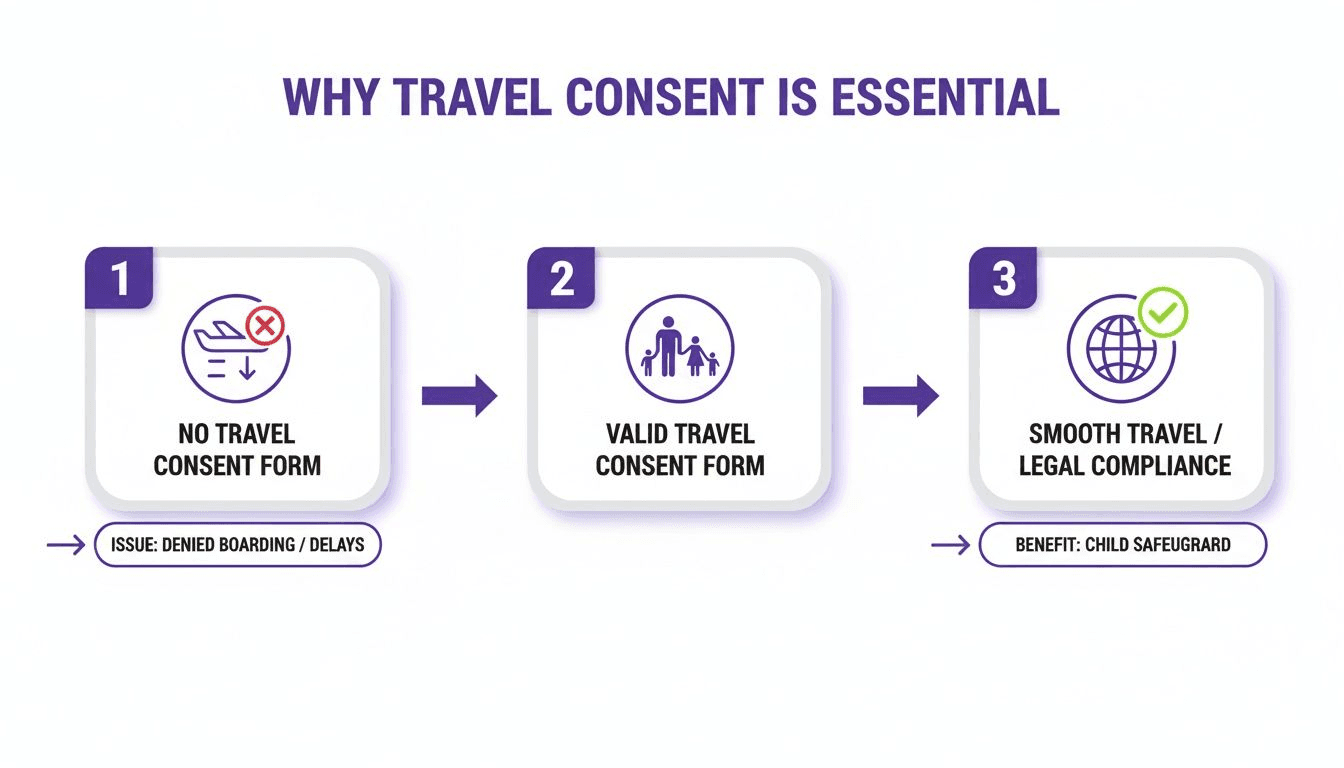
At its heart, a child travel consent form offers undeniable proof that the child is travelling with the full knowledge and permission of every legal guardian. Without one, you're essentially gambling your holiday on the discretion of an airline agent or immigration officer.
The Real-World Consequences of Forgetting the Form
Picture the scene: you're at the airport check-in desk, buzzing with excitement, when you're pulled aside. Your child is getting anxious as an airline representative explains you can't board the flight. This scenario is happening more and more. We've heard stories of families missing their long-awaited holidays and facing thousands of pounds in rebooking fees, all because they didn't have one properly signed document.
In one actual case, a mother flying to Portugal with her son was stopped right at the boarding gate. Because her husband wasn't there, the airline insisted on seeing a notarised letter of consent. The frantic scramble to find a solution almost made them miss their flight entirely.
These stressful situations are completely avoidable. Carrying a correctly filled-out child travel consent form gives you:
- Legal Protection: It acts as official proof that you have the other parent's permission to travel, protecting you from any potential accusations.
- Peace of Mind: It takes away the worry of being questioned or delayed, so you can actually relax and enjoy your trip.
- Smooth Passage: It ticks all the boxes for airlines and border agencies, paving the way for a hassle-free journey from beginning to end.
What to Include in Your Travel Consent Form
When you're preparing a child travel consent form, it's easy to think of it as just another permission slip. But in reality, it’s a detailed legal document that needs to satisfy both airline staff and border officials. A vague or incomplete form can cause just as many headaches as not having one at all.
The key is to fill every section with precise, accurate information. Your goal is to paint a complete, unquestionable picture of the trip and the child's circumstances, leaving no room for doubt.
Create a Free Child Travel Consent Form Here!
As you can see, a properly prepared document is often the only thing standing between a stressful travel nightmare and a smooth, authorised journey.
Key Information About the Child
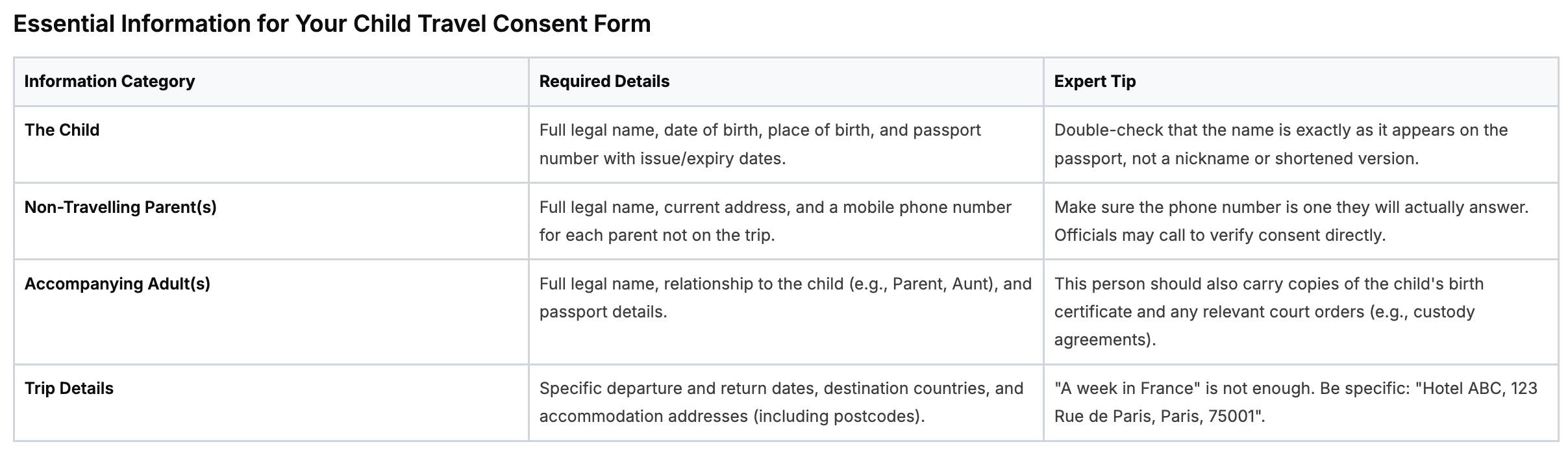
The foundation of the entire form is the child’s personal information. This section absolutely must be a perfect match for their official travel documents, like their passport. Don't use nicknames or shortened names; only their full legal name will do.
Any discrepancy, even a tiny typo, can raise a red flag and lead to lengthy questioning or, worse, a denied boarding.
Details of the Non-Travelling Parent(s) or Guardian(s)
This is where the actual consent comes from. The form needs to clearly identify the parent or legal guardian who is not travelling and confirm their permission for the trip. It’s absolutely vital to include their full contact information in case officials need to phone them to verify the consent on the spot.
Think of it this way: this section provides undeniable proof that everyone with parental responsibility is aware of and agrees to the travel plans. It’s your main defence against any hint of wrongful removal.
Make sure your form has a clear space for the full name, address, and mobile number of each non-travelling parent. If the child is travelling with grandparents or a school group, for example, then both parents need to be listed and must give their consent.
Information About the Accompanying Adult
If the child is travelling with just one parent, another relative, or a different responsible adult, that person’s information needs to be just as detailed. They are temporarily responsible for the child's welfare, and border officials need to know exactly who they are.
This section must be completed with the same level of care as the child's details, with all information matching their own passport.
To ensure your form is watertight, you need a checklist of all the essential information. Missing even one of these fields could cause problems with border officials or airlines.
Create a Free Child Travel Consent Form Here!
Finally, remember that the travel itinerary itself needs to be crystal clear. Vague details like "a week in Spain" simply won't cut it. You need to list exact departure and return dates, all destination countries, and even the specific addresses where the child will be staying.
Being specific is what gives the document its authority and provides the reassurance officials are looking for. You can use our straightforward template to generate a child travel consent letter that covers every one of these crucial details.
Getting Your Consent Form Officially Notarised

Create a Free Child Travel Consent Form Here!
For many international destinations, a simple signature on a travel consent form just won't cut it. Border officials need an extra layer of proof that the signatures are legitimate, and that’s where notarisation becomes essential.
This official verification process can be the difference between a smooth journey and a major travel headache. It elevates your form from a simple agreement to a legally sound document that’s recognised internationally.
The Notary Public Versus a Standard Witness
It's a common point of confusion: why can't a friend just witness the signing? The answer comes down to legal authority.
- Standard Witness: This is usually someone you know who can confirm they saw you sign the paper. While fine for some informal agreements, their signature holds very little weight with official bodies like border agencies.
- Notary Public: A notary is a specialist lawyer holding an internationally recognised public office. Their role is to independently verify the identity of signatories and witness them signing the document willingly. Their official stamp and signature are accepted worldwide as proof of authenticity.
For any child travel consent form you're using for international travel, a notary's seal is the gold standard. It’s a clear signal to an official in another country that your document has been properly vetted by a legal professional in the UK, removing any doubt about its validity.
Some countries are notoriously strict about this. Destinations like the USA, Canada, Brazil, and South Africa often require notarisation as a matter of course. Turning up without it could lead to delays or even being denied entry.
The Notarisation Process in the UK
Getting your document notarised is straightforward, but it does need a bit of preparation. The key thing to remember is that you must sign the form in the notary’s presence—you can’t sign it at home and bring it in.
The easiest way to find a professional is by searching online for a "notary public near me." You can also use the official directory maintained by The Notaries Society, which lists all practising notaries across England and Wales.
Here's what to expect at your appointment:
- Identity Verification: You and the other signing parent (if applicable) will need to prove who you are. A current passport or photocard driving licence is perfect for this.
- Document Review: The notary will give the form a once-over to make sure it’s filled out correctly. They won’t give you legal advice on what’s in it, but they'll check for completeness.
- Signing in Person: This is the crucial part. You will sign the document right there in front of the notary.
- Official Seal and Signature: Once signed, the notary will complete their own certificate, then add their official signature and embossed seal to the document.
In the UK, the cost to notarise a single document usually falls between £60 and £120, though this can vary depending on the notary's location.
Are Digital Notarisation Services an Option?
The legal world is modernising, and digital notarisation (or 'e-notarisation') is becoming more available. These services let you meet a notary over a secure video call to have documents signed and sealed electronically.
While incredibly convenient, their acceptance for international travel forms is still a mixed bag. Many border agencies are old-school and still want to see a physical document with a 'wet ink' signature and a traditional embossed seal.
Until there's a universally accepted global standard, the safest bet for your child travel consent form is traditional, in-person notarisation. If you’d like to understand more about how identity is verified in these processes, our guide on the Affidavit of Identity offers some useful context. Carrying that original, physically notarised form gives you peace of mind that your paperwork will be accepted, no matter where your travels take you.
Navigating International Rules and Extra Documents
While a notarised child travel consent form is your best bet for smooth travel, it's crucial to realise it's not a universal key. Different countries have their own specific rules and expectations. Thinking about your destination's requirements from the very beginning is the best way to ensure your documents will stand up to scrutiny, no matter which border you're crossing.
The country you're flying to ultimately sets the rules. Most will accept a properly drafted consent form, but some have unique preferences or require additional supporting paperwork. Knowing about these variations before you even book your flights can save you from a huge amount of stress at an international checkpoint.
Remember, the purpose of this paperwork is to proactively answer any question a border official might have. A complete set of documents tells a clear, undeniable story: that the child is travelling with full and transparent parental permission.
For example, imagine you're on a road trip that crosses several borders. If you drive from France into Switzerland, you are leaving the Schengen Area for a non-Schengen country. Officials at that land border are fully entitled to check your documents just as rigorously as an agent at an airport.
Destination-Specific Requirements
The best advice is always to check with the embassy of your destination country for the most up-to-date rules. That said, some popular destinations have well-known requirements for families travelling with children.
- The USA and Canada: Both countries are known for being particularly strict. A notarised child travel consent form is highly recommended, and in many situations, it's practically a requirement. Border agents here are trained to ask detailed questions.
- The Schengen Area: This zone covers 29 European countries with open internal borders, but the officials at your first point of entry can be very thorough. A consent form is a smart move, especially if the child has a different surname from the adult they're with.
- South Africa: This country has a history of having some of the world's most stringent rules for child travel, designed to combat trafficking. While the regulations have been relaxed, it is still strongly advised to carry the child's full unabridged birth certificate along with the consent form.
Extra Documents You Might Need
Think of your child travel consent form as the main document, but don't forget its supporting cast. Depending on your specific family situation, you should be ready to present other official documents to paint the full picture for border officials.
It's about building a solid case for your trip's legitimacy. The more supporting evidence you have, the smoother your journey will be. Make sure to carry originals or certified copies.
Here are some commonly requested supporting documents:
- The Child's Birth Certificate: This is fundamental. It proves the relationship between the child and the parents who signed the consent form.
- Parent's Death Certificate: If one parent is deceased, this document explains why their signature is missing from the form.
- Custody Agreements or Court Orders: For separated or divorced parents, a copy of the legal custody arrangement clarifies who has the authority to approve the child's travel.
- A Child Medical Consent Letter: It’s also wise to carry a separate document that authorises the travelling adult to make medical decisions in an emergency. You can learn more about how to prepare a child medical consent letter in our dedicated guide.
The UK Electronic Travel Authorisation (ETA) Scheme
Adding another layer to travel planning, the UK government's Electronic Travel Authorisation (ETA) scheme was fully rolled out between January and April 2025. This is a digital pre-screening system that introduces new duties for families with children under 18.
The scheme requires that contact details for someone with parental responsibility must be provided during the ETA application for any minor. You can find out more about how this system works by reviewing the official ETA scheme details). This change shows just how quickly travel rules can evolve and highlights the importance of staying current on all travel documentation, not just the consent form.
Common Mistakes That Can Derail Your Trip
A tiny error on a child travel consent form can spiral into a massive travel nightmare. I've seen it happen. Even with the best intentions, a simple oversight can lead to stressful delays, intense questioning from border officials, or even being denied boarding altogether.
Knowing what can go wrong is the best way to make sure everything goes right.
Create a Free Child Travel Consent Form Here!
It’s tempting to rush through the paperwork to get to the exciting part of the trip, but this is one document where every single detail matters. Getting it right from the start means your journey is smooth and worry-free.
Using Incomplete or Incorrect Names
One of the easiest mistakes to make—and to avoid—is using nicknames or partial names. The child travel consent form must show your child's full legal name, exactly as it’s printed on their passport. The same goes for the parents and any other adult travelling with them.
So, if your son's passport says "William," don't write "Will" on the form. A mismatch like that is an immediate red flag for airline staff and border agents, who are trained to spot inconsistencies.
This also applies to surnames. If your child has a different surname from the parent they're travelling with, a perfectly completed consent form is absolutely essential to prove the relationship. I always recommend carrying a copy of the child’s birth certificate in these situations, just to be safe.
Forgetting or Being Vague About Travel Dates
A consent letter that says "for travel in August" or "for a two-week trip" is pretty much useless. Officials need to see a clearly defined, authorised travel window. Vague timelines won't cut it.
Your form has to include:
- The exact date of departure from the UK.
- The exact date of return to the UK.
Think of a child travel consent form as a single-use, time-sensitive permission slip. It authorises one specific journey, not open-ended travel. That specificity is what gives the document its legal weight and assures officials the trip has clear boundaries agreed upon by everyone.
Providing Outdated Contact Information
Just imagine this scenario: a border official in another country needs to quickly verify your form. They try calling the non-travelling parent's number listed on the document, but it's an old number that’s disconnected. That instantly throws the whole document into question and could stop your trip in its tracks.
Always, always double-check that the contact details for the non-travelling parent(s) are current. Make sure they’ll be reachable during the travel dates—a mobile number is usually best. This simple five-second check can save you from a world of stress.
Getting the Witnessing or Notarisation Wrong
For many trips, especially international ones, just signing the form isn't enough. A common mistake is getting a friend to witness the signature, thinking that’s all you need. The reality is, for most countries, a standard witness signature doesn't carry much legal weight.
A notary public provides an official stamp of verification that the signatures are genuine, which is the gold standard for international travel.
Here's another critical error: signing the form before you get to the notary's office. The whole point of notarisation is for the notary to watch you sign it in person. If you show up with a pre-signed document, they’ll just make you fill out and sign a new one.
How Robot Lawyer Prevents These Mistakes
When you're trying to create a document from scratch or using a generic template you found online, it's easy to fall into these common traps. A platform like Robot Lawyer is designed to prevent these errors. Our smart questionnaire walks you through the process, prompting you for specific details like exact travel dates and full legal names, which takes out all the guesswork.
Here’s a quick look at how using a guided platform stacks up against going it alone.
DIY Form vs Robot Lawyer Generation
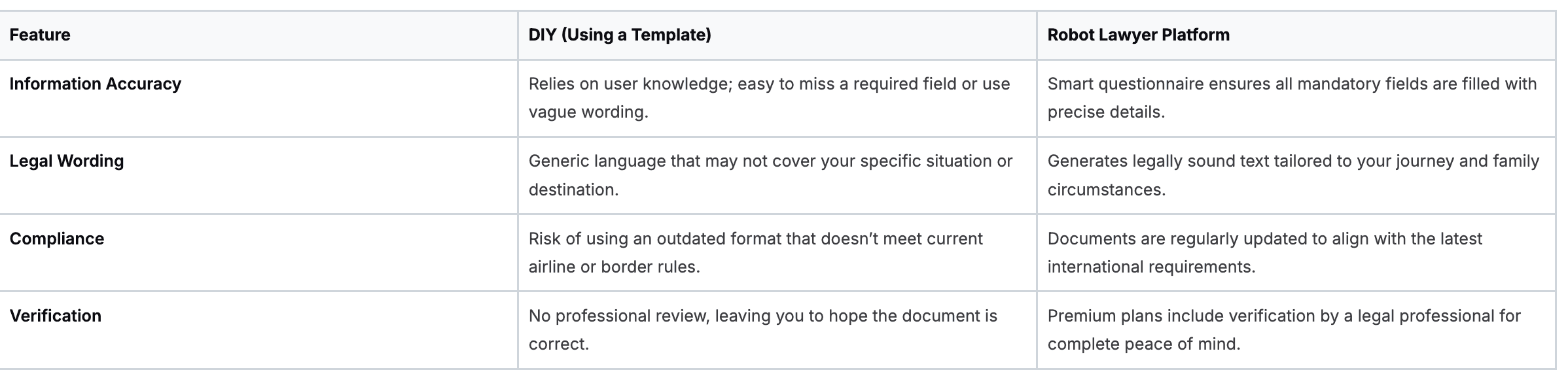
Create a Free Child Travel Consent Form Here!
Ultimately, by using a service designed to eliminate these common mistakes, you can travel with confidence, knowing your **child travel consent form** is compliant, comprehensive, and ready for any border crossing.
Of course. Here is the rewritten section, adopting the voice, tone, and formatting of the provided examples.
Frequently Asked Questions
Planning a trip with a child can bring up a lot of questions, especially around the legal paperwork. Getting clear, straightforward answers is the key to preparing with confidence and ensuring your journey goes smoothly.
Here, we'll tackle some of the most common queries we see from parents and guardians about child travel consent forms.
Do I Need a New Consent Form for Every Trip?
Yes, you must have a new, specific consent form for each trip. Border officials are trained to look for specific details and will almost certainly reject a generic form that simply authorises travel "for the summer" or for an indefinite period.
Each form needs to state the exact travel dates and the specific destinations for that journey. This precision is what gives the document its authority and reassures officials that the trip has clearly defined, agreed-upon boundaries. It’s a small bit of extra admin that prevents major headaches at the border.
Think of a travel consent form like a single-use ticket. Its validity is tied to one specific journey, with clear start and end points. This is what gives it legal weight.
What if the Other Parent Refuses to Sign?
This is a delicate situation that needs to be handled carefully. If you have a court order that grants you sole custody, you can generally travel by carrying a copy of that order with your signed consent form. This legally explains why the other parent’s signature is missing.
If you share custody and the other parent is withholding their consent without a good reason, you will need to seek legal advice. The next step is often to apply for a Specific Issue Order from a court, which can grant you permission to take the child on that specific trip.
- Don't delay: It is critical to start this process well in advance, as court applications can take a significant amount of time to resolve.
- Never travel without permission: Attempting to leave the country without the necessary consent could lead to serious consequences, including accusations of child abduction.
Is a Digital Copy of the Form Enough?
While keeping a digital copy on your phone is a great idea as a backup, you must carry the original, signed hard copy with you at all times during your travels.
Many airlines and almost all border officials will insist on seeing the original document. They need to inspect the "wet ink" signatures and, if applicable, the physical stamp or seal from the notary. The physical form is the primary legal document, so keep it in a safe place with your passports and other critical papers.
How Does Robot Lawyer Simplify This Process?
Instead of you having to search for a reliable template and worrying about missing a crucial detail, Robot Lawyer makes the process straightforward. Our platform guides you through an intelligent questionnaire, asking for all the necessary information—from full legal names to the specific travel itinerary.
This ensures the document generated is comprehensive and tailored to your exact trip. For complete peace of mind, our Premium plan includes verification by a legal professional. They review the document to ensure it's flawless and meets current international standards, so you can travel without worrying about paperwork problems.
Navigating legal documents can be complicated and time-consuming. With Robot Lawyer, you can generate precise, compliant documents in minutes. Our AI-powered platform, verified by legal professionals, removes the guesswork and gives you the peace of mind you need. Start your 7-day free trial with Robot Lawyer today!