
Secure Your Vision: how to protect business idea, UK 2026
Protecting your business idea is a two-part game: documentation and confidentiality. The easiest way to put a protective bubble around your concept is to treat it like a trade secret from the very start. That means keeping quiet and creating a dated paper trail of your work. It's a simple, no-cost defensive line you can draw while you figure out the bigger legal moves.
Your First Moves: How to Protect Your Idea From Day One
That lightbulb moment is thrilling. But your idea is at its most vulnerable right at the beginning. Think of it less like a finished product and more like a secret recipe you're still perfecting. The first rule is the simplest, and often the hardest: keep it to yourself.
Before you even think about lawyers or patents, your strongest shield is discretion. Get into a "need to know" mindset. Who really needs the full picture right now? Probably fewer people than you think. This isn't paranoia; it's about staying in control of your most valuable asset.
Document Everything (And We Mean Everything)
You need to create a rock-solid record of your idea's journey. This doesn’t have to cost a penny in legal fees.
Start a dedicated, secure digital folder. Into that folder goes every scrap of work related to your idea—napkin sketches, late-night brainstorms, market research, and early drafts of your business plan.
Using cloud storage that automatically timestamps your files is a game-changer. It builds an undeniable log of when you created and modified things, proving you had the concept at a specific point in time. While this "poor man's copyright" won't win a court case on its own, it’s powerful evidence in any early-stage argument.
The Bottom Line: Your goal is to build a body of evidence. If a dispute ever comes up, being able to prove when you developed your idea gives you a massive advantage. Consistent, dated documentation is your first line of defence.
Do a Quick IP Self-Audit
Before you start spending money, take five minutes to figure out what kind of intellectual property (IP) you’re actually dealing with. Different ideas need different kinds of protection, and knowing which bucket you fall into helps you focus your efforts and your budget.
Here’s a quick guide to help you sort it out:
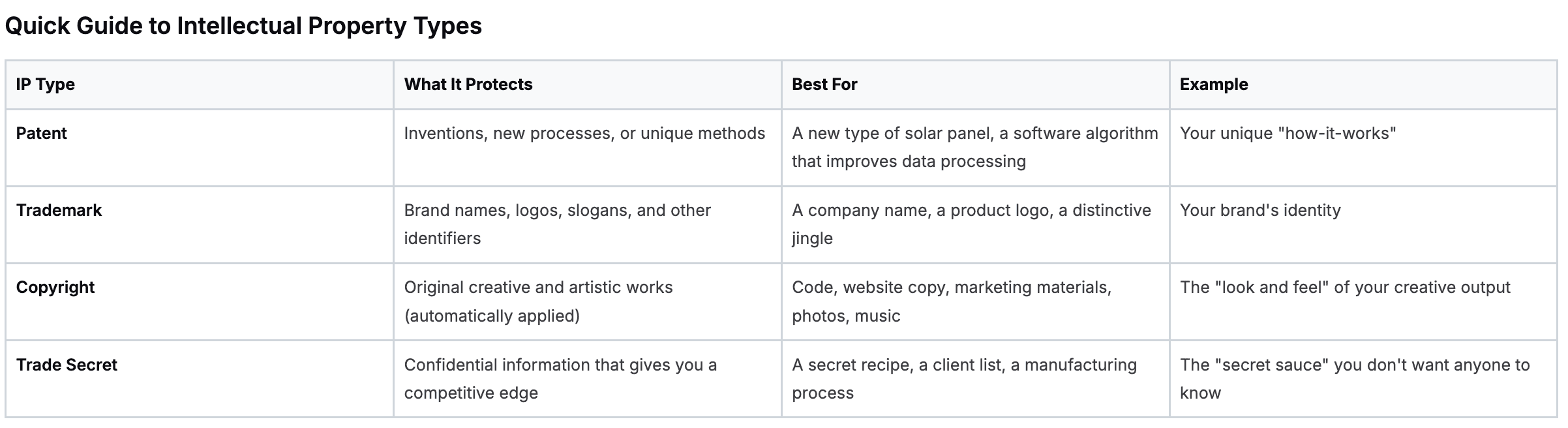
Getting this right from the start is crucial. The UK's business scene is fierce, and founders are wising up to the need for early protection. Just look at the numbers: the UK Intellectual Property Office saw 10,368 trade mark applications in December 2025 alone.
That figure, from the government's own intellectual property statistics report, shows just how vital it is to lock down your brand identity early. Figuring out which category your idea belongs to is the first real step in building a protection strategy that actually works.
Choosing Your Shield: Patents, Trademarks, Copyright, or Trade Secrets?
Once you’ve got your idea documented and buttoned up internally, it’s time to decide on the right kind of armour. This is a massive step. You’re moving from keeping things quiet to potentially making a public claim, and picking the right shield—whether it's a patent, trademark, copyright, or just good old-fashioned secrecy—is absolutely critical.
Don't make the common mistake of thinking these are interchangeable. They aren’t. Each one protects a very different part of your business, like having a different tool for a specific job. Getting this wrong can be an expensive lesson, leaving your crown jewels exposed while you’re busy protecting something less valuable.
This flowchart lays out the fundamental choice you need to make: does your advantage come from secrecy, or do you need to go public to own it?
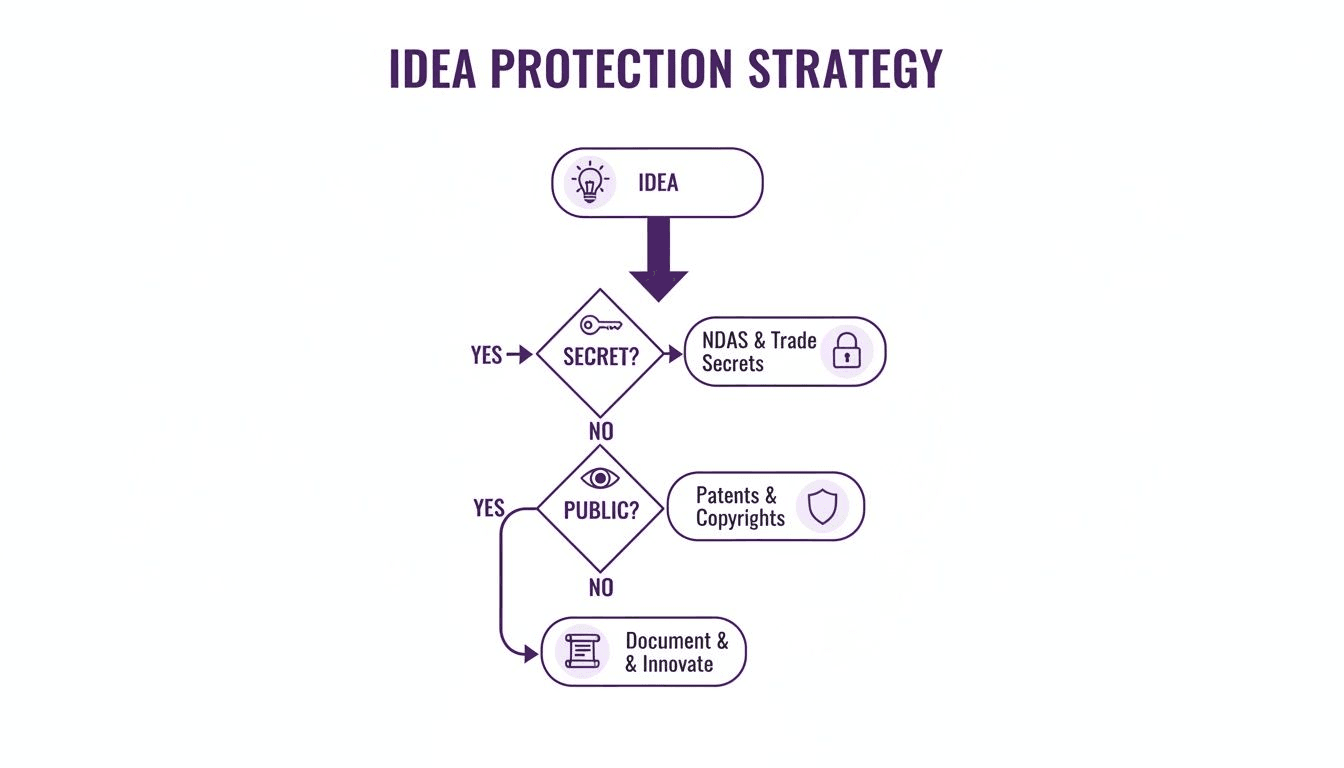
As you can see, it forces a hard look at where your real competitive edge lies. Let's break down what each of these shields actually does.
Patents: For How Things Work
If you've invented something truly new, a patent is the ultimate prize. It gives you a legal monopoly over your invention for up to 20 years, meaning no one else can make, use, or sell it without your say-so. But this kind of power doesn't come easy—or cheap.
To even be considered for a patent in the UK, your idea has to tick three specific boxes:
- It must be novel – completely new, with no public disclosure anywhere in the world before you file.
- It must be inventive – not just an obvious tweak to something that’s already out there.
- It must have an industrial application – you have to be able to actually make or use it.
Think of a startup that’s cracked the code on a new, hyper-efficient battery chemistry. That's a perfect candidate for a patent. The exclusive rights give them the breathing room to find investors and scale up without a corporate giant swooping in to copy their core tech.
The commitment is huge, but so is the payoff. A look at the UK patent statistics from 2025 shows a steady stream of innovators protecting their work—with filings hitting 620 in April and staying strong. You can dive into the raw data yourself by checking the government's intellectual property statistics report.
Trademarks: For Your Brand and Identity
While patents cover the function of an idea, trademarks protect your brand. A trademark is any sign—a name, a logo, even a specific colour or sound—that tells customers, "This is us." For almost any business, this isn't optional; it's essential.
Your brand is how people find you, trust you, and remember you. If you don't register your trademark, another company can legally set up shop with a confusingly similar name or logo, piggybacking on your hard work and confusing your customers.
Key Insight: Registering your company name at Companies House does not give you trademark rights. It only stops someone else from registering the exact same company name. It offers zero protection against someone trading under a similar name to steal your thunder.
Say you launch an amazing coffee shop called "Morning Buzz." Without a trademark, another café could open down the street as "Morning Buzz Coffee" and legally ride your coattails. A registered trademark gives you the power to shut that down.
Copyright: For Your Creative Output
Copyright is an automatic right that kicks in the moment you create something original. It covers a huge range of things: the code for your app, the words on your website, your marketing materials, your product photos, and more.
The best part? You don't have to register for copyright in the UK. It’s yours the second you create the work. The real challenge isn't getting the right, but proving you own it if someone rips you off.
This is exactly why all that early documentation is so important. Your timestamped documents, sketches, and drafts are your evidence. If a competitor copies your website text word-for-word, you can use your dated original files to prove you were first and force them to take it down.
Trade Secrets: For Your Hidden Advantages
Finally, some of the most powerful business ideas are protected by simply keeping them secret. A trade secret is any confidential information that gives you a competitive edge—think customer lists, a secret manufacturing process, or a unique algorithm. The most famous example in history is the formula for Coca-Cola.
This is the right path for valuable assets that can't be patented or aren't public-facing. Protection lasts as long as the information stays secret. This isn’t a passive strategy, though. It demands strict internal controls, solid NDAs for anyone who gets a peek, and a company culture that values confidentiality above all else.
Mastering NDAs and Employment Contracts
So you’ve documented your idea and figured out the best formal protection. That’s a massive step. But the game changes the second you need to talk to someone else—a potential partner, an investor, or even a new hire. You’ve now introduced human risk.
A casual chat over coffee is just that—a chat. It’s not legally enforceable, which is why you need solid legal agreements in place. These documents are the next critical layer of your protection strategy, turning verbal understandings into commitments with real consequences. Without them, you’re just relying on trust, and that’s a risky foundation to build a business on.

The Power of the Non-Disclosure Agreement
The Non-Disclosure Agreement (NDA) is your best friend for any confidential discussion. It’s a contract that legally binds the other person to keep your secrets, well, secret. But here's the thing: not all NDAs are the same, and using the right one is crucial.
You'll mainly come across two types:
- One-Way NDA: You use this when you're the only one spilling the beans. Think of pitching your idea to a contractor or a consultant. They don't need to share their confidential info, but you need them to protect yours.
- Mutual NDA: This one’s for when both sides are sharing sensitive information. It’s perfect for exploring a potential partnership where you both need to see under the bonnet of each other's operations.
Picking the wrong type can either leave you exposed or just create pointless friction. For most initial chats with service providers, a one-way NDA does the job perfectly.
Key Clauses Your NDA Must Have
Grabbing a generic template off the internet is a recipe for disaster. A strong NDA needs to be tailored to your specific situation to have any real teeth. If you overlook the details now, the agreement could be useless when you need it most.
Here’s what your NDA absolutely should cover:
- A Clear Definition of "Confidential Information": Don't be vague and say "business information." Get specific. List out things like financial data, customer lists, marketing strategies, software code, and technical specs. The more precise you are, the less wiggle room there is later.
- Exclusions from Confidentiality: The agreement also needs to state what isn't confidential. This usually covers information that’s already public or stuff the other person knew before you even spoke to them.
- The Recipient's Obligations: This part needs to be crystal clear. State that they can only use the information for the agreed purpose (e.g., "to evaluate a potential business partnership") and can’t show it to anyone else without your written permission.
- The Duration of the Obligation: How long does the secrecy last? A period of 3-5 years is pretty standard, but it really depends on how long your information stays valuable.
- Consequences of a Breach: What happens if they break their promise? This clause should state that you can get a court order to stop them (injunctive relief) and sue for financial damages.
Expert Tip: Never feel awkward about asking for an NDA before you dive into the details. Any legitimate partner or professional will get it. If they kick up a fuss, that’s a massive red flag about their intentions.
Securing IP in Employment and Freelancer Contracts
It's not just about protecting your idea from outsiders; you need to think about your internal team too. Anyone who helps create your product—whether they're a full-time employee or a freelance developer—is generating intellectual property. And if you don't have a contract stating otherwise, they could argue they own the work they did for you.
This is why a strong Intellectual Property (IP) Assignment Clause isn't just nice to have; it's non-negotiable. This clause, tucked into an employment or freelancer agreement, makes it explicit that any work, ideas, or inventions created for the company belong 100% to the company.
Imagine hiring a freelance designer for your logo. Without an IP assignment clause, they could pop up later claiming they own the copyright, giving them the power to ask for more money. A proper contract kills that risk from the start, ensuring you own everything you pay for.
Getting this right early on prevents gut-wrenching and expensive ownership battles down the road. As your team grows, these documents become the legal spine of your business. You can learn more about how to create a solid Non-Disclosure Agreement with tools like Robot Lawyer to get started on the right foot.
How to Pitch Your Idea Without Giving It Away
You have to talk about your idea to get feedback, find partners, or secure that all-important funding. But this creates the classic founder's Catch-22: how do you share your vision without just giving the whole thing away? The fear of someone stealing your idea is very real, but staying completely silent is a guaranteed path to failure.
The trick is to master the art of the strategic, or ‘staged,’ reveal. It’s all about building excitement and showing the value of your idea without handing over the keys to your secret sauce.
Prepare a Non-Confidential Pitch
Here’s a hard truth: most serious investors, particularly venture capitalists, will not sign a Non-Disclosure Agreement (NDA) before a first meeting. They look at hundreds of ideas, and signing an NDA for every single one would create a legal nightmare, possibly blocking them from investing in similar businesses later on.
Instead of fighting this reality, you need to prepare for it. Your first move should be to create a powerful, non-confidential pitch deck that focuses on everything except the proprietary mechanics.
This deck needs to tell a compelling story, covering:
- The Problem: Clearly lay out the pain point you’re solving. Use real data and stories to show just how big and important this problem is.
- The Market Opportunity: Show them the numbers. Investors need to see that you’re aiming for a large and growing customer base.
- Your Solution (The ‘What’, Not the ‘How’): Describe what your product or service does for the customer and the benefits it provides. Focus on the value, not the inner workings.
- Your Team: Sell yourselves. Highlight why you and your team are the absolute best people to solve this problem. Often, your expertise and passion are more valuable than the idea itself.
This approach allows you to have genuinely productive conversations while keeping your most valuable technical details or processes under wraps.
Navigating the "How Does It Work?" Question
Sooner or later, someone is going to push for more detail. They'll hit you with the "how." This is a critical moment where you need to have a simple, polite, and firm response ready to go.
Key Takeaway: An idea on its own has very little value; execution is everything. Investors know this. In an initial meeting, they're often far more interested in your team's ability to deliver and your grasp of the market than the nitty-gritty details of your tech.
If someone presses you for proprietary information, you can use replies like these:
- "That’s a great question. The specific technology that makes it work is something we consider a core trade secret. We’d be more than happy to do a deep dive into the technical architecture under an NDA once we’ve established a mutual interest to move forward."
- "We’ve developed a proprietary process to achieve that, and it's what gives us our competitive edge. For now, let's focus on the market fit and the amazing results our approach delivers for customers."
- "The 'how' is really our secret sauce, but what I can tell you is that it allows us to deliver [benefit X] at a 50% lower cost than any current solutions. That’s the key business advantage."
Notice that these replies aren't confrontational. They acknowledge the question, reinforce the value of your intellectual property, and professionally park the conversation for a later, more secure stage. This shows you're a savvy founder who knows how to protect your business—a big plus in any investor's book.
Protecting Your IP with Co-Founders and Contractors
It's easy to focus on outside threats when you've got a brilliant business idea. But often, the most damaging intellectual property disputes don't come from competitors—they come from inside your own team.
When you're caught up in the excitement of a new venture, it's tempting to dive straight in with co-founders or hire a contractor to get things moving. Legal paperwork can feel like a drag. But without clear agreements, the very people helping you build your business could legally walk away with critical parts of it.
This is a surprisingly common—and completely avoidable—trap. Setting clear boundaries isn't about mistrust. It's about building a professional foundation for a partnership that can go the distance.
Why You Need a Founders' Agreement
Bringing on a co-founder without a formal agreement is like trying to build a house with no blueprints. Everyone starts off optimistic and on the same page, but what happens when you disagree on a major decision? Or when one founder wants out?
A Founders' Agreement is the single most important document you can have to stop early-stage partnerships from falling apart. It’s a contract that forces you to have those tough, essential conversations while everyone is still friends.
A solid agreement needs to cover a few key areas:
- Equity Distribution: How is the ownership split? Is it a straight 50/50, or does it reflect who brought what to the table—the initial idea, the capital, the late nights?
- Roles and Responsibilities: Who does what? Clearly defining roles from the outset minimises friction and makes sure nothing important falls through the cracks.
- Vesting Schedules: This is non-negotiable. A vesting schedule means founders earn their equity over time, usually over four years with a one-year "cliff". If someone leaves after just six months, they don't get to keep a quarter of the company. It protects the business from losing huge chunks of equity to someone who didn't stay for the journey.
- IP Assignment: The agreement must state that any intellectual property created for the business by a founder belongs to the company, not the individual who came up with it.
Scenario: Picture two founders starting a software company. One founder writes all the source code. A year in, they have a massive argument and the coder leaves, claiming they personally own the copyright to the software. If there’s no Founders' Agreement with an IP clause, they could be right, and your business is dead in the water.
Handling Contractors and Freelancers
The risk doesn't stop with co-founders. When you pay a freelancer—a developer, a designer, a writer—they are creating intellectual property for you. But under UK law, the default rule is that the creator owns the copyright unless you have a written agreement that says otherwise.
That means if you hire a developer to build your app with only an invoice as proof, they could legally own the code they wrote for you. They’d be free to sell it to someone else or charge you a fortune to transfer the rights.
To dodge this nightmare, you must have a Consultancy Agreement or Contract for Services signed before any work starts. This contract absolutely needs an Intellectual Property Assignment Clause. This simple clause ensures that once you've paid them, all rights and ownership of the work they created are transferred to your company. It's a few lines of text that can save you from a catastrophic legal and financial headache down the road.
If you're ready to get this sorted, you can find out more about what makes a rock-solid Co-Founder Agreement.
Common IP Mistakes and When to Seek Expert Advice
Navigating the world of intellectual property can feel like walking through a minefield. As a founder, you're rightly focused on building your idea, but a few common IP missteps can stop you in your tracks before you've even properly started.
One of the most catastrophic mistakes is public disclosure before you've filed for a patent. It's so easy to do. You get excited and talk about your invention at a conference, demo it to a potential customer, or even mention it in a blog post. If you do that before filing, you've likely lost your right to patent it in many countries, including the UK. You’ve just destroyed its novelty, effectively donating your idea to the public.
Another trap I see founders fall into is confusing a company registration with brand protection. Registering your business name at Companies House does one thing and one thing only: it stops someone else from registering a limited company with the exact same name. It offers zero protection for your brand itself.
A registered trademark is what actually protects your brand identity—your name, logo, and slogan. Thinking a company name registration is enough leaves the door wide open for competitors to piggyback on your hard-earned reputation.
When to Bring in the Professionals
Knowing when to stop the DIY work and call in an expert is a crucial skill. You can absolutely handle the initial documentation and get basic NDAs in place, but there are moments when professional guidance isn't just helpful—it's essential.
It’s time to get an expert on your side if you:
- Are seriously considering a patent. The application process is notoriously complex and expensive, with very little room for error. An expert can give you a realistic assessment of your chances and draft an application that will actually hold up.
- Need to register a trademark in multiple countries. International trademark law is a tangled web, and a professional can help you secure your brand in all the markets that matter to your business.
- Are sitting down to negotiate with a major corporate partner or investor. Their legal team will be looking for any advantage. You need someone in your corner who can level the playing field and protect your interests.
- Are facing a potential IP infringement. Whether someone is copying your work or you've just been hit with a cease and desist letter, you need to get legal advice immediately.
Ultimately, asking for help isn’t a sign of weakness; it’s a smart, strategic investment in your company's future. Using a service like Robot Lawyer is a fantastic, affordable way to generate and verify your essential legal documents. It also helps you understand when it's time to bring in a specialist IP solicitor for more tailored advice.
Common Questions About Protecting Your Idea
When you're sitting on a great business idea, a lot of questions pop up. It’s only natural. Getting your head around the legal side of things is crucial for making smart moves and protecting your hard work. Let’s tackle some of the most common queries we hear from founders.
Can I Patent an App Idea in the UK?
This is a big one. The short answer is no, you can't patent an 'idea' on its own. What you can potentially patent is the unique software process or specific method your app uses to solve a technical problem in a new way.
Think of it like this: the general idea for a food delivery app is not patentable. There are loads of them. But, if your app uses a brand-new algorithm that analyses real-time traffic and weather patterns to slash delivery times in a way no one else has done, that specific technology might be patentable.
The technology has to be novel, inventive, and have a real technical effect beyond just being software on a computer. It's a tricky area, so getting an IP expert to look at your specific case is always a good move.
How Much Does It Cost to Protect a Business Idea?
The cost really depends on which protection route you go down. The good news is that some of the most important first steps cost next to nothing. Properly documenting your work as you go and using Non-Disclosure Agreements (NDAs) for sensitive chats are powerful, low-cost starting points.
When you get to formal registration, the costs become clearer:
- UK Trademark Application: A standard online application starts at around £200.
- UK Patent Application: This is a much bigger investment. You're often looking at several thousand pounds once you include the professional fees for drafting and seeing the application through.
It's all about prioritising your spending. Focus on what provides the most essential protection for your business model right now.
A Word of Warning: You might have heard of the 'poor man's copyright'—mailing a copy of your work to yourself to prove a creation date. This method is not recognised as legal protection in the UK and carries very little weight in court. Copyright is automatic when you create something, but proving when you created it is key. Time-stamped digital files are far more effective.
Ready to get the right legal documents in place to protect your idea? Robot Lawyer offers AI-powered, expert-verified contracts and agreements that are quick, affordable, and built for your needs. You can generate your NDAs, employment contracts, and more in minutes at https://robotlawyer.co