

If you need a redundancy letter template UK, the letter itself is only one part of the job. Before any dismissal is confirmed, employers need a genuine redundancy reason, a fair consultation process, and wording that matches what has actually happened.
This is where many small businesses go wrong. A template can help with structure, but it cannot fix a weak process. Simply changing the employee's name, adding a termination date, and sending the letter will not make the redundancy fair or compliant.
This guide explains how to handle redundancy letters properly in 2026, what each stage of the paperwork should do, and the common mistakes that lead to disputes. If the process is sound, the final letter becomes much easier to draft and defend.
Navigating the Redundancy Process with Confidence
A typical small business scenario looks like this. A founder has kept the team together through a difficult trading period, cut non-essential spend, paused recruitment, and tried to move work around internally. Eventually one function no longer supports the business in the same way it used to. The owner knows a role may no longer be needed, but worries that saying the wrong thing in writing will make a difficult situation worse.
That concern is justified. Redundancy letters sit at the intersection of employment law, communication, and human judgment. They need to be clear enough to protect the business and careful enough to show the employee they are being treated fairly.
What usually works is a process that is both structured and human:
- Name the business reason clearly: Use plain language. If the business is closing a site, say that. If the business needs fewer employees doing a particular kind of work, say that.
- Separate the role from the person: Redundancy is about the role ceasing or reducing. It is not a backdoor performance process.
- Keep each letter tied to a specific stage: An at-risk letter does a different job from a final confirmation letter.
- Document discussions properly: Notes from meetings, scoring records where relevant, and written outcomes matter.
Practical rule: If your letter is doing all the explanatory work by itself, the process is probably too thin.
The aim isn't to produce a beautifully formal document. The aim is to create a fair record that matches what happened. That gives you something far more valuable than polished wording. It gives you confidence that the decision can stand up if it's challenged.
Create a redundancy letter here!
Understanding the Legal Framework for UK Redundancy
A small business owner closes one location, keeps trading from another, and assumes every affected employee can receive the same redundancy letter. That is often where trouble starts. The legal reason for redundancy depends on what is changing in the business, and the wording needs to reflect that reality.
Create a redundancy letter here!
Start with the real statutory reason
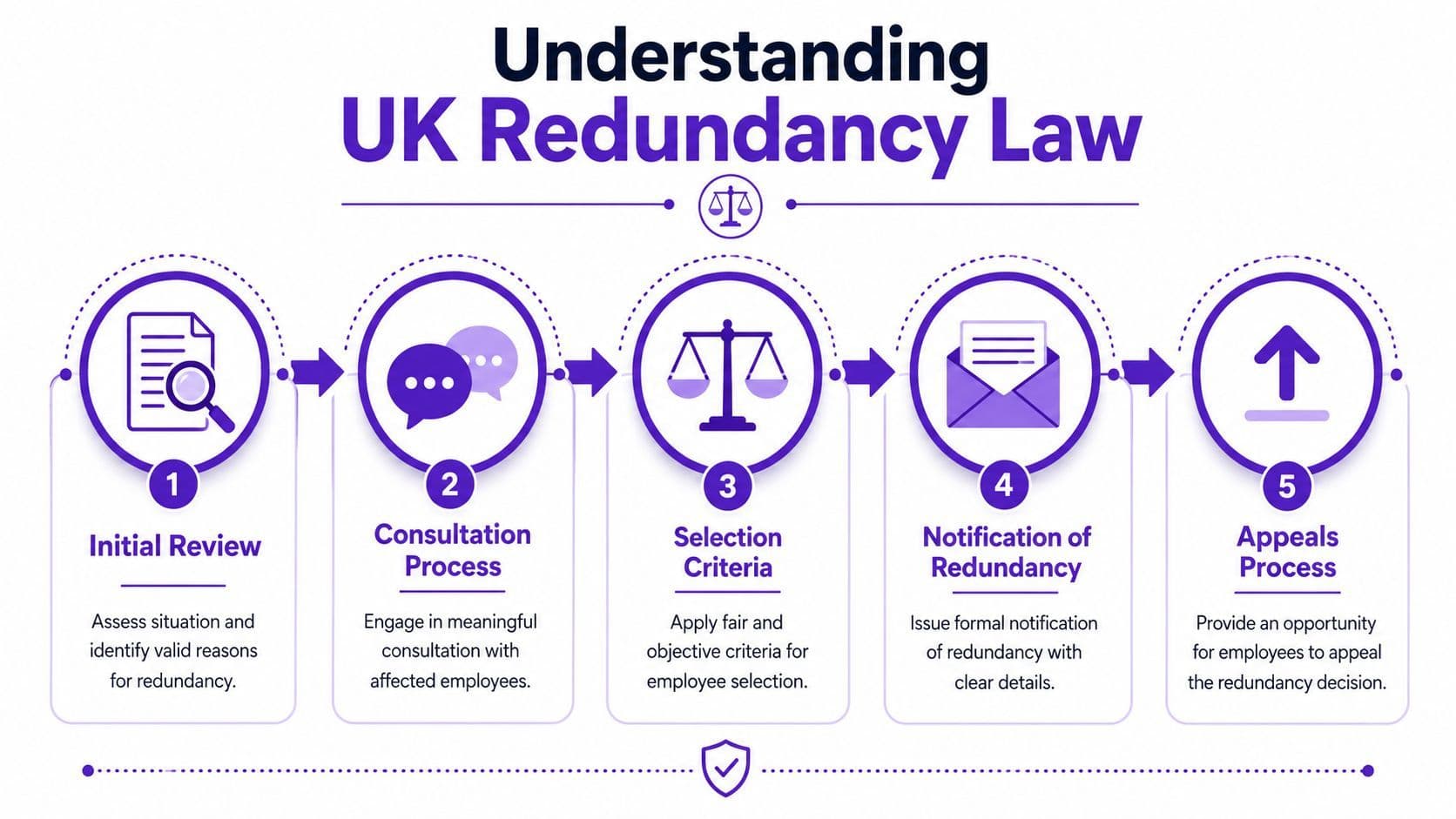
Under UK law, redundancy is not a general label for any dismissal caused by financial pressure. The reason must fit a recognised redundancy situation under the Employment Rights Act 1996. In practice, that usually means one of three things. The business is closing altogether, a workplace is closing, or the business needs fewer employees to do work of a particular kind.
That distinction matters in the letters and in the process behind them.
If a shop in Leeds is shutting but the company still operates in Manchester, that is usually a workplace closure case. If the business is keeping the site open but cutting one administrator role because software has removed part of the workload, that is a reduced need for employees to do that kind of work. A generic line such as "due to business changes" hides the reason and makes the paper trail weaker than it needs to be.
This is why template wording often causes problems. The legal wording should match the facts on the ground, not just sound formal.
Fair process decides whether the dismissal stands up
A genuine redundancy reason is only half the job. Employers also need a fair procedure. Acas sets out the key steps in its guide to handling staff redundancies fairly, including consultation, fair selection where a pool applies, and consideration of alternative employment.
Consultation must happen while there is still room to influence the outcome. If the employee is invited to a meeting after the decision is effectively made, the business has a process problem, even if the letter itself is carefully drafted.
For larger exercises, collective consultation rules can apply. The government explains the thresholds and minimum consultation periods in its guidance on making staff redundant. Smaller employers often assume those collective rules are irrelevant to them and stop there. That is a mistake. Even where collective consultation is not triggered, individual consultation still needs to be real, documented, and open to alternatives.
If you are at the point of formally notifying someone that their role is under review, an at-risk of redundancy letter should sit within that wider process, not replace it.
Selection pools and suitable alternative roles need careful thought
The legal risk usually increases where only some employees in a team are selected. At that stage, the business needs to identify the right selection pool and apply criteria that can be explained and evidenced. Attendance records linked to disability, pregnancy-related absence, or other protected reasons can create obvious problems. Subjective language such as "better attitude" is also difficult to defend unless it is tied to clear, consistent evidence.
Alternative employment is another area where small employers sometimes move too quickly. If there is another suitable role in the business, it should be considered and discussed before redundancy is confirmed. This is especially important for employees with priority rights, such as some employees on maternity leave or other family leave, where the legal position is more specific.
Notice and payments set the legal floor
The final paperwork must match the employee's minimum legal rights on notice, holiday pay, and statutory redundancy pay where they qualify. GOV.UK explains who qualifies for statutory redundancy pay and how it is calculated, and the statutory minimum notice periods for employees. Contract terms can improve on those minimums. They cannot lawfully give less.
In practice, I advise employers to sense-check two things before any dismissal letter goes out. First, does the stated redundancy reason reflect what has changed in the business? Second, does the process record show consultation, fair selection if relevant, and consideration of other roles?
If the answer to either question is no, the letter is not the problem. The process is.
Choosing the Right Redundancy Letter for Each Stage
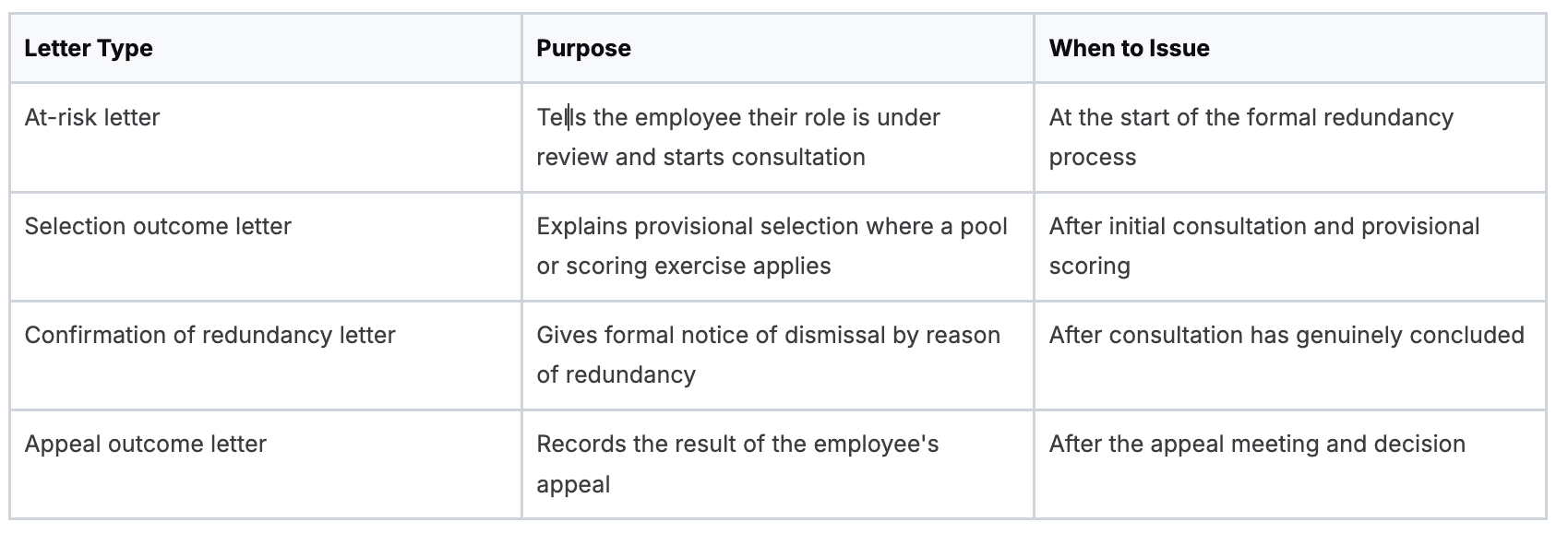
There isn't one universal redundancy letter. A proper process usually involves a sequence of documents, each with a different purpose. Treating them as interchangeable is one of the main reasons employers send mixed messages.
The letters serve different jobs
An at-risk letter opens the process. It tells the employee their role is at risk of redundancy and invites them into consultation. It should not read like a final dismissal decision.
A selection outcome letter is useful where there is a pool and a scoring exercise. It explains that the employee has been provisionally selected, gives enough information for them to understand why, and leaves room for challenge during consultation.
A confirmation of redundancy letter comes only after consultation has concluded and the decision is final. This is the formal notice of dismissal.
An appeal outcome letter closes the loop. It records whether the appeal succeeded, partly succeeded, or was not upheld.
UK redundancy letter types
Create a redundancy letter here!
If you need a starting point for the first stage, an at risk of redundancy letter can help structure the opening communication, but it still needs tailoring to the business reason and the employee's circumstances.
What each letter should avoid
Different letters fail in different ways.
- At-risk letter mistake: Saying or implying the employee has already been dismissed.
- Selection letter mistake: Referring to scores without showing the criteria or how the decision was reached.
- Confirmation letter mistake: Omitting notice details, payments, or appeal rights.
- Appeal letter mistake: Giving a conclusion without explaining what was reviewed.
A simple test helps. Read the letter and ask, "Could the employee tell what stage they are at?" If the answer is no, the letter is too vague.
Good redundancy documentation creates a timeline. Each letter should make sense on its own, but also fit logically with the one before it.
That structure is what turns a collection of templates into a compliant process.
How to Write a Legally Sound Redundancy Confirmation Letter
A small business owner usually reaches this stage after several difficult conversations. Consultation has finished, the decision has been made, and one document now needs to do a lot of work. It must confirm the dismissal, show the reason is a genuine redundancy, and give the employee enough detail to understand what happens next.
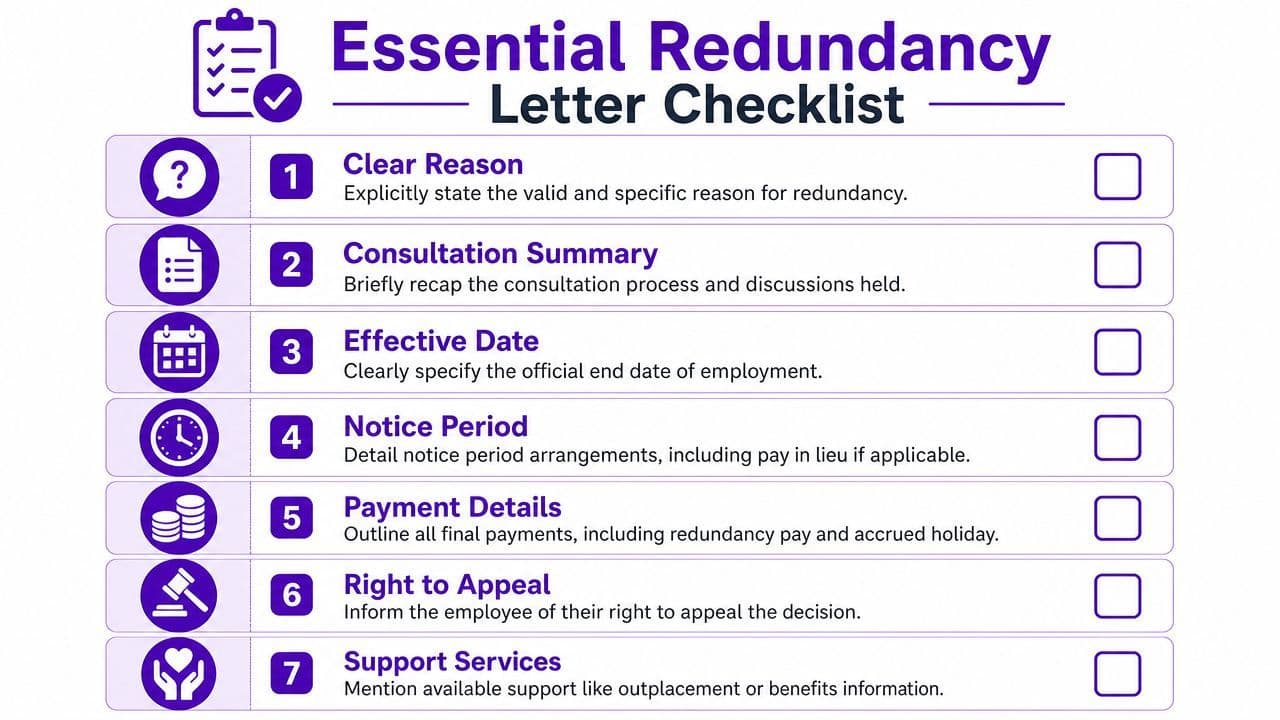
The safest approach is to draft the letter around the questions an employee, adviser, or tribunal would ask later. Why is this role redundant? What consultation took place? When does employment end? What will be paid? How can the employee appeal? If the letter answers those points plainly, it is doing its job.
Create a redundancy letter here!
State the reason precisely
Generic templates often fall short; the wording needs to match the actual redundancy situation.
If the business is closing a site, say the employment ends because that workplace is closing. If the business still needs the function but needs fewer people doing it, say the requirement for employees to carry out work of that kind has reduced. Those are different redundancy scenarios, and the letter should reflect the one that applies.
The letter should also make clear that the dismissal is by reason of redundancy and that the decision follows the process already carried out. Where selection formed part of that process, refer to it briefly. For example, confirm that the employee was included in the selection pool, that scoring was discussed during consultation, and that no suitable alternative role was identified.
Short wording usually works best:
Following the consultation process, we confirm that your employment will terminate by reason of redundancy because the business requires fewer employees to carry out work of this kind.
That is clearer than phrases such as "operational change" or "business review". Those phrases are too vague to explain why this role is ending.
Record the consultation history and the decision
A confirmation letter does not need to read like meeting minutes. It does need to show that the decision was reached after a fair process.
Set out the consultation history in a short paragraph. Include the dates of the key meetings, any alternatives discussed, and the date the final decision was made. If the employee suggested reduced hours, a different role, or a delayed dismissal date, record that those points were considered and explain the outcome in a line or two.
This matters for two reasons. It shows the employee they were heard, and it gives the business a clean record if the decision is later challenged.
For consistency with the wider dismissal paperwork, many employers use an employment termination letter template for UK employers as a structural reference, then add the redundancy-specific wording that a standard termination letter would miss.
Explain notice and payments clearly
Money is often the part employees read first. If this section is vague, confidence in the whole process drops.
Set out each payment separately and use plain labels. In practice, that usually means:
- Notice pay: State whether the employee will work notice or receive pay in lieu, and give the notice period.
- Redundancy pay: Confirm whether the employee qualifies for statutory redundancy pay, or whether an enhanced redundancy payment applies.
- Holiday pay: Confirm payment for accrued but untaken holiday up to the termination date.
- Outstanding sums: Include unpaid wages, expenses, commission, or other contractual amounts if relevant.
I usually advise employers to attach a payment schedule where the figures are more than simple. That keeps the letter readable and reduces the risk of a calculation error being buried in a long paragraph.
A video walkthrough can also help employers visualise how the final letter should fit into the broader process.
Get the tax wording right
Tax wording needs care. Employers sometimes overstate what is tax free, which creates avoidable disputes later when payroll applies deductions.
The safe position is straightforward. Statutory redundancy pay can usually be paid tax-free up to £30,000. Other termination payments may be taxable depending on what they are and how they are treated through payroll, as discussed in Ember's redundancy letter template commentary.
Keep the wording measured:
Any genuine redundancy payment will be paid in accordance with the applicable tax treatment. Statutory redundancy pay is tax-free up to £30,000. Other payments made on termination may be subject to tax and deductions as required.
That tells the employee enough without drifting into tax advice.
Include appeal rights clearly
A final redundancy letter should always explain how to appeal. State the deadline, who the appeal should be sent to, and whether the employee should set out the grounds in writing.
A short paragraph is enough, provided it is specific. For example, tell the employee they may appeal within a stated number of days of receiving the letter and give a named contact or job title. If there is no internal appeal route in writing, it becomes harder to show that the employee had a real chance to challenge the outcome.
The trade-off is simple. A shorter letter is easier to read, but a letter that leaves out the reason, process, payments, or appeal route is harder to defend. A sound redundancy confirmation letter covers each of those points directly and matches the facts of the case.
Common Redundancy Letter Pitfalls to Avoid
A small business owner often reaches this point after weeks of difficult conversations. The draft letter looks formal, the date is set, and there is relief in finally getting it done. Then the actual risk appears. A letter can read well and still be wrong for the situation.

Create a redundancy letter here!
Templates cause problems when they skip the reason behind the wording. Redundancy letters are not interchangeable. The right phrasing depends on what has changed in the business, how consultation was handled, and whether the employee was selected from a wider pool. That is why a generic draft often needs more than light editing.
Pitfall one uses the wrong redundancy scenario
This is one of the easiest mistakes to make and one of the hardest to defend later. A redundancy caused by closing a site should be described as a site closure or workplace closure. A redundancy caused by needing fewer people in the same role should say that the business requires fewer employees to carry out work of that kind.
Those are different legal situations. The distinction shapes the explanation you give, the consultation record you rely on, and sometimes the range of suitable alternative roles you need to consider. If you close a branch, say so plainly. If you are keeping the function but reducing headcount, say that instead.
I often see employers blur the two because they want the letter to sound broad and safe. In practice, broad wording usually creates more questions than it answers.
Pitfall two uses language that is too vague
A final letter should tell the employee what decision was made and why. Phrases such as "business needs," "restructure," or "ongoing review" are too loose on their own. They do not show the employee what changed, and they do not help if the decision is challenged.
Use wording tied to the facts.
- Weak wording: "Following organisational changes, your employment will end."
- Better wording: "Following consultation, we have decided to reduce the number of employees required to carry out the role of warehouse supervisor at our Bristol site."
That level of detail does two jobs. It helps the employee understand the decision, and it shows that the business had a genuine redundancy reason rather than a general wish to end employment.
Pitfall three skips over the selection process
If only one role disappeared and no one else was doing comparable work, selection may be straightforward. Many cases are not that simple. If several employees carried out similar duties, the letter should reflect that a fair pool and fair criteria were used.
Employers often write, "you were selected for redundancy," and leave it there. That is thin evidence. The letter does not need to reproduce every score, but it should match the process. If selection criteria were used, the documents behind the letter should show what they were, how scoring was applied, and how the employee had a chance to comment during consultation.
The trade-off is practical. Too much detail in the letter can make it clumsy. Too little can make it look as though no fair process existed. A short reference to the pool and criteria, backed by proper records, is usually the right balance.
Pitfall four confuses redundancy with a settlement or severance arrangement
Some employers mix up a redundancy confirmation letter with documents used to agree additional exit terms. They are not the same thing. A redundancy letter confirms the dismissal decision and the employer's reasoning. If the business is also offering extra terms beyond the minimum, those terms usually need separate documentation, such as a severance agreement document.
Keeping those documents separate reduces confusion. It also helps avoid accidental wording that suggests the redundancy reason is negotiable when the core issue is whether extra terms are being offered on exit.
Pitfall five treats the letter as admin rather than evidence
A redundancy letter is part of the evidence trail. If the wording does not match the consultation notes, scoring documents, or internal decision record, that inconsistency can cause avoidable problems later.
Keep and organise:
- Drafts showing who approved the wording
- Consultation invitations and meeting notes
- Selection matrices and scoring notes where relevant
- Any suitable alternative role correspondence
- The final issued letter and proof of sending
- Any appeal documents and outcome notes
A shorter letter that fits the facts is usually safer than a polished template filled with generic wording. The letter should make sense to the employee reading it and to a tribunal or adviser reviewing the file months later.
Final Steps Issuing Payments and Managing Records
The process is not finished when the final redundancy letter goes out. The last stage is where many disputes start, usually because payment details were vague, dates were handled loosely, or the file does not show a clear link between the reason for redundancy and the sums paid on exit.
Start with the practical basics. Confirm the employee's leaving date, confirm whether they are working notice or being paid in lieu, and give them a written breakdown of each payment line. In practice, that usually means wages up to termination, accrued but untaken holiday, notice pay where due, statutory redundancy pay if they qualify, and any enhanced payment the business has agreed. If tax or National Insurance applies to a payment, say so. If it does not, say that too. A short schedule attached to the outcome letter often prevents the argument that the employee "didn't understand what they were being paid for."
Appeals also need proper handling. If the employee appeals, the review should be carried out by someone who was not the original decision-maker where that is possible in a small business. Record the appeal points, the documents reviewed, the outcome, and the date the outcome was sent. A genuine appeal process matters because an appeal is not just a courtesy. It is part of showing that the business tested its own decision.
Statutory redundancy pay is one area where templates often fall short because the wording is simple but the calculation depends on the facts. The legal basis is straightforward. Eligibility depends on sufficient continuous service, and the amount depends on age, length of service, and a statutory cap on a week's pay, as noted earlier. Employers should calculate it from payroll records rather than estimate it in a meeting. If an employee is leaving because a site is closing, the calculation method is the same as it is for a role reduction exercise. What changes is the evidence behind the dismissal, not the payment formula.
A quick example shows why precision matters. If two employees both have long service but fall into different age bands during the relevant calculation period, their statutory redundancy pay may differ even if their salaries are similar. That is exactly why I advise employers to check dates carefully before putting figures in writing. The employee will often remember the number in the conversation, not the caveats around it.
Keep enhanced terms separate from the redundancy decision itself. If the business is offering more than the statutory minimum or wants extra protections around confidential information or claims, document those terms in a separate severance agreement template for additional exit terms. That separation helps preserve a clear paper trail. The redundancy letter explains why employment is ending. The additional agreement, if used, deals with extra terms.
Your records should let an adviser, auditor, or tribunal follow the story from first consultation to final payment without filling gaps for you. Keep the final letter, appeal papers, payroll instructions, payment breakdown, proof of payment, and notes showing who approved the figures. For a premises closure, keep the business case or closure decision. For a reduced headcount exercise, keep the selection materials and role rationale. Generic templates rarely tell you that difference, but it matters later because the paperwork must match the type of redundancy you are relying on.

Create a redundancy letter here!
If you need redundancy documents that are fast to produce and easier to trust, Robot Lawyer offers AI-powered legal documents and services verified by qualified professionals. You can answer a short questionnaire, generate relevant paperwork, and handle sensitive HR processes with more structure and less risk. For employers who need compliant documents without the delay and cost of traditional drafting, it's a practical way to move quickly while keeping legal safeguards in place.