
You've probably already created more intellectual property than you think.
If you run a startup, that might be your product name, interface copy, codebase, pitch deck, onboarding emails, pricing model, and customer database structure. If you freelance, it could be your templates, training materials, proposals, portfolio pieces, and the process you use to get results. If you manage property, it may be the branding around your portfolio, your website content, your floorplan designs, and your tenant systems.
Most small businesses don't lose control of IP because they ignored the law. They lose it because they didn't spot what mattered early enough, didn't document ownership, or spent money in the wrong order. A practical approach to protecting intellectual property starts with knowing what you've got, deciding what is commercially important, and using the cheapest effective protection first.
First Identify Your Hidden IP Assets
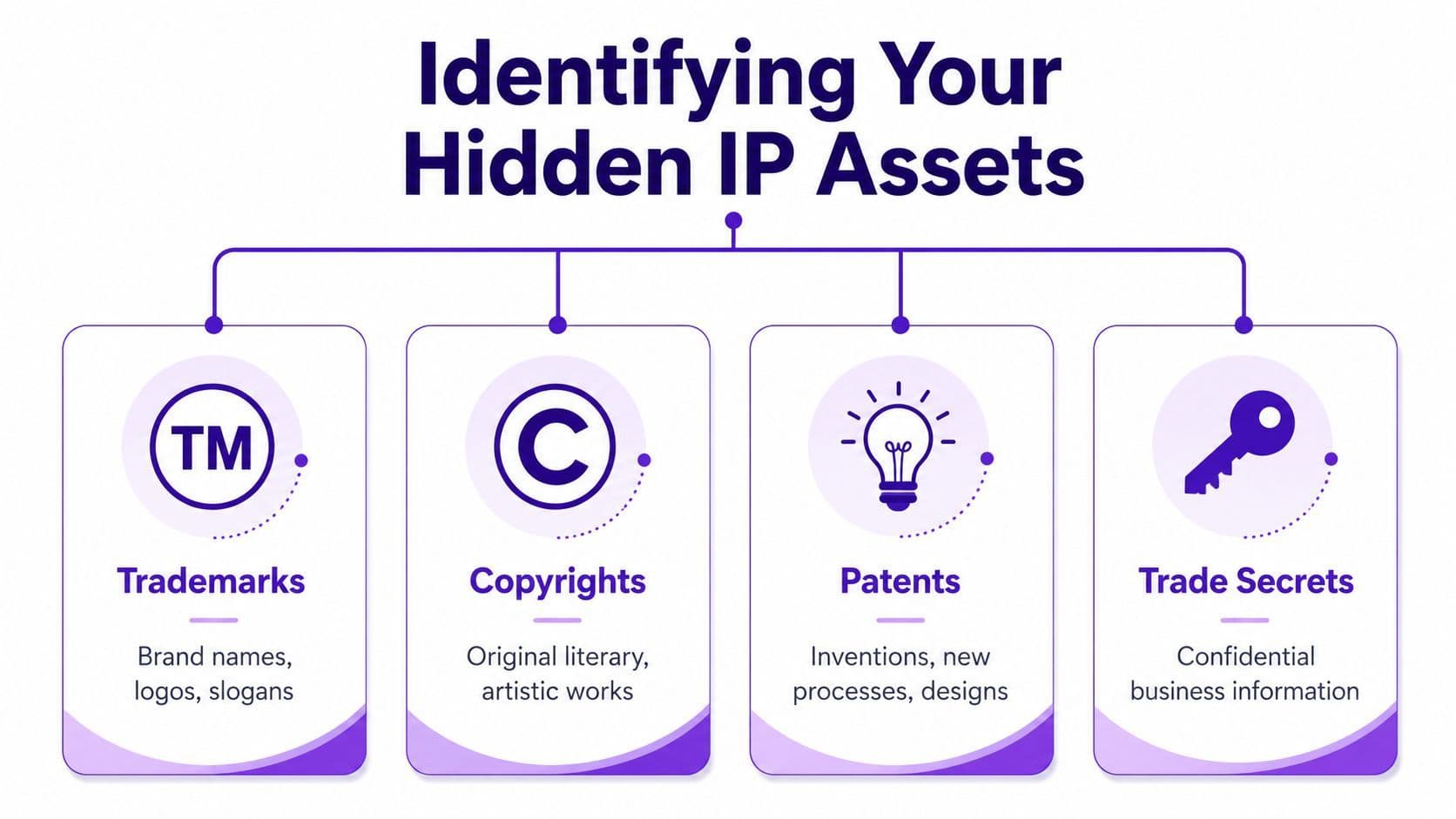
A lot of founders assume IP means patents. Usually, it doesn't. For most UK SMEs, the main value sits in branding, content, designs, software, know-how, and confidential information.
The fastest way to get clarity is to run a simple internal audit. Open a spreadsheet and list every asset your business uses that someone else could copy, reuse, or claim. Don't limit yourself to polished final work. Drafts, internal systems, and workflows can matter just as much.
Create Bespoke Intellectual Property Agreements Here!
What usually counts as IP in a small business
Here's the practical version.
- Trademarks cover the signs customers use to recognise you. Think business names, logos, slogans, product names, and sometimes distinctive service names.
- Copyright usually protects original written, artistic, musical, and similar works. In a business context, that often means website copy, articles, graphics, software code, videos, course materials, and proposal documents.
- Design rights can protect the appearance or shape of products and visual features.
- Trade secrets protect confidential commercial information, such as formulas, internal methods, customer strategies, pricing logic, or technical know-how that gives you an edge.
The UK framework gives these rights very different lifespans. The UK IP overview published by Orrick notes that copyright typically lasts for 70 years from the death of the author, unregistered design rights last for the shorter of 10 years from first public availability or 15 years from creation, and registered designs can last up to 25 years with renewals every 5 years.
Practical rule: If an asset helps people recognise your business, create your product, or reproduce your value, treat it as IP until proven otherwise.
Three quick examples
A startup might own source code, API documentation, a product name, interface designs, a customer onboarding sequence, and internal product roadmaps. Not all of that needs registration, but all of it needs handling.
A freelancer may have a personal brand, proposal templates, training decks, workshop materials, photo libraries, and a repeatable client process. The mistake here is assuming “I made it” is enough. It often isn't if ownership and dates are unclear.
A landlord or property operator may have original website text, branded property names, photography, floorplan layouts, tenant packs, and operational systems. These assets are easy to overlook because they sit inside day-to-day admin.
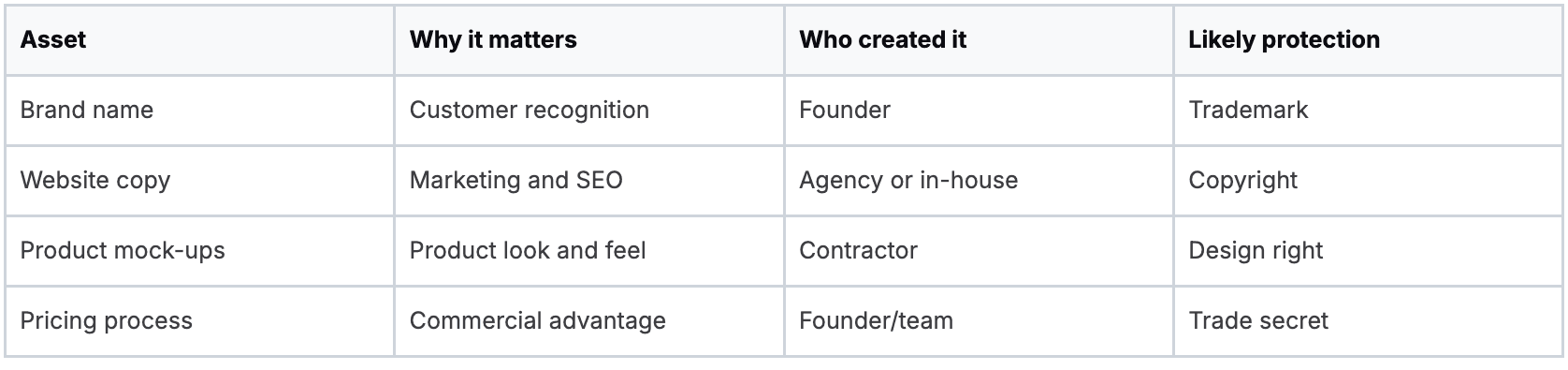
A simple audit that works
Use four columns:
Create Bespoke Intellectual Property Agreements Here!
Then mark anything that leaves the business regularly. That includes investor decks, client proposals, demo environments, prototype files, and supplier briefings. Those are often where leakage starts.
If part of your value depends on secrecy, put protection in place before sharing it. A proper trade secret protection agreement is often far cheaper than trying to argue later that something was meant to stay confidential.
Prioritise What to Protect A Strategic Approach
Once you've listed your assets, resist the urge to protect everything at once. That usually leads to overspending on low-value items and neglecting the few assets that drive revenue.
A better approach is to split your IP into two groups. Crown jewels and nice-to-haves.
Crown jewels versus nice-to-haves
Your crown jewels are the assets that would hurt badly if copied. For one company, that's the brand name. For another, it's the source code, customer method, or product design. Nice-to-haves still matter, but they aren't where a limited budget should go first.
Use these questions:
- Does this asset drive sales or trust?
- Would copying it make a competitor look credible fast?
- Is it hard to replace?
- Does it need secrecy, registration, or both?
- Will it still matter in a year?
If the answer is yes to most of those, move it up the list.
UK IPO analysis discussed by IPKat found that 34.95% of UK industries are classified as IP intensive. That matters because it shows IP isn't a side issue for a narrow corner of the economy. In many sectors, it's tied directly to competitive position.
What founders often get wrong
The common error isn't underestimating IP. It's protecting the wrong layer first.
A founder may spend time worrying about a patent when the immediate risk is that someone else grabs the trading name. A freelancer may focus on watermarking portfolio samples while leaving ownership clauses out of client and subcontractor agreements. A product business may obsess over a logo refresh while sharing prototype files too freely.
Protect the asset that controls recognition, delivery, or leverage. Everything else comes after that.
Here's a quick way to rank your list:
- Protect first: Brand names customers search for, core product code, signature designs, proprietary processes, and confidential commercial information.
- Protect next: Reusable templates, sales content, training material, visual assets, and non-core product features.
- Protect later: Older campaign assets, internal drafts that no longer shape the business, and materials with short shelf life.
Match the protection to the asset
Some assets are strongest when kept secret. Others become stronger when registered. Others need clear contract wording and good records more than anything else.
That trade-off matters. Registration can be worth it, but not every asset justifies the cost or admin. Secrecy can be powerful, but only if you control access. Copyright may arise automatically, but if ownership is messy, enforcement becomes awkward quickly.
A lean strategy is usually the right one. Pick the few assets that hold up your business model, protect those properly, and don't let admin distract you from the main risks.
Your IP Protection Toolkit Contracts and Registrations
Most small businesses should start with contracts, not filings.
That isn't because registrations don't matter. It's because contracts work immediately, cost less, and solve the ownership and confidentiality problems that appear long before a dispute reaches a registry or court.
Create Bespoke Intellectual Property Agreements Here!
Contracts are your first line of defence
If you're discussing an idea with a developer, agency, manufacturer, or potential partner, use an NDA before the useful details leave your inbox. A conversation that feels informal can still expose the commercial core of your business.
A solid non-disclosure agreement for UK businesses should define what is confidential, who can access it, how it can be used, and what happens after the discussion ends. That won't solve every problem, but it changes the legal position from vague expectation to written obligation.
Ownership clauses matter just as much. If an employee, freelancer, or consultant creates something for your business, the contract should deal clearly with IP ownership and assignment. Don't assume payment alone transfers rights. It often doesn't.
Use this checklist before any work starts:
- Check ownership wording: The contract should say who owns drafts, final outputs, and any underlying materials.
- Define permitted use: If a contractor keeps certain pre-existing tools or templates, say so clearly.
- Cover confidentiality: Don't leave sensitive methods or data to verbal understanding.
- List contributors: If multiple people touch the same asset, identify them from the start.
Registrations that usually make sense for SMEs
For many UK startups and small businesses, trademarks are the most practical formal filing. They protect the names and signs customers associate with your business. They're usually more commercially immediate than patents.
UKIPO trademark data discussed by Trama reports an 86.22% success rate for UK trademark applications, and states that applications increased by 5.8% to 173,180. That tells you two things. The route is active, and for many businesses it's a realistic first registration.
A trademark is worth early attention if:
- Your brand name is central: Customers search for it, refer others to it, or associate trust with it.
- You're investing in visibility: Paid ads, packaging, signage, marketplaces, and social profiles all become more exposed if the brand isn't secured.
- You plan to scale: Rebranding after traction is expensive in time and goodwill.
If your competitive edge sits in how a product looks, registered design protection can also be worth a closer look. If it sits in confidential know-how, contracts and access controls may beat registration altogether.
What works and what doesn't
What works is layering. Use confidentiality terms before disclosure. Use assignment clauses before creation starts. Register the assets that anchor your brand or product position. Keep evidence from day one.
What doesn't work is relying on goodwill, unsigned scopes of work, or vague emails saying “we'll sort the legal side later”. That usually becomes expensive only after the relationship sours.
If you pay for creative or technical work, fix ownership before the first draft appears.
A lean toolkit is enough for most early-stage businesses. NDA. Clear service or employment contracts. Trademark where the brand matters. Design registration where appearance drives value. Good records for everything else.
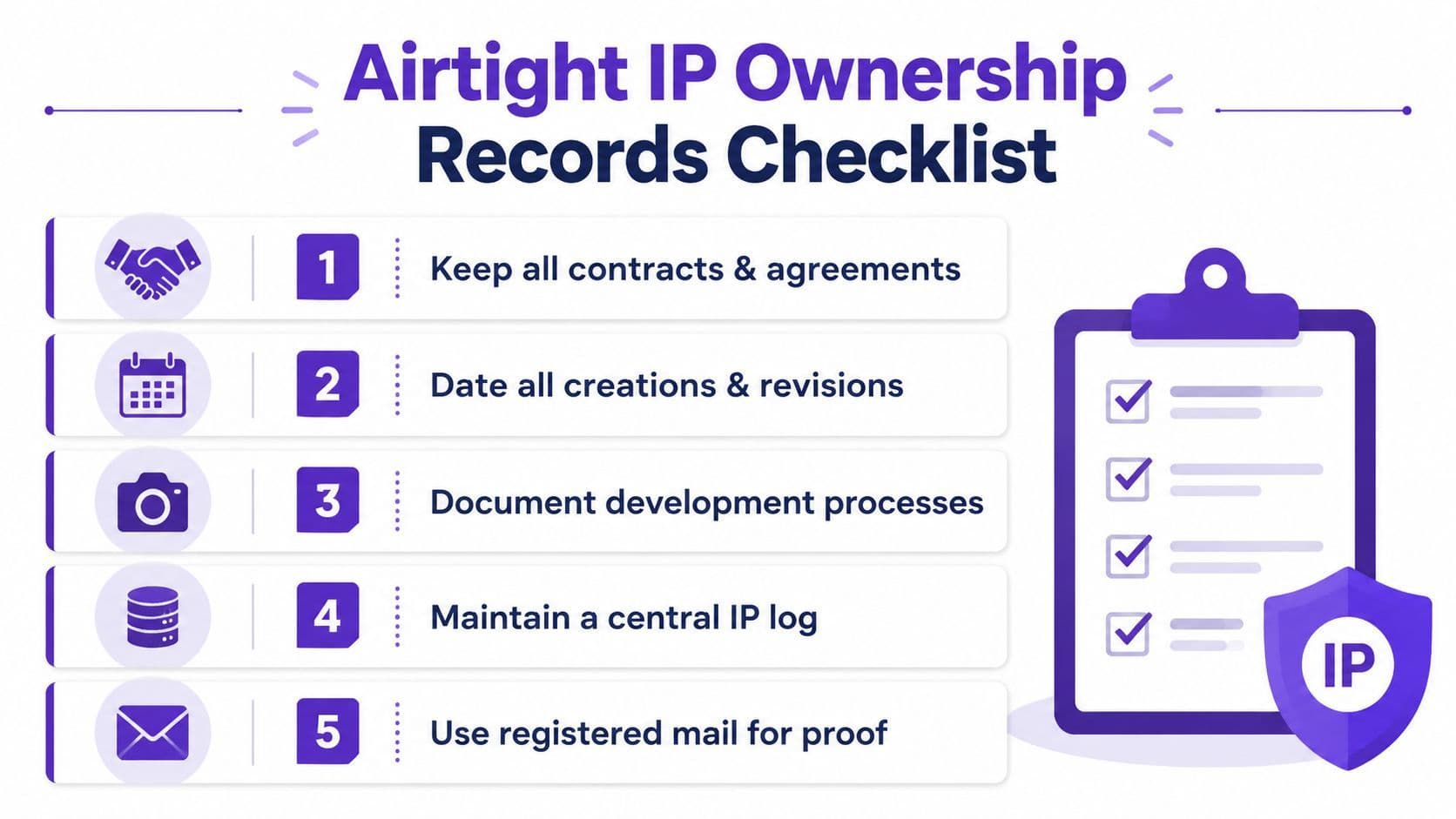
Create an Airtight Record of Ownership
The dispute usually starts with confidence from both sides.
You say the work is yours because you paid for it or created it first. The other side says they built it, adapted it, or used it before you. At that point, the winner often isn't the person who feels right. It's the one who can prove the timeline.
Create Bespoke Intellectual Property Agreements Here!
Build an evidence locker
Think of this as a central file for each important asset. It doesn't need fancy software. A tidy cloud folder structure can do the job if you're disciplined.
Your file should include:
- Signed contracts and variations: Employment agreements, freelancer contracts, assignment clauses, and confidentiality terms.
- Dated creation records: Drafts, sketches, source files, version history, and export dates.
- Communication trail: Emails approving work, messages discussing revisions, and meeting notes confirming scope.
- Proof of first use: Screenshots of launch pages, packaging proofs, published content, and dated marketing materials.
- Access history for confidential material: Who had access, when, and for what purpose.
For software teams, version control history is often your friend. For designers, layered files and dated exports matter. For writers and consultants, proposal drafts, marked-up copies, and email approvals can make all the difference.
A simple IP register beats memory
Create one live document that tracks each key asset. Include the asset name, creator, date created, where the master file sits, whether any contract governs ownership, and whether the asset has been disclosed publicly.
That register becomes more valuable as the business grows. Team changes, agencies rotate, and old assumptions disappear. A clean record saves you from rebuilding history under pressure.
Briffa's guidance on IP strategy for UK businesses warns that businesses that fail to monitor and document IP properly can lose 30-40% of potential licensing revenue due to unmonitored infringement. Even if licensing isn't your current goal, the underlying point stands. Weak documentation weakens bargaining power.
Keep the proof while relationships are good. You won't enjoy chasing it once a contractor disappears or a co-founder falls out.
Five habits that reduce future pain
- Date every meaningful version. Don't overwrite important files without retaining earlier copies.
- Name the creator clearly. If several people contribute, note what each person did.
- Store signed PDFs centrally. Not in one person's inbox.
- Record first publication or launch. Public use dates can matter.
- Review the register regularly. New assets appear faster than is often realised.
This is boring admin until it isn't. Then it becomes the cheapest insurance in the business.
Spotting and Stopping IP Infringement
Protecting intellectual property doesn't end when the contract is signed or the application is filed. If nobody checks the market, misuse can sit in plain sight for months.
You don't need expensive software to start monitoring. Small businesses can do a lot with routine habits and a clear escalation plan.
How to monitor without a large budget
Set up searches for your brand name, product names, and distinctive taglines. Check major platforms where your customers buy, browse, or compare suppliers. If your business relies on visual assets, run image searches for logos, packaging, or product photography.
If your value sits in confidential information, your monitoring looks different. Watch for unusual access, odd requests for files, or ex-staff and suppliers using language that mirrors your internal materials too closely. Trade secret problems often appear through behaviour before they appear through paperwork.
Yousign's review of UK IP best practices states that 64% of UK creators fail to strengthen their position with dated records or copyright notices, and 78% of UK small businesses lack clear protocols to identify or respond to trade secret leaks. That combination is a bad one. Weak records and no response plan give the other side room to deny, delay, or deflect.
What to do when you find copying
Don't rush into an angry email. First preserve evidence.
Take screenshots. Save URLs. Download the page if appropriate. Note dates. Keep copies of your own original files and any documents showing ownership and first use. If the infringement disappears later, you still need a record of what happened.
Then decide your objective. You may want removal, correction, payment, attribution, or a stop to further use. Different goals call for different wording.
A formal cease and desist letter for IP infringement is often the right first move. It shows you're serious, identifies the conduct complained of, sets out the basis of your position, and gives the other side a chance to stop before the dispute hardens.
A workable escalation path
- Step one: Preserve evidence before contact.
- Step two: Check your ownership documents and timeline.
- Step three: Send a measured legal notice, not an emotional complaint.
- Step four: Keep all replies and deadlines organised.
- Step five: Escalate for legal advice if the issue continues, spreads, or involves meaningful commercial harm.
A good cease and desist letter is specific, calm, and evidenced. Threats without proof usually weaken your position.
What doesn't work is waiting too long, contacting the wrong person, or sending broad accusations without attaching the facts. Enforcement is strongest when it looks organised from the start.
When to DIY vs When to Hire an IP Professional
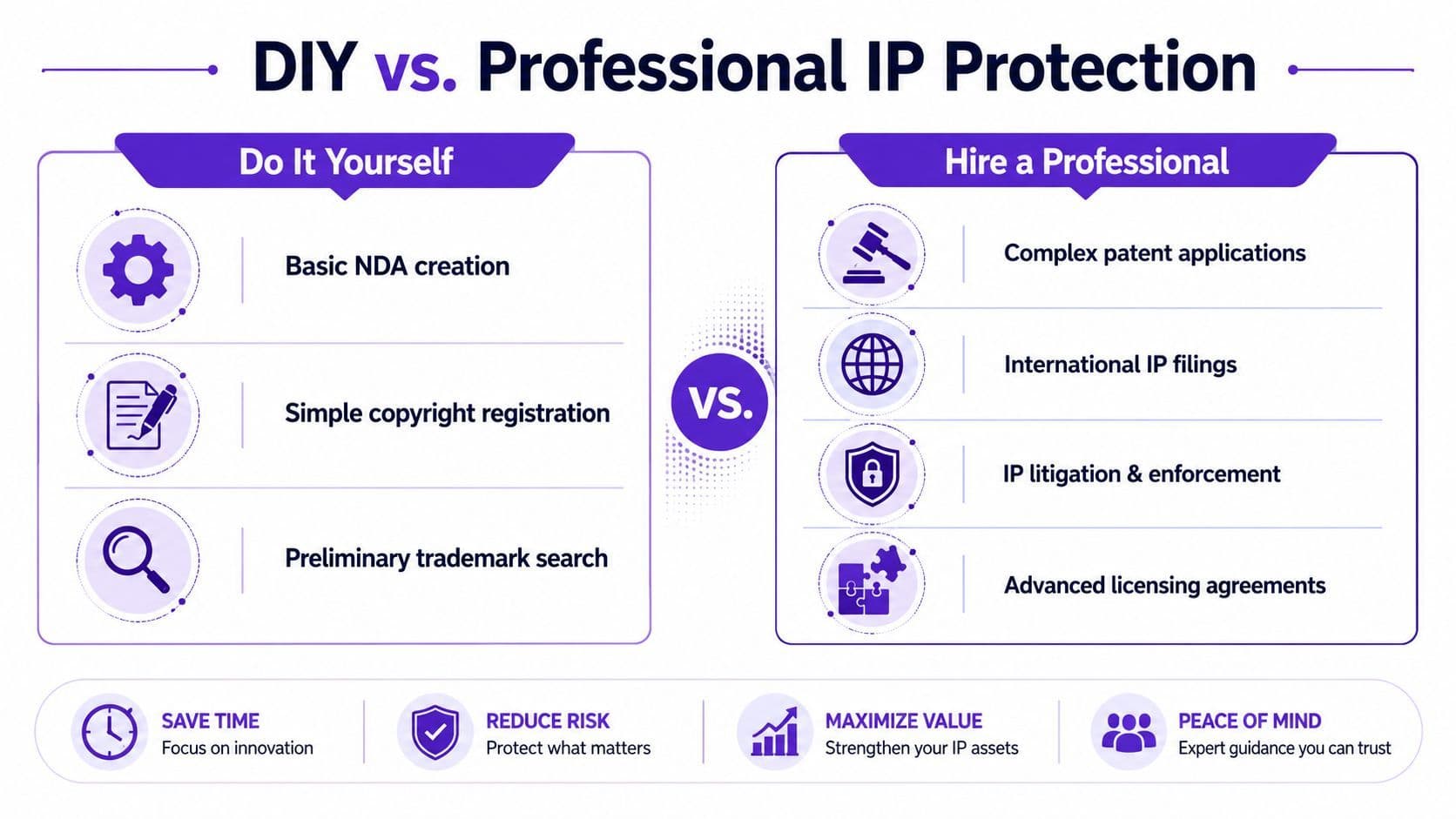
DIY protection has improved a lot. That's good news for founders, freelancers, and lean teams that need decent legal groundwork without the cost of turning every routine task into a law firm matter.
Still, some IP work is well suited to self-service tools, and some isn't. Knowing the difference saves money and avoids avoidable mistakes.
Create Bespoke Intellectual Property Agreements Here!
Good candidates for DIY
DIY is usually sensible where the legal task is standard, the facts are straightforward, and the commercial risk is contained.
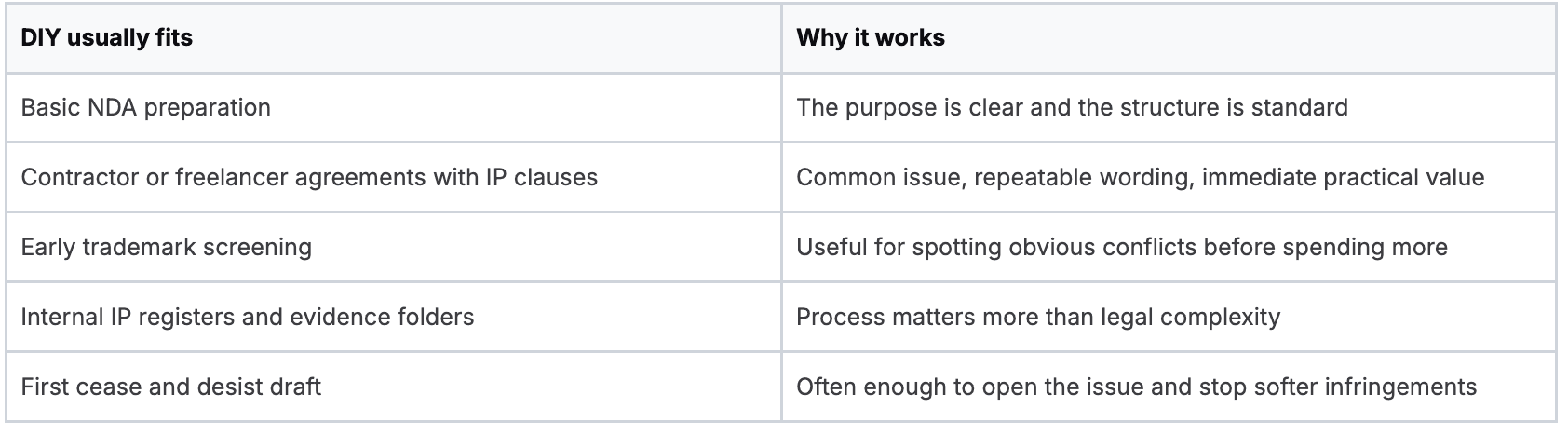
This route works best when you're organised. You still need to answer the questions properly, gather the right facts, and avoid treating templates like magic.
Create Bespoke Intellectual Property Agreements Here!
When professional help is worth paying for
Some matters have too much value, complexity, or procedural risk to handle casually.
Bring in an IP professional if you're dealing with:
- Patent strategy: Patent work is technical, timing-sensitive, and expensive to get wrong.
- International filings: Rights are territorial and filing strategy can become messy quickly.
- High-value disputes: If the other side has lawyers, meaningful turnover, or a litigation mindset, get advice early.
- Ownership messes: Co-founders, agencies, inherited code, and undocumented contributions often need careful untangling.
- Licensing deals: If the agreement will shape revenue, exclusivity, or future product rights, bespoke drafting is worth it.
The key question isn't “Can I do this myself?” It's “What's the cost if I get this wrong?”
A practical decision test
Use this three-part filter.
First, ask whether the issue is standard or bespoke. If it's routine, DIY may be enough. If it involves unusual facts, conflicting documents, or negotiation, get help.
Second, ask whether the asset is replaceable or central. If losing control would disrupt the business materially, don't cut corners.
Third, ask whether the matter is preventive or contentious. Prevention is usually where affordable tools shine. Once a dispute becomes serious, professional judgement matters more.
DIY is best for setting the floor. Professionals are best when the stakes, complexity, or hostility rise.
A founder doesn't need a solicitor for every NDA or contractor agreement. But that same founder shouldn't try to wing a patent filing, international trademark conflict, or live dispute over core software ownership. Smart legal spend isn't about always spending less. It's about spending at the right moment, on the right problem.
If you need a practical starting point, Robot Lawyer offers affordable legal documents and services for founders, freelancers, landlords, and small businesses that want fast, compliant paperwork without the delay and cost of a traditional process. It's a useful option for routine protections like NDAs, cease and desist letters, employment contracts, and other day-to-day legal documents where speed, clarity, and cost control matter.