
How to Draft an Employment Contract A UK Guide for 2026
Knowing how to draft an employment contract is a core skill for any employer. It’s not just a formality; it’s a strategic move that sets clear expectations from day one and protects your business down the line. A well-written contract is the bedrock of a professional relationship with your employee, covering everything from pay and hours to what happens with the brilliant ideas they have on your time.
Why Your Employment Contract Is a Critical Business Tool

Create a Free Employment Contract Here!
It’s easy to feel a bit lost when faced with drafting a legal document, but getting your employment contract right is one of the most important things you can do as a business owner in 2026. See it less as a legal hurdle and more as the foundation for building trust and clarity with your new hire.
Ultimately, this document is your best defence against future disputes. It also signals to top talent that you’re a professional and serious employer. This guide will skip the dense legal jargon and give you the practical, actionable steps you need to build a contract that’s fair, compliant, and right for your business.
Navigating the New UK Legal Landscape
Getting your contracts spot-on has become even more critical following recent shifts in UK law. The Employment Rights Act, passed in December 2025 under Prime Minister Keir Starmer's Labour government, has significantly changed the rules of the game for employers.
The act brought in new regulations for zero-hours contracts, widened the net for statutory sick pay eligibility, and bolstered union rights. All of this places new responsibilities squarely on your shoulders.
This new legal environment is already making waves in hiring. A recent Chartered Institute of Personnel and Development (CIPD) survey revealed that over 33% of UK employers are now looking to reduce permanent hiring. They cite the increased costs and complexity from these new labour laws as the main reason. A clear, compliant contract has therefore never been more important for managing your workforce effectively.
Key Changes from the Employment Rights Act 2025
The 2025 Act introduced several changes you must reflect in your contracts. Here’s a quick summary of the most significant updates and what they mean for you.

Create a Free Employment Contract Here!
These are just the headlines, of course. It's vital to ensure your templates and any new contracts you issue are fully updated to avoid falling foul of the new legislation.
A strong employment contract is not just about compliance; it's about creating a clear roadmap for the employment relationship. It proactively addresses potential issues before they become costly problems, saving you time, money, and stress down the line.
Beyond a Formality: A Strategic Asset
For any small business or startup, a solid contract of employment is more than just good housekeeping—it's a critical asset. It formalises the entire arrangement and acts as the single source of truth for both you and your employee.
Specifically, it helps to:
- Define expectations clearly on both sides, from job duties to performance standards.
- Protect your business interests, safeguarding your confidential information, client lists, and intellectual property.
- Ensure legal compliance with current UK employment law, which is your best defence against tribunal claims.
- Build a positive workplace culture that’s founded on transparency and mutual respect from the very beginning.
Putting in the time now to draft a comprehensive contract is a direct investment in a more secure and stable future for your business.
Building a Compliant Contract The Core Components
Create a Free Employment Contract Here!
Alright, let's get practical and start building the bedrock of your employment contract. In the UK, every contract needs to include a 'principal statement' that lays out the fundamental terms of employment. This isn't just good practice; it’s a legal must-have under the Employment Rights Act 1996. You’re legally required to provide these key details in writing to an employee on or before their very first day.
Getting this wrong can be costly. If you fail to provide this statement, an employment tribunal could order you to pay compensation. So, we're not just going to run through a checklist. We'll dig into the 'why' behind each clause, ensuring you create a document that's clear, fair, and legally sound from the get-go.
Identifying the Parties and Start Date
First things first, let's get the names right. The contract has to clearly state the full, legal name of your business and the employee's full name. It sounds basic, but getting this spot-on is crucial for making it clear exactly who is bound by the agreement. No ambiguity allowed.
Just as important is the start date. You must specify the exact date the employment begins. If any previous employment counts towards their period of continuous service, that date needs to be in there too. This is vital because it affects major entitlements down the line, like statutory redundancy pay and the right to claim unfair dismissal.
Defining the Role and Responsibilities
A vague job title is a recipe for confusion. Be specific. "Marketing Manager" is much better than "Team Member" because it immediately sets expectations about seniority and function. This clarity helps manage expectations from day one and gives you a solid reference point for future performance reviews.
The contract also needs to outline the employee's main duties. You don't have to list every single task they'll ever do, but you should describe the core responsibilities of the role. For a really thorough breakdown, it’s often best to refer to a separate document. If you need help with that, you can learn more about crafting a comprehensive job description that works hand-in-hand with your contract.
Pro Tip: I always recommend including a flexibility clause. Something like, "You may be required to perform other duties as reasonably requested by the Company from time to time." This gives you the operational agility to adapt to changing business needs without having to formally alter the contract for every minor adjustment.
Specifying Place of Work
Where will the job actually get done? The contract must state the address (or addresses) where the employee is expected to work. This might seem straightforward, but it's important for everything from travel expense claims to establishing legal jurisdiction.
With the rise of remote and hybrid working, you need to be crystal clear.
- Fully Remote: State that the employee’s home address is their primary place of work.
- Hybrid: Specify the office address(es) they must attend and how often they're expected to be there.
- Field-Based: Define the geographical area the employee will be responsible for covering.
Getting this right from the start prevents arguments about commuting or changes to working arrangements later on. For example, you could state, "Your normal place of work is our London office, though you may be required to work from other company locations or client sites as needed."
Outlining Pay and Working Hours
This is the section everyone reads first. You must clearly state the rate of pay, how it's calculated (e.g., annual salary, hourly rate), and how often they'll be paid (e.g., weekly, monthly). It’s a legal requirement that all pay must meet or exceed the National Minimum Wage, so double-check your figures.
The contract must also detail the working hours. This includes the total hours per week, the days of the week, and any specific start and finish times. If you have shift workers, you need to explain how their shift patterns will be set and communicated.
This section is also where you ensure compliance with the Working Time Regulations 1998, which generally cap the average working week at 48 hours. If you anticipate an employee working more than this, you'll need them to sign a separate 'opt-out' agreement. Be explicit about overtime too—is it expected? Is it paid, or does it accrue as time off in lieu? Leaving these details vague is one of the most common causes of workplace disputes.
Essential Clauses for Clarity and Business Protection
With the basic framework of your contract in place, it’s time to build in the clauses that really shield your business from risk. These aren't just legal formalities; they are the strategic safeguards for your most valuable assets. Let's walk through the three big ones: confidentiality, intellectual property (IP), and restrictive covenants.
Think of these as your business's insurance policy in contractual form. Disputes over leaked information and trade secrets are more common than you'd think, costing UK businesses an estimated £1.9 billion a year. A well-written contract is your first and best line of defence.
Protecting Your Confidential Information
Every business runs on information that shouldn't be public knowledge. We're talking about your client lists, pricing models, marketing strategies, or even the secret recipe for your best-selling product. A confidentiality clause makes it a non-negotiable part of the job for an employee to keep this information secret, both while they work for you and long after.
Without one, a departing employee could walk out the door and, in theory, hand your entire customer database over to a direct competitor. That's a risk no business can afford.
A solid confidentiality clause needs to do three things well:
- Clearly define 'Confidential Information': Don't be vague. List examples like financial data, customer details, supplier lists, and technical processes.
- Spell out the employee's duty: State clearly that they cannot use, share, or copy this information for any reason other than doing their job.
- Make it last: The clause must explicitly state that this duty of confidentiality continues even after their employment ends.
For particularly sensitive projects or pre-employment discussions, you might need an extra layer of protection. This is where a dedicated agreement comes in handy. You can find out more about creating a standalone non-disclosure agreement for these specific situations.
Securing Your Intellectual Property
Imagine you hire a talented designer to create a new brand identity for your company. They leave after a year. Who actually owns the logo and all the creative assets they produced? If you don't have an IP clause, the answer is messy and potentially very expensive.
An intellectual property (IP) clause makes it crystal clear that any inventions, code, designs, or creative work an employee produces as part of their job belongs to the company. For any business driven by innovation or creativity, this clause is absolutely critical.
An IP clause is a pre-emptive transfer of ownership. It removes any doubt by stating that work created on company time or with company resources belongs to the business, not the individual who came up with it.
This clause should confirm that the employee assigns all rights to the IP they create in their role to the company. It’s also wise to include a requirement for them to help you formally protect that IP later, like signing paperwork for a patent or trademark application.
Using Restrictive Covenants Fairly
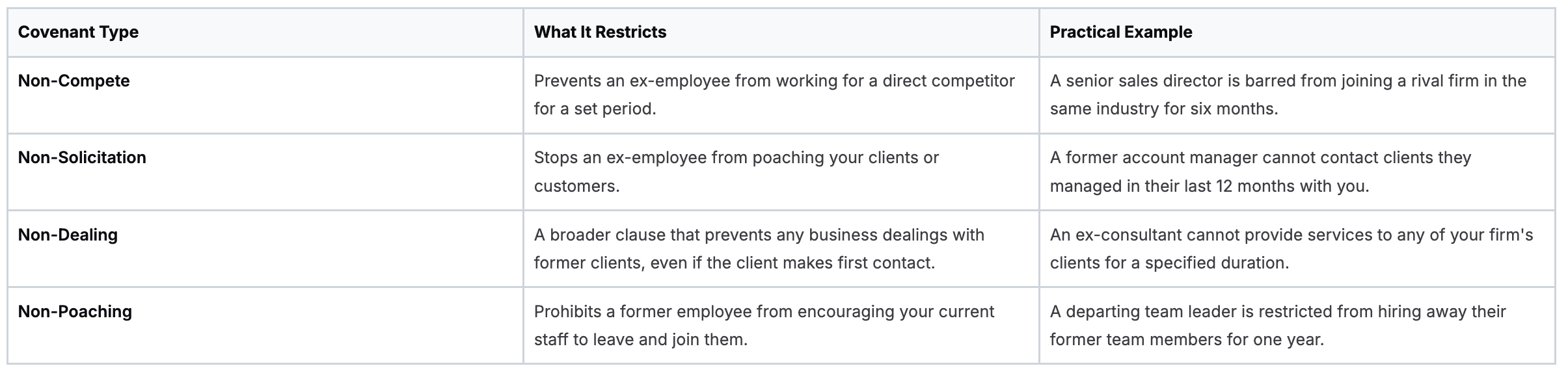
Restrictive covenants are designed to stop a former employee from immediately using their knowledge to harm your business after they leave. However, they are a balancing act. UK courts scrutinise them carefully and will only enforce them if they're reasonable and don't go any further than what's necessary to protect legitimate business interests.
Here are the most common types you’ll encounter.
Create a Free Employment Contract Here!
The secret to making these clauses enforceable is reasonableness. A blanket 12-month non-compete clause for a junior assistant covering the entire UK would almost certainly be thrown out by a court. But a targeted six-month restriction for a key director within a specific market niche? That's far more likely to hold up.
Be precise. When you draft these, think carefully about the duration, geographical area, and the specific business activities you need to restrict. The aim is to be surgical, not to use a sledgehammer that a court will see as an unfair restraint of trade.
Drafting for a Flexible Workforce
The old 9-to-5 model isn’t the only way to build a great team anymore. Modern businesses thrive on a mix of full-time staff, part-time experts, fixed-term specialists, and independent contractors to stay sharp and agile. While this flexibility is a massive plus, it means you have to get your contracts right for each specific arrangement.
Let's be clear: a one-size-fits-all contract isn't just lazy; it’s a legal minefield. Each type of working relationship comes with its own set of rights and obligations under UK law. Using the wrong agreement can lead to worker misclassification, which can trigger a cascade of problems like unexpected tax bills, benefit claims, and even employment tribunal hearings.
This trend toward a more varied workforce is only picking up speed. Recent research from December 2025 shows UK employers are doubling down on flexible hiring for 2026. Nearly half (47%) plan to bring on more interim hires, and 36% are looking to expand their use of contractors, especially for strategic projects in tech and legal fields, according to a report from Robert Half. This makes having distinct, watertight contracts for each worker type more critical than ever.
Fixed-Term Versus Permanent Contracts
A fixed-term contract is your go-to when you need someone for a specific mission—like a six-month project, maternity cover, or a seasonal rush. The key is that the contract must clearly state the end date or the exact event that concludes the employment.
But here’s something you can't overlook: fixed-term employees are legally entitled to be treated no less favourably than your permanent staff. This covers their pay, benefits, and training opportunities. You can't short-change them just because they're temporary.
When you're drafting the contract, be crystal clear about what happens when the term ends. Does the contract just expire, or is there a chance of renewal? Leaving this ambiguous is an invitation for a dispute down the line.
Part-Time Employee Contracts
Part-time workers are just employees—permanent or fixed-term—who work fewer hours than their full-time colleagues. The guiding principle here is pro-rata treatment. This means their pay, holiday allowance, and access to benefits must be proportional to what a full-time employee gets.
For instance, if a full-timer working 40 hours a week gets 28 days of holiday, a part-timer on 20 hours a week is entitled to 14 days. Your contract must spell out their exact hours and detail how their entitlements are calculated. This simple step can save you from a world of headache and claims of unfair treatment.
A Word of Warning: Misclassifying someone as a self-employed contractor when they are, for all intents and purposes, an employee is one of the costliest mistakes a business can make. Get it wrong, and HMRC could come knocking for back-paid PAYE tax and National Insurance contributions, plus hefty penalties.
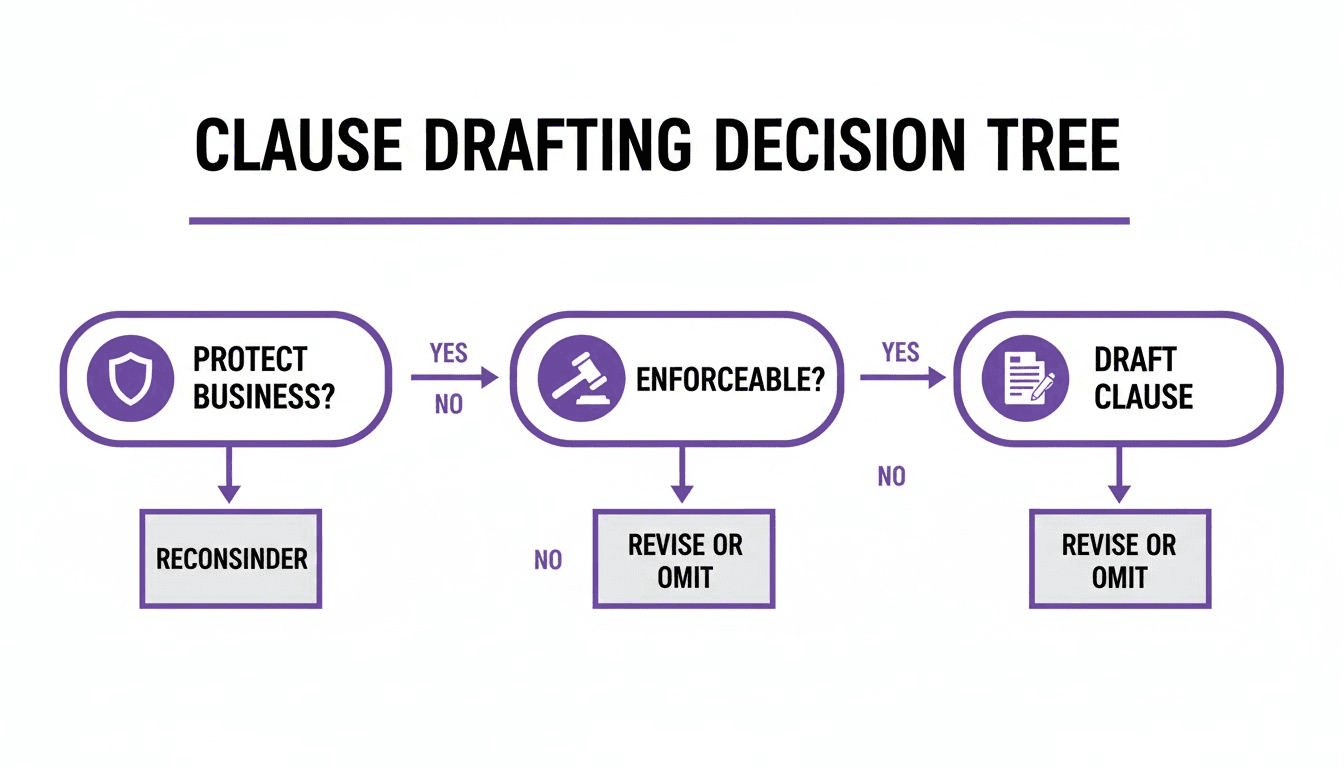
The flowchart below walks you through the thought process for drafting any protective clause, making sure it’s both commercially sound and legally compliant.
Create a Free Employment Contract Here!
As you can see, any clause must first serve a legitimate business need and then pass the test of legal enforceability before you even start writing it. It’s a two-step check that forces you to be deliberate.
The Critical Contractor Versus Employee Distinction
This is where so many businesses trip up. A genuine independent contractor or freelancer is a business owner in their own right. You hire them to deliver a service, not to become an integrated member of your staff. For them, you need a contract for services, not a contract of employment.
The language you use in this document is completely different. Here are the crucial distinctions your drafting must reflect:
- Control: You tell an employee how, when, and where to work. A contractor decides these things for themselves and is judged only on the finished product.
- Substitution: A contractor should have the right to send a suitably qualified substitute to perform the work. An employee can't just send their mate in to cover their shift.
- Equipment: Contractors bring their own tools of the trade. Employees use equipment you provide.
- Financial Risk: A contractor carries their own financial risk. They invoice for their time, aren't paid for sick days or holidays, and sort out their own taxes.
Your contract for services needs to reinforce this separation at every turn. Avoid any clauses that smell like employee control—things like setting fixed working hours, requiring attendance at staff socials, or applying your internal disciplinary process. If the lines get blurry, a court or HMRC might reclassify the relationship as employment, no matter what you've called the document.
Final Review Checklist and Common Pitfalls to Avoid

Create a Free Employment Contract Here!
Before you hit send on that employment contract, just pause for a moment. This final review is your best line of defence against future headaches and disputes. I've seen it happen—one vague clause or an outdated term can unravel all your careful work.
Think of it as your pre-flight check. Running through a systematic review makes sure the document is airtight, professional, and ready to go. It gives both you and your new hire a solid, confident start. This isn't just about catching typos; it’s about making absolutely certain your contract is legally sound and fit for purpose.
Your Final Contract Review Checklist
Before you issue any contract, it's worth taking a few minutes to run through these essential checks. It's a small investment of time that can save you a world of trouble down the line.
- Have you included all the legal must-haves? You need to make sure all the statutory particulars are present. This means names, start date, pay details, working hours, holiday entitlement, and place of work. These are the absolute non-negotiables.
- Are the job title and duties crystal clear? The contract must accurately describe the role. Any ambiguity here is a recipe for 'scope creep' arguments later. It's a good idea to reference a separate, more detailed job description for total clarity.
- Are the pay and benefits stated correctly? Double-check everything: the salary or wage, how often they'll be paid, and the pension details. Crucially, make sure the pay meets or exceeds the current National Minimum Wage. With 30.3 million people on UK payrolls as of January 2026, getting this right is vital for competing for talent. Getting it wrong can lead to disputes, which accounted for 155,000 lost working days in November 2025 alone. You can dig into these trends in the UK labour market overviews on Statista.
- Are your restrictive covenants reasonable? If you've included non-compete or non-solicitation clauses, are they specific enough? A court will only uphold restrictions that are considered reasonable in their duration, scope, and geographical reach.
- Are notice periods clearly defined? Check that you've explicitly stated the notice period required from both you and the employee, covering the time both during and after probation. This is one of the most common points of friction when an employment relationship ends.
Costly Mistakes to Sidestep
Learning how to draft a solid employment contract is as much about knowing what not to do. Some of the most common mistakes are surprisingly easy to make, but they can have serious repercussions for your business.
A huge pitfall is grabbing a generic template from the internet. These are often outdated, not specific to UK law, or simply fail to cover recent changes in legislation. A single non-compliant clause can be ruled unenforceable, leaving your business completely exposed.
Another frequent error I see is writing ambiguous clauses. Let me give you a real-world example:
A small marketing agency had a clause allowing them to make "deductions for any sums owed to the company." When an employee left, the agency tried to deduct the cost of a training course from their final pay. The employee argued this was an unauthorised deduction, took it to a tribunal, and won. Why? Because the contract didn't explicitly state that training costs were recoverable.
This just goes to show how a lack of specificity can seriously backfire. Your contract has to be precise, especially where money is involved.
Finally, one of the biggest mistakes is not getting the contract reviewed. Whether you use a legal tech service or a solicitor, getting a second pair of expert eyes on it is invaluable. They'll catch the things you might have missed, transforming your draft from a good document into a genuine protective asset for your business.
Create a Free Employment Contract Here!
Common Questions About Drafting Employment Contracts
Even with the best guide in hand, a few tricky questions always seem to pop up right when you're about to finalise a contract. It's completely normal.
Let's tackle some of the most common queries we see from business owners, so you can handle these situations with confidence.
Can I Change an Employment Contract After It Is Signed?
The short answer is yes, but you absolutely need your employee's agreement. You can't just decide to change the terms and force them on someone—that’s a one-way ticket to a breach of contract claim.
If you push through negative changes, like a pay cut, and the employee quits because of it, you could be facing a constructive dismissal case. The right way to handle this involves a bit of process.
First, you need to consult. Sit down with the employee and explain why the changes are necessary from a business perspective. Once you've talked it through, you must get their explicit, written agreement. For small tweaks, a simple letter of variation referencing the original contract might do. For anything significant, it's always safer to issue a brand new, fully compliant contract to avoid any confusion down the line.
What Happens If I Do Not Provide a Written Contract?
This is a big one. While you can technically have a verbal agreement, UK law is very clear on this. Under the Employment Rights Act 1996, you are legally required to give an employee a "written statement of particulars of employment" on or before their first day.
Failing to do this isn't just bad practice; it has real consequences. An employment tribunal can order you to pay compensation directly to the employee for the oversight.
But the bigger risk, frankly, is the sheer ambiguity it creates. Without a written contract, arguments over pay, hours, holiday entitlement, and notice periods are almost inevitable. A clear contract is your best defence against future misunderstandings and protects both you and your team.
How Long Should a Probationary Period Be?
A probationary period is one of the most useful tools for a new hire. It gives both of you a chance to see if it’s the right fit. In the UK, a probation period of three to six months is pretty standard and generally seen as a fair amount of time to gauge performance.
What’s crucial is that your contract spells out the rules of probation clearly. It needs to state the exact length, confirm that a shorter notice period applies (often one week), and mention if you have the right to extend the period if performance isn't quite up to scratch yet.
Remember, key rights like protection from discrimination apply from day one. However, the right to claim unfair dismissal typically requires two years of service. A well-managed probation lets you sort out any performance issues long before that two-year milestone.
Are Online Contract Templates Safe to Use?
This is a huge risk. Grabbing a free template from a quick search is a legal minefield. They’re often outdated, not written for UK law, or miss crucial recent updates, like those in the Employment Rights Act 2025.
A single poorly worded clause can be thrown out by a court, leaving your business completely exposed. For example, if your restrictive covenants are too broad, a judge will just deem them unenforceable, giving you zero protection.
Instead of rolling the dice on a freebie, a much smarter move is to use a dedicated service that generates a compliant contract based on your specific needs. It ensures your document isn't just a flimsy template, but a proper legal shield for your business.
Creating legally sound employment contracts shouldn't be a source of stress. Robot Lawyer Limited offers a fast, affordable, and reliable way to generate compliant documents tailored to your business. Our platform blends smart automation with verification from legal professionals, ensuring you get it right every time. Protect your business and build clear relationships from day one by visiting https://robotlawyer.co to start your free trial.