
Example of a tenancy agreement: Your 2026 UK Guide to Renting
A proper tenancy agreement isn't just a bit of admin to tick off your list. It's the absolute bedrock of your entire landlord-tenant relationship. This document, usually an Assured Shorthold Tenancy (AST) in the UK, lays out every right and responsibility for both you and your tenant. Get it right, and you're set up for a smooth, drama-free tenancy.
What Is a Tenancy Agreement and Why Is It So Important?
Think of it like the rulebook for your property. Without clear rules, nobody knows what they can or can't do, leading to misunderstandings and arguments down the line. A solid, well-written agreement is your first and best line of defence against disputes, making it an essential part of being a modern landlord.
If a disagreement does pop up—whether it's about late rent, property damage, or how the tenancy ends—this document is your go-to evidence. While a verbal agreement might hold some legal weight, it's incredibly difficult to prove what was actually said. Relying on one is a recipe for stress and expensive legal battles you just don't need.
Create a Free Tenancy Agreement (AST) Here!
The Rise of the UK Rental Market
Having a watertight tenancy agreement is more crucial today than ever before. The UK's housing market has changed dramatically, with the private rented sector expanding at an incredible rate. Between 1990 and 2023, the number of rental homes in England shot up by 36%, from 6.3 million to 8.6 million.
With so many people, especially younger generations, now renting their homes, the demand for fair and legally sound agreements has never been higher. You can dig deeper into UK rental trends to get the full picture of this shifting landscape.
Core Components Every Agreement Must Include
At its core, a tenancy agreement is all about creating clarity and security. We'll get into a full example of a tenancy agreement later, breaking it down clause by clause, but every contract must have these fundamental pillars in place:
- The Parties Involved: Who is the landlord? Who are the tenants? Are there any guarantors? Get everyone's full names down correctly.
- The Property Details: The full, exact address and a clear description of what's included in the rental.
- The Financials: The exact rent amount, the date it's due each month, and all the details about the tenancy deposit.
- The Tenancy Term: The official start date and the length of the tenancy.
Nailing these basics from day one is what turns a potentially fraught relationship into a professional, well-managed business arrangement. It’s the smart way to be a landlord.
A Tenancy Agreement Example Clause by Clause
Let’s be honest, staring at a tenancy agreement can feel like you’re trying to decipher ancient legal text. To help cut through the jargon, we're going to break down a typical agreement, piece by piece. Here’s a practical walkthrough of what each section looks like and what it actually means for you.
At its heart, every tenancy agreement is about the relationship between the landlord, the tenant, and the property. It’s the rulebook that everyone has to play by.
Create a Free Tenancy Agreement (AST) Here!
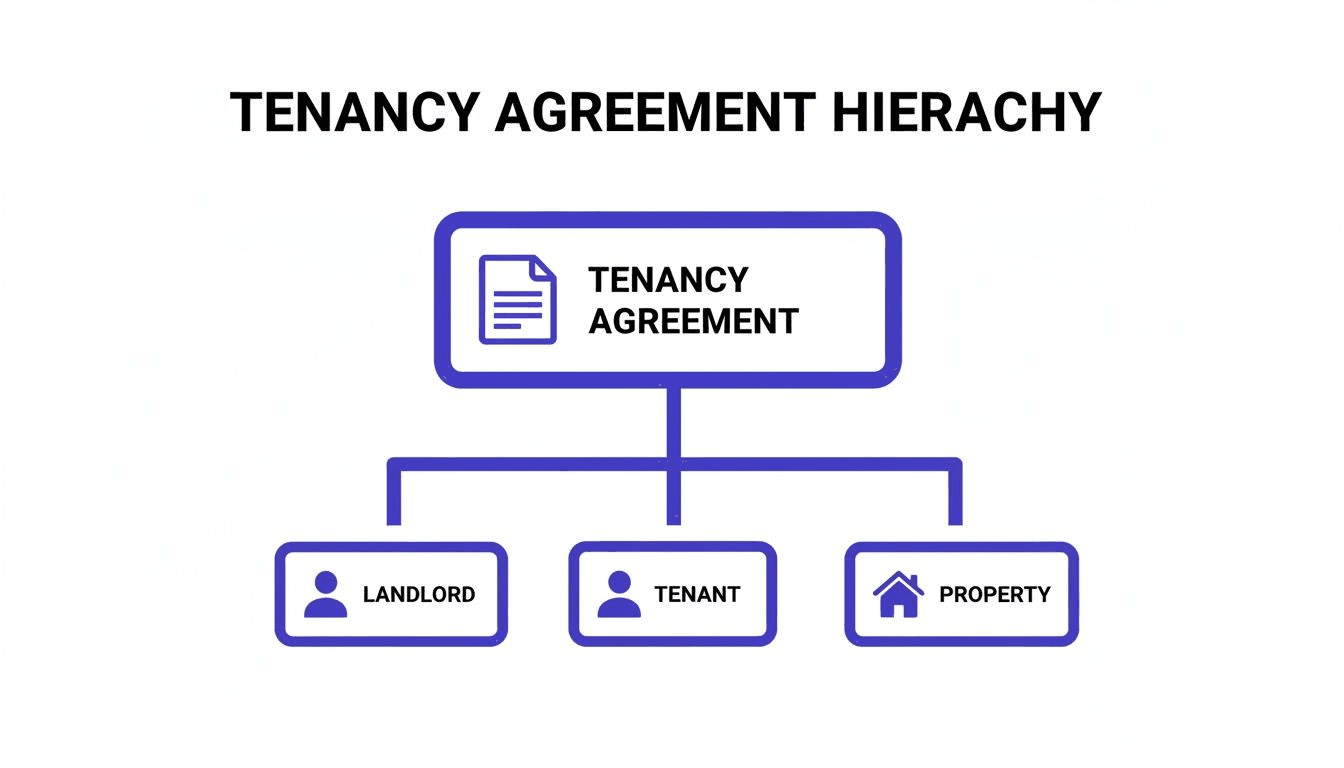
Think of the agreement as the central pillar holding everything together. It’s the legally binding document that defines everyone's rights and responsibilities regarding the property.
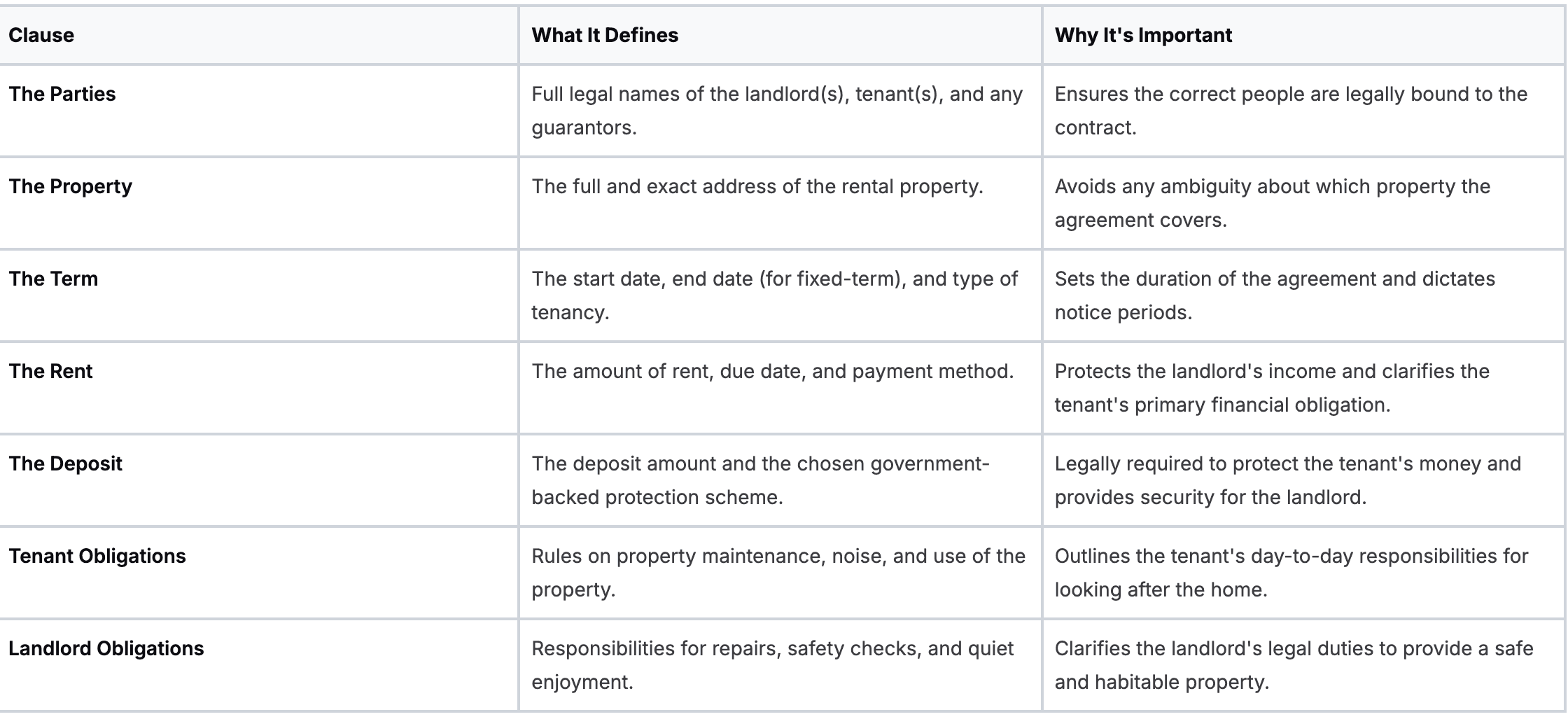
Before we get into the nitty-gritty, it's helpful to see what the most common clauses are and why they matter. The table below summarises the absolute must-haves in any standard UK tenancy agreement.
Create a Free Tenancy Agreement (AST) Here!
These clauses form the backbone of the agreement, ensuring both sides are clear on their commitments from day one.
The Parties and The Property
Every agreement has to start by clearly stating who is involved and what property is being rented. It sounds simple, but a mistake here can cause huge problems down the line, potentially even voiding the contract.
EXAMPLE CLAUSE: The Parties
1.1 This Agreement is made between: (a) THE LANDLORD: [Landlord's Full Name] of [Landlord's Address]. (b) THE TENANT(S): [Tenant's Full Name(s)] of [Tenant's Current Address]. (c) THE GUARANTOR (if any): [Guarantor's Full Name] of [Guarantor's Address].
This section needs the full legal names of everyone involved. For tenants, that means every adult who will be living there. The property address must also be precise, right down to the postcode.
The Tenancy Term
This clause sets the clock for the tenancy. It defines exactly when the tenant’s right to live in the property begins and, for a fixed-term tenancy, when it’s scheduled to end.
- Start Date: The day the tenant can move in and rent payments kick in.
- End Date: For a fixed-term agreement, this is the last day of the initial contract. After this date, the tenancy might roll over into a periodic one.
Getting these dates right is crucial. It prevents any arguments about when the tenancy officially started or when notice periods should be calculated from.
The Rent
For any landlord, this is arguably the most important clause of all. It specifies exactly how much rent is due, when it has to be paid, and what happens if it’s late. A well-worded rent clause is your front line of defence for protecting your rental income.
EXAMPLE CLAUSE: The Rent
3.1 The Tenant agrees to pay the Landlord a rent of £1,250 per calendar month. 3.2 The first payment is to be made on or before the signing of this Agreement. Subsequent payments are due on the 1st day of each month by standing order to the Landlord's nominated bank account. 3.3 If rent is more than 14 days late, interest may be charged at 3% above the Bank of England's base rate.
It’s vital to define the payment method (like a standing order) and the due date. With UK private rental prices jumping by a record 6.2% in the year to January 2024, having clear terms for rent reviews is also more important than ever. You can see the full data on rising rental prices from the ONS.
The Deposit
The tenancy deposit acts as a financial safety net for landlords, covering potential damages or unpaid rent. This clause must clearly state the deposit amount and, critically, specify which government-approved scheme will be used to protect it.
EXAMPLE CLAUSE: The Deposit
4.1 The Tenant shall pay a tenancy deposit of £1,442 (equivalent to five weeks' rent) to the Landlord upon signing this Agreement. 4.2 The Landlord confirms the deposit will be protected with the [Name of Tenancy Deposit Scheme] within 30 days of receipt. The prescribed information relating to the deposit will be provided to the Tenant as required by law.
Protecting the deposit isn’t just good practice; it's a strict legal requirement. You must also give the tenant the official paperwork proving it's protected. To get a better handle on all your duties, our guide on creating an Assured Shorthold Tenancy (AST) is a great place to start, as the AST is the foundation for most private rentals in the UK today.
Understanding Your Legal Obligations as a Landlord
Getting a tenancy agreement signed is a great first step, but it’s really just the beginning of your journey as a landlord. In the UK, you’re bound by a strict set of laws designed to keep tenants safe and the rental process fair.
Think of these duties as the non-negotiable rules of the game. Getting them wrong isn’t just bad form—it can land you in serious legal trouble with hefty fines. Let’s break down exactly what you need to do, and just as importantly, what happens if you don’t.
Deposit Protection Is Non-Negotiable
When a tenant pays you a deposit, that money isn’t yours to keep. It still belongs to them, and you’re just holding it. Your legal duty is to protect it in a government-approved tenancy deposit scheme (TDP) within 30 days of receiving the funds.
You also have to give your tenant the 'Prescribed Information', which is basically a receipt telling them exactly where their deposit is being held and how the scheme works.
Failing to protect a deposit properly comes with severe penalties. A tenant can take you to court, and you could be ordered to repay the entire deposit plus a fine of up to three times its value.
On top of that, if the deposit isn't protected correctly, you lose your right to use a Section 21 notice to regain possession of your property. This one mistake can trap you in a tenancy you need to end. You can find out more in our detailed guide on the Section 21 notice process.
Verifying a Tenant's Right to Rent
Before you hand over the keys, you have a legal duty to check that every adult tenant has the right to rent a home in the UK. This applies to everyone aged 18 or over who will be living in the property, even if their name isn't on the tenancy agreement.
The 'Right to Rent' check means you must inspect and take copies of their original documents, like a passport or biometric residence card. The government has a straightforward list of acceptable documents to guide you.
Don’t treat this as a simple box-ticking exercise. Failing to do these checks can lead to an unlimited fine or even a prison sentence.
Essential Safety Certifications
Your responsibility to provide a safe and habitable home is cemented in law. This means keeping up with several key safety standards and having the paperwork to prove it.
- Gas Safety: Any gas appliances and flues must be inspected every year by a registered Gas Safe engineer. You must give your tenant a copy of the Gas Safety Certificate before they move in, and then within 28 days of each annual check.
- Electrical Safety: You are required to have an Electrical Installation Condition Report (EICR) for the property. A qualified electrician must carry out this check, and the report is valid for five years.
- 'How to Rent' Guide: At the very start of the tenancy, you must give your tenants the latest version of the government's 'How to Rent' checklist. It’s a simple but mandatory step.
Choosing Your Tenancy Structure: Fixed-Term vs Periodic
Not all tenancy agreements are created equal. When you look at any example of a tenancy agreement, one of the first things you’ll notice is whether it’s a fixed-term or periodic tenancy. Getting this right from the start is all about balancing your need for security with your desire for flexibility.
Most tenancies in the UK kick off with a fixed-term agreement. Think of it as a contract with a clear start and end date, locking in the rent and other terms for that specific period. It gives both you and your tenant a solid footing – you get a predictable income, and they get a secure home.
The Standard Fixed-Term Tenancy
The fixed-term agreement is the bread and butter of the UK’s private rental market. It’s by far the most common setup. In fact, the government's 2021-2022 English Housing Survey found that 58% of new private tenancies began with a 12-month fixed term. Another 32% started with a 6-month term, showing a real preference for these defined periods. You can dive deeper into the numbers by checking out the latest UK rental market trends.
So, what makes a fixed-term tenancy?
- A Defined End Date: The agreement clearly states when the initial term is over.
- Rent Security: You can’t increase the rent during the fixed term, unless you’ve included a specific rent review clause from the outset.
- Notice Periods: Neither you nor the tenant can end the tenancy early without a very good reason, like a break clause or by mutual agreement.
This structure provides a strong, reliable foundation, which is perfect for new tenancies where everyone wants to know exactly where they stand.
The Flexible Periodic Tenancy
But what happens when that initial 6 or 12 months is up? If you don’t sign a new fixed-term contract, the tenancy doesn’t just end. It automatically rolls over into a statutory periodic tenancy.
A periodic tenancy essentially "rolls over" on a month-by-month basis (or week-by-week, if rent is paid weekly). It continues under the same terms as the original agreement but without a fixed end date, offering much more flexibility.
This switch has a big impact on how the tenancy can be ended. To end a periodic tenancy, a landlord usually has to give at least two months' notice. A tenant, on the other hand, typically only needs to give one month's notice.
This flexibility can be a real advantage if circumstances change, but it comes at the cost of long-term security. Getting your head around this tenancy lifecycle is crucial for managing your property like a pro.
Common Mistakes to Avoid When Drafting Your Agreement
A weak tenancy agreement can be worse than having no agreement at all. It gives you a false sense of security while leaving you wide open to expensive disputes. Getting this crucial document right from the start takes care, as even tiny errors can have massive consequences.

Create a Free Tenancy Agreement (AST) Here!
It’s surprisingly easy to fall into predictable traps when putting a contract together. By understanding these common pitfalls, you can make sure your agreement is solid, compliant, and actually protects your interests.
Using Outdated or Invalid Templates
One of the biggest mistakes is grabbing a free template off the internet without checking if it's still valid. Laws change, and an old document might contain clauses that are now illegal, like charging for credit checks—something banned by the Tenant Fees Act 2019.
- The Mistake: Relying on an old agreement that includes unlawful fees or terms.
- The Solution: Always start with a current, professionally reviewed template. Make sure your example of a tenancy agreement complies with all recent laws to avoid parts of your contract becoming useless.
Using an invalid template doesn’t just weaken your position; it can hit you with financial penalties.
If a clause in your agreement is found to be unfair or unlawful, a court will simply void it. Worse, they could decide the entire contract is invalid, leaving you with no more protection than if you'd never had a written agreement in the first place.
Including Unenforceable Clauses
In an effort to protect their property, some landlords go too far and include overly restrictive or "unfair" terms. A classic example is a blanket ban on all guests or trying to make the tenant responsible for repairs that are legally the landlord's job.
These kinds of clauses are almost always unenforceable under UK law. A tenant has a right to "quiet enjoyment" of their home, and that includes having guests over. Likewise, you can't just pass on your legal responsibility for major structural repairs.
Simple Clerical Errors
Never underestimate the damage a simple typo can cause. Misspelling a tenant’s name, getting the address slightly wrong, or mistyping the rent amount can create huge confusion and legal headaches down the line.
- The Mistake: Incorrectly recording names, addresses, or financial figures.
- The Solution: Double-check every single detail before anyone signs. Confirm the full legal names of all tenants and verify the property address and rent amounts are 100% accurate.
How to Create a Custom Tenancy Agreement in Minutes
After wading through all the legal must-haves and common pitfalls, the thought of actually drafting a tenancy agreement can feel pretty daunting. Most landlords find themselves stuck between a rock and a hard place: either fork out for a pricey solicitor or take a gamble on a free template you’ve found online.
Thankfully, there’s a third option that’s much simpler, quicker, and far more reliable.

Create a Free Tenancy Agreement (AST) Here!
You can generate a fully customised and legally sound Assured Shorthold Tenancy (AST) agreement in just a matter of minutes. These modern tools walk you through a simple set of questions, gathering the key details about your property, the rent, your tenants, and any specific rules you want to include.
A Document Built for You, Not a Fill-in-the-Blanks Template
Here’s the clever part: this isn’t just a generic form where you plug in a few names and dates. It’s a smart system that actually constructs a compliant contract from the ground up, based on your specific situation.
As you answer the questions, the platform pulls together the right legal clauses to match your needs. This gives you a professional-grade example of a tenancy agreement that's ready to sign, but without the eye-watering legal bill. It’s also incredibly handy if you need to tweak agreements for different properties. For trickier scenarios where you need to amend an existing lease, it’s worth knowing how to do it formally bycreating a lease addendum.
This process takes all the guesswork out of the equation. You get a document that’s not just tailored to you, but is also bang up-to-date with current UK housing laws, like the Tenant Fees Act 2019.
Get an Expert Eye for Total Peace of Mind
For that extra layer of confidence, the best services offer more than just the automated document. Once your custom agreement is ready, you have the option to have it checked over by a qualified legal professional. It’s the perfect blend of fast technology and real human expertise.
This final review makes sure every single detail is spot-on, giving you absolute certainty that your agreement is solid, enforceable, and offers the best possible protection for your investment. It's an immediate, trustworthy solution for one of the most important jobs on any landlord's to-do list.
Your Tenancy Agreement Questions, Answered
Even the most straightforward tenancy agreement can throw up questions down the line. Let's tackle some of the most common ones that both landlords and tenants run into.
What Happens If a Tenant Wants to Leave Early?
Life happens, and sometimes a tenant needs to move out before their fixed term is up. In legal terms, this is called "surrendering the tenancy."
It’s not as simple as just handing back the keys, though. A tenant can only end the agreement early if the landlord agrees. Otherwise, they're on the hook for the rent until the end of the term, unless the landlord finds a new tenant or formally agrees to release them from the contract.
The get-out clause here is, well, a break clause. Some agreements include this specific term, which allows either the landlord or tenant to end the tenancy early by giving a set amount of notice. If your agreement doesn't have one, any early exit comes down to good old-fashioned negotiation.
Can I Change a Tenancy Agreement After It Is Signed?
The short answer is no, not by yourself. Once that ink is dry, the tenancy agreement is a legally binding contract. You can't just decide to change the rent or add a new rule on your own.
Any changes need the written thumbs-up from everyone involved—that means the landlord and all the tenants. To make it official, you have two options:
- Create an addendum: This is just a separate document that outlines the specific change. Everyone signs it, and you attach it to the original agreement.
- Sign a new agreement: You can tear up the old contract and have everyone sign a brand new one that includes the updated terms.
Is a Verbal Tenancy Agreement Legally Binding?
Technically, yes. A verbal agreement to rent a property can be legally binding in the UK. But—and this is a big but—relying on one is a massive gamble for everyone.
Think about it. If a dispute crops up over the rent amount, who's responsible for a leaky tap, or the notice period, how do you prove what was agreed? It becomes a messy "he said, she said" situation that's incredibly difficult to resolve.
A written agreement isn't just a formality; it’s your safety net. It provides undeniable proof of the terms you both agreed to. Plus, landlords are legally required to give tenants certain information, like the 'How to Rent' guide and deposit protection details. A proper, written example of a tenancy agreement is the best way to tick all those boxes.
Ready to create a professional, legally-sound tenancy agreement in minutes? Robot Lawyer helps you generate custom documents tailored to your exact needs, blending smart automation with expert verification for complete peace of mind. Start your 7-day free trial today.