
Difference Between Contractor and Employee: 2026 Guide to Classification
At its heart, the difference between a contractor and an employee comes down to the legal paperwork you sign. An employee joins your team under a ‘contract of service’, making them a core part of your business. A contractor, on the other hand, is brought in for a specific project or task under a ‘contract for services’, operating as their own distinct business.
Understanding The Core Difference Between Contractor and Employee
Getting this distinction right is crucial. It’s the foundation for everything that follows, from your tax duties and their employment rights to how much day-to-day control you can have over their work.
When you hire an employee, you take on a whole host of responsibilities. This includes handling their PAYE tax and National Insurance contributions, as well as providing statutory holiday pay and enrolling them in a pension scheme. With a contractor, these obligations fall on them; they manage their own taxes and business finances.
Don't assume a job title is enough. UK tribunals and HMRC will look past the label and examine the real-world working relationship. They use a few key tests to figure out a worker's true status:
- Control: Who decides how, when, and where the work gets done?
- Personal Service: Does the individual have to do the work themselves, or could they send someone else in their place?
- Mutuality of Obligation (MOO): Are you required to keep offering work, and are they required to accept it?
These factors, along with others, paint the full picture. A misstep in classification can lead to serious legal headaches and hefty financial penalties.
At-a-Glance Comparison Contractor vs Employee
To help you get a quick handle on the main differences, we’ve put together a high-level summary.
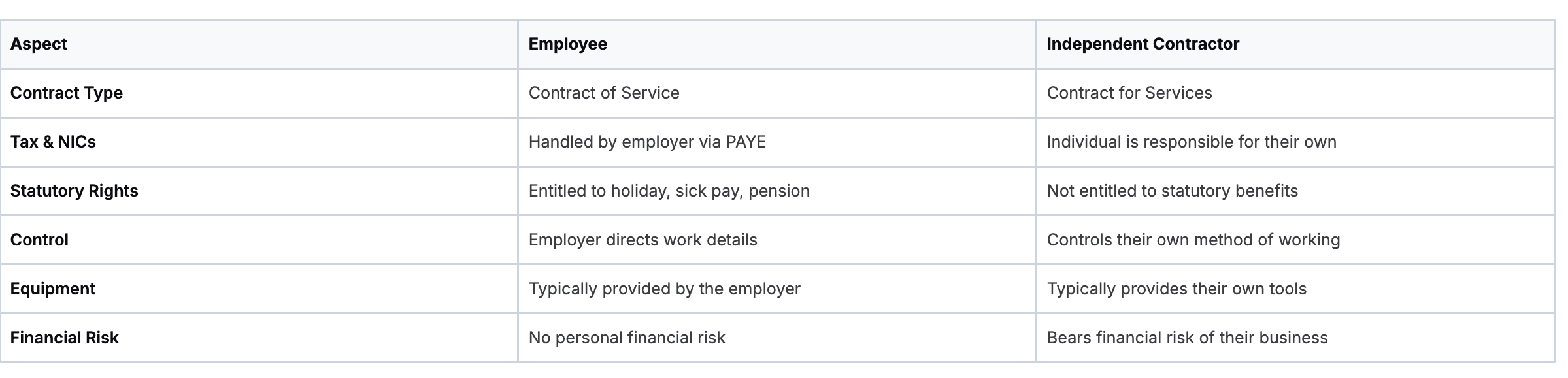
While this table gives you a solid starting point, the reality on the ground can be much more complex. These distinctions are clear in UK employment data. For instance, while only about 13% of the workforce is self-employed, some sectors depend heavily on them. The construction industry is a prime example, with around 745,000 self-employed individuals, followed closely by professional and technical fields.
This is precisely why getting your documentation right isn't just a box-ticking exercise. A clear and accurate contract of employment is an essential shield for your business.
Understanding the Legal Tests for Employment Status
When it comes to figuring out if someone is a contractor or an employee, UK tribunals and HMRC don't just take your word for it. They look past job titles and the labels on a contract, focusing instead on the day-to-day reality of the working relationship. To get it right, you need to understand the legal tests they use to build their picture of the engagement.
Three main pillars guide the assessment: Control, Personal Service, and Mutuality of Obligation (MOO). It's not a simple checklist; no single factor decides the outcome. Instead, they're all weighed together to see where the relationship truly sits.
The Control Test
The first, and arguably most important, test looks at the level of control a business has over the worker. This isn't just about managing the final result—that’s normal for any project. It’s about having control over how, when, and where the work actually gets done.
If a company sets the working hours, gives detailed instructions on how to do the job, and makes the person work from a specific location, it points strongly towards employment. On the other hand, a genuine contractor has the freedom to choose their own methods, set their own hours, and decide where they work from.
Think about it this way: an in-house marketing coordinator who has to be at the office from 9-to-5, use company equipment, and follow a rigid content schedule is clearly under the business's control. An external consultant hired to deliver a strategy by a certain deadline, who uses their own laptop from their own office, is not. That autonomy is a hallmark of self-employment.
The Personal Service and Substitution Test
Next up is the critical test of personal service. Is the individual required to do the work themselves? Or do they have a genuine right to send a qualified substitute to do the job instead? This is a fundamental split between a contract of service (employment) and a contract for services (contracting).
A genuine right of substitution, where the contractor can send another suitably skilled individual to complete the work without needing the client's permission, is a powerful indicator of self-employment. It shows the client is paying for a service, not a specific person.
For this right to be taken seriously, it has to be a real, unrestricted option. If a contract has a substitution clause but in practice the client would never accept a substitute, or the process is so difficult it’s impossible to use, a tribunal will see right through it. Crucially, the contractor should be the one paying their substitute, not the client.
The flowchart below shows how these key factors guide the classification process.
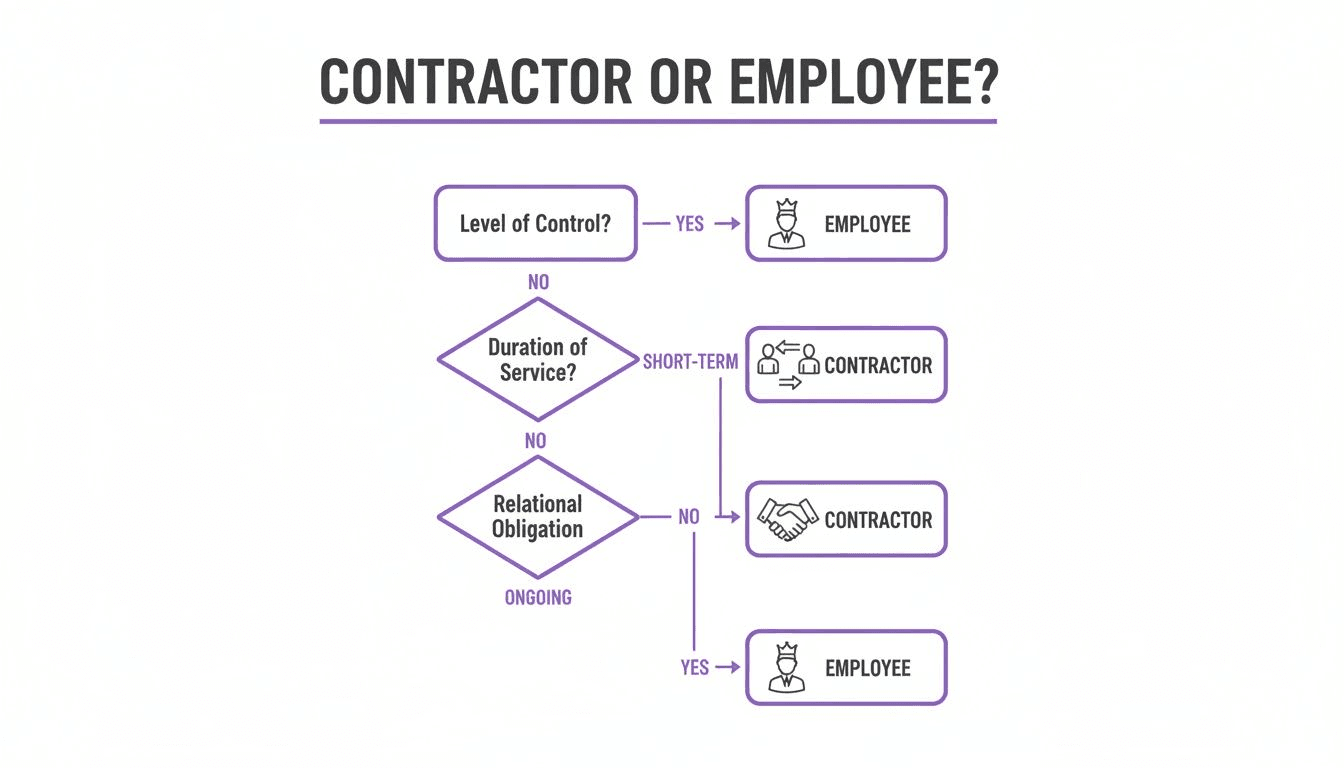
As you can see, a lack of control, the real ability to send a substitute, and no ongoing expectation of work are the core elements that point towards a contractor status.
The Mutuality of Obligation Test
Finally, we have Mutuality of Obligation (MOO). This test simply asks: is the company obliged to keep offering work, and is the individual obliged to accept it? In a standard employment contract, this mutuality is a given—the employer provides paid work, and the employee is expected to do it.
For a contractor, this obligation shouldn't exist beyond the specific project they were hired for. Once that piece of work is done, neither side should expect more work to be offered or accepted. Every new project should come with a new, separate agreement.
This is a common pitfall. If a contractor works for one client continuously for a long time, with new work flowing automatically, it can create an implied mutuality of obligation that starts to look a lot like employment.
The UK construction industry is a great example of these relationships working at scale. In late 2025, self-employed workers made up 37% of the entire construction workforce, with around 748,450 individuals operating this way. This figure has held steady since 1997, demonstrating how vital contractors are for project-based work in the sector. Whether you're drawing up an employment contract or a service agreement, understanding these established norms is vital. You can discover more about these workforce trends at the Building Cost Information Service.
Comparing The Financial and Legal Implications

The decision to hire an employee or engage a contractor carries some serious financial and legal weight. It’s a choice that directly shapes your budget, your day-to-day admin, and the legal rights of the person doing the work for you. Getting this right from the start is fundamental to running a sound, compliant business.
For an employee, the salary you agree on is just the beginning. On top of their gross pay, you’re on the hook for several mandatory on-costs that can balloon your total spend. These aren't optional extras; they're the legal requirements of being an employer in the UK.
With a contractor, things are much more straightforward. You pay their invoices for the work they’ve done, and that’s pretty much where your direct financial ties end. They handle their own tax, National Insurance, and business costs, which is why their daily or project rate is typically higher.
The True Cost of an Employee vs a Contractor
Let's run a practical comparison. Say you've budgeted around £65,000 for the year to bring someone in. With that budget, you could hire a permanent employee on a £50,000 salary or engage a contractor at a day rate of £300.
At first glance, the contractor might seem more expensive. But when you factor in all the hidden costs of employment, the numbers tell a very different story. For that £50,000 employee, your business also has to cover:
- Employer’s National Insurance Contributions: A significant cost, typically around 13.8% on earnings above the threshold.
- Workplace Pension Contributions: You are legally required to pay a minimum of 3% of their qualifying earnings into a pension.
- Statutory Holiday Pay: An employee is entitled to 5.6 weeks of paid leave every year, which you have to fund.
- Statutory Sick Pay (SSP): While the direct cost of SSP can be low, you also bear the cost of covering their absence and lost productivity.
When you add it all up, the true annual cost of that £50,000 employee can easily climb towards or even past £60,000. And that’s before you even think about other costs like training, equipment, software licences, or the mandatory employer’s liability insurance.
In contrast, a contractor at £300 per day, working a typical 220 days a year, would cost your business £66,000. While that figure is a bit higher, it's completely fixed and transparent. There are no hidden employment overheads. This gives you budget certainty, which is a massive draw for businesses needing help on specific projects.
Rights and Obligations: A Detailed Comparison
These financial differences all stem from a deep legal divide in rights and obligations. An employee gets a wide range of statutory protections because they have a ‘contract of service’. A contractor, working under a ‘contract for services’, gives up these rights in exchange for more freedom and the potential to earn more.
The table below breaks down these key distinctions. Understanding this framework is absolutely essential for managing your legal risk and making sure you classify people correctly.
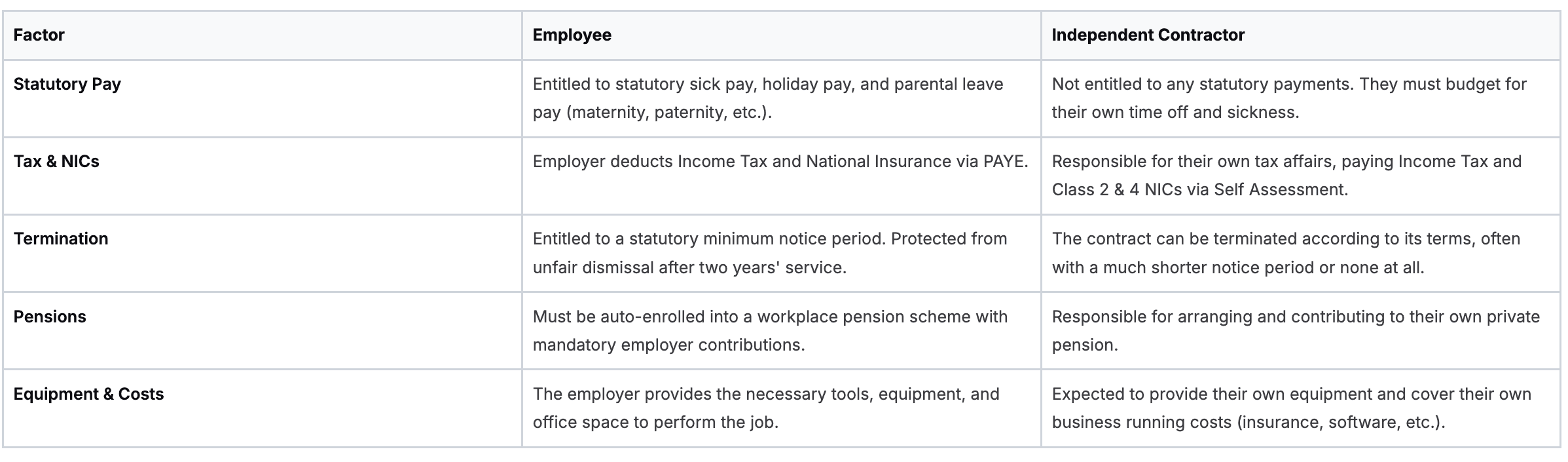
Getting to grips with these differences is crucial. They are not just administrative points; they are the bedrock of UK employment law.
It's a trade-off. Employees receive security and a safety net of statutory rights, which comes at a direct cost to the employer. Contractors gain flexibility and control but must take on the financial risk and administrative burden of running their own business.
Ultimately, the right choice comes down to what your business actually needs. If you're looking for a core team member for an ongoing role that's integral to your business, the investment in an employee is both necessary and smart. But if you need specialist skills for a defined project without the long-term strings attached, a contractor is often the more financially and operationally sensible path.
Navigating The Complexities of IR35
The off-payroll working rules, better known as IR35, are arguably the biggest legal minefield when you're weighing up a contractor versus an employee. The rules exist to tackle what HMRC calls 'disguised employment'—essentially, where a contractor acts just like an employee but gets the tax benefits of running their own limited company.
For many businesses, this has created a major layer of responsibility. Since April 2021, if you're a medium or large-sized company in the private sector, the ball is in your court to figure out the employment status of your contractors. Small businesses get a pass here; in those situations, the contractor's own company is still responsible for making the call.
Determining Status and The Role of the SDS
When the responsibility lands on your shoulders, you are legally required to assess each contractor engagement. This isn't a new set of rules; you'll be applying the same classic employment status tests we've already covered—Control, Personal Service, and Mutuality of Obligation—to decide if the work falls 'inside' or 'outside' IR35.
If you find the engagement is 'inside IR35', you're effectively saying the relationship is one of employment, at least for tax purposes. This means you must start deducting Income Tax and National Insurance Contributions from their fees, exactly as you would for a regular employee on your payroll.
To make it official, you have to issue a Status Determination Statement (SDS) to the contractor and any recruitment agency involved. This is a formal document that states your decision and, crucially, explains your reasoning. It’s not just a piece of paper; failing to issue an SDS, or not taking 'reasonable care' to get your decision right, could leave your business on the hook for the unpaid taxes and any penalties. Think of it as your main piece of evidence that you’ve done your due diligence. You can learn how to create a compliantIR35 Status Determination Statement to keep your business protected.
Taking Reasonable Care in Your Assessment
So, what does 'reasonable care' actually look like in the real world? It means you have to conduct a proper, objective review of the working arrangement, not just go through a checklist on autopilot. HMRC wants to see that you've genuinely considered the facts on the ground.
To make sure you're meeting this standard, your process should involve:
- Reviewing the Contract: The written agreement must be a true reflection of how you're actually working together.
- Assessing Working Practices: Look at the day-to-day reality. How much direction are you giving? Can they genuinely send someone else to do the job?
- Using Assessment Tools: HMRC’s Check Employment Status for Tax (CEST) tool can be a useful starting point, but it's not a silver bullet. You shouldn't rely on it as your only source of truth.
- Keeping Detailed Records: Document every part of your assessment process, from the information you gathered to the logic that led to your final decision.
One of the most common pitfalls is issuing a blanket determination for all contractors. IR35 demands an individual assessment for each engagement. The reality of the work can vary wildly, even for people with similar job titles. A one-size-fits-all approach is a textbook example of failing to take reasonable care.
The demand for skilled contractors isn't going away. Recent data shows the IT contractor market hit its strongest point since late 2023, largely thanks to roles in AI and cybersecurity. At the same time, while the UK construction contractor market is forecast to see a 2.3% employment dip from 2024 to 2025, it still accounted for 583,824 jobs. This ongoing reliance on a flexible workforce makes getting your contractual paperwork right more important than ever. As more businesses bring on contractors, having accessible and compliant service agreements is essential for managing your legal risk. You can explore more on UK construction employment trends on IBISWorld.com.
Avoiding The High Cost of Worker Misclassification

Getting the distinction between an employee and a contractor wrong is one of the costliest mistakes a business can make. This isn't just about fixing a bit of paperwork; the fallout can involve huge financial penalties and legal headaches that put your company's future on the line.
The first and most immediate threat usually comes from HMRC. If they investigate and decide you've misclassified a worker, your business could be on the hook for years of unpaid PAYE Income Tax and both employer and employee National Insurance contributions.
On top of that, HMRC can add hefty fines and charge interest on the entire overdue sum. Suddenly, a simple working arrangement transforms into a major financial crisis.
Beyond Taxes: The Risk of Employment Tribunals
The financial pain doesn't end with a tax bill. A worker who believes they were misclassified can bring a case to an employment tribunal, claiming all the statutory rights they were denied. This is where the costs can really spiral.
Tribunals can award backdated payments for a whole range of entitlements, most commonly:
- Backdated Holiday Pay: A worker can claim payment for all the statutory holiday leave they should have had, potentially going back years.
- Unpaid Statutory Sick Pay: If they were ever off sick, they could claim SSP for those periods.
- Pension Contributions: The tribunal can order you to make backdated employer contributions into a pension scheme.
Just imagine this: a contractor you've worked with for two years is reclassified as an employee. They could suddenly be owed nearly 12 weeks of backdated holiday pay, plus pension contributions and other benefits. It’s an unexpected financial shock that many businesses simply aren't prepared for.
This isn’t a rare scenario. Even well-meaning companies get this wrong, often because the day-to-day working relationship slowly changes over time, blurring the lines between contractor and employee. Without clear boundaries and the right paperwork, you’re left completely exposed.
A Proactive Checklist for Prevention
The best way to defend yourself is to be proactive. Before you bring any new worker on board, and during regular reviews of your current team, you need to assess the situation with a critical eye. This checklist will help you document your decisions and keep your risk low.
- Define the Scope of Work: Is this for a specific, time-limited project with clear deliverables? Or is it an open-ended role that’s fundamental to your daily operations? Get this down in writing.
- Assess the Key Status Tests: Look at how Control, Personal Service, and Mutuality of Obligation play out in the real world, not just on paper. Does the contract reflect who truly controls the work and whether a substitute could genuinely be sent?
- Draft a Robust Contract: Your contract is your first line of defence, but only if it accurately reflects the real-life arrangement. For a contractor, this means having a proper 'Contract for Services'. It must clearly state their independent status, the specific work they are doing, and how they get paid, all while reinforcing that they are not part of your core business. If the reality doesn't match the contract, the paper it's written on won't protect you.
Choosing and Documenting The Correct Relationship
So, after wading through all the legal tests and financial implications, how do you actually decide? It really comes down to what your business needs at this moment. The right call hinges on practical things like how long the work will last, what your budget looks like, and just how much control you need to have over the person doing the work. This is where you put the theory into practice and make sure your decision is both smart for your business and legally watertight from day one.
Making the right choice begins with asking some honest questions about the role itself. Is this a core part of what your business does, something you'll need for the long haul? If the answer is yes, you're almost certainly looking at hiring an employee. On the other hand, is it for a specific, one-off project with a clear finish line? Then a contractor is probably a much better fit.
The real acid test is often about integration. An employee is woven into the fabric of your company. A contractor is an outside expert you bring in for a specific task. Nail this distinction, and you’ll sidestep a world of trouble later on.
Situational Recommendations
To put some meat on the bones, let's look at two common scenarios:
- Engage a contractor when: You need a specialist for a defined project. Think of a web developer to build your new e-commerce site or a marketing consultant to manage a three-month social media campaign. The work has clear deliverables, and you aren't telling them when to start and stop each day. This route saves you the significant overheads that come with employment.
- Hire an employee when: You're filling a permanent, essential role. This could be your full-time sales manager or the administrative assistant who keeps the office running. The job demands ongoing commitment, deep integration with your team, and you need to direct their day-to-day tasks and set their priorities.
Getting this right is the foundation for how you structure the relationship and, critically, how you document it.
The Power of The Right Contract
Once you've made the call, the contract you put in place is your single most important defence against misclassification claims. The title on the document helps, but it’s the words inside that really matter. The clauses must be a true reflection of how the relationship works in reality.
For an employee, a Contract of Employment has to lay out specifics like:
- Job title and a clear description of duties
- Working hours and the primary place of work
- Salary, pay dates, and any benefits
- Entitlement to holiday and sick pay
For a contractor, a Contract for Services must do the opposite—it needs to reinforce their independence at every turn. For a solid agreement, you need crystal-clear terms on the project scope, deliverables, and payment schedule. You can see a professionally drafted independent contractor agreement on Robot Lawyer to get a feel for how these clauses are framed.
Key clauses in a contractor's agreement should always include the scope of work and project fees. But the one that really carries weight is a substitution clause. This gives the contractor a genuine right to send someone else in their place to do the work. A single, well-worded substitution clause is a massive signal to HMRC and the courts that you have a genuine business-to-business relationship.
Ultimately, getting the right legal document in place from the start is how you protect your business. It’s what turns your decision into a practical, defensive asset and stops costly disputes before they even begin.
Frequently Asked Questions
Working out the day-to-day differences between contractors and employees can throw up some tricky questions. Here, we tackle some of the most common queries to give you clear answers and help you stay on the right side of the law.
Can A Contractor Work For Only One Client?
While there's no law against it, a contractor who works exclusively for one client over a long period sets off major alarm bells for HMRC. This kind of arrangement strongly suggests a level of dependency and integration that looks an awful lot like a traditional employment relationship.
Ultimately, it seriously weakens the argument for self-employment and massively increases the risk of the contract falling inside IR35.
What Is A Worker In UK Law?
In UK law, a 'worker' is a middle-ground status between an employee and a self-employed contractor. These individuals get some core employment rights, like the national minimum wage and paid holidays.
However, they don't get the full range of protections that employees do, such as the right to claim for unfair dismissal. This classification is often seen in the gig economy and is decided by looking at things like personal service and the level of control—much like the tests for employment status.
The 'worker' category is a recognition that not every working relationship fits neatly into the employee or contractor box. It offers a safety net of basic protections for people who aren't fully integrated employees but aren't running a truly independent business either.
How Do I Change A Contractor To An Employee?
To properly move a contractor into an employee role, you need to formally terminate their 'Contract for Services' and issue an entirely new 'Contract of Employment'. This new document must spell out their employee status, including salary, benefits, working hours, and job duties.
Starting from their first day as an employee, you also have to add them to your company's payroll system. This step is crucial for managing PAYE tax and National Insurance contributions correctly from day one, officially completing their move from an external provider to a member of your internal team.
Does Providing Equipment Make Someone An Employee?
Yes, providing significant equipment is a very strong pointer towards an employment relationship. When a company supplies the main tools for the job—whether it's a laptop, specialist software, or machinery—it signals a degree of control and integration that's typical of an employee.
A genuinely self-employed contractor is expected to operate their own business, and that includes providing their own tools. Supplying these items yourself can therefore seriously undermine their independent status in an HMRC investigation.
Managing legal documents for both contractors and employees can feel overwhelming, but it doesn't have to be. With Robot Lawyer, you can instantly generate compliant contracts tailored to your needs, from a Contract of Employment to an Independent Contractor Agreement. Create your first document for free and handle your legal tasks with confidence.